


This post is the second in a series analyzing Billboard’s 2025 year-end charts
The Top 40 chart for the week ending October 23, 2025 was missing something that’s been there for 35 years. For the first week since February 1990—the era of Biz Markie’s “Just a Friend”—there were no Rap titles among the 40 biggest songs on the Billboard Hot 100.
This particular milestone only happened because a recent Billboard change kicked Kendrick Lamar & SZA’s “luther” off the Hot 100 for being too old. Coupled with perennial chart dominator Drake not releasing a new album yet and tracks from Taylor Swift’s Life Of a Showgirl hogging chart positions, songs like YoungBoy Never Broke Again’s “Shot Callin” was relegated to #44.
Is this a fluke or a long-range trend?
Examining Billboard’s Hot 100 Year-End charts suggests a dramatic decline in Hip Hop. Just five years ago (2020), there were three times as many Hip Hop titles among the year’s biggest hits than there were last year (2025).
Furthermore, Hip Hop fell by a third since just last year. Meanwhile, we haven’t seen as many pure Pop titles among the year’s biggest tunes since 2017 when people still downloaded iTunes.
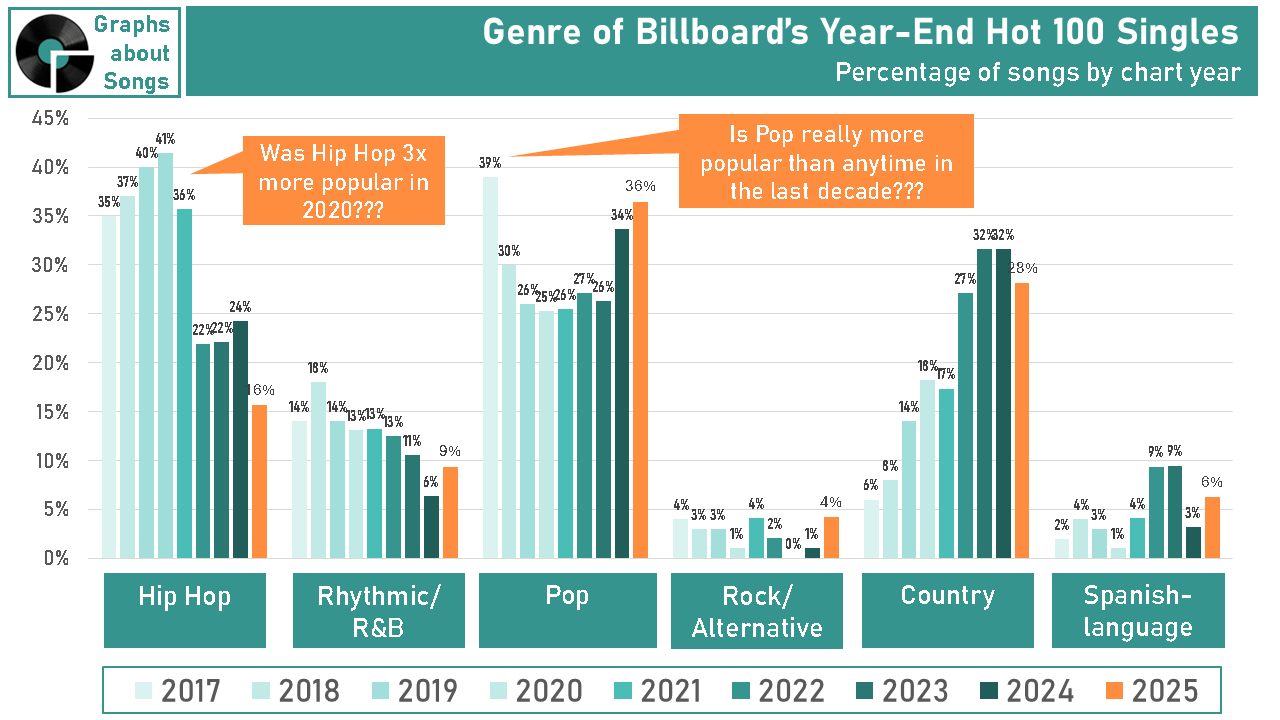
Only the second trend is actually reflective of Hip Hop’s overall appeal.
Hip Hop did a lackluster year in 2025 compared to 2024. However, the genre is not actually experiencing a decline that comparisons with Billboard Year End Charts from the late 2010s through early 2020s suggest.
Why We Can’t Compare Genre Popularity Before 2022
Why am I writing about 2022 in a series supposedly about the Billboard year-end charts of 2025?
Simple: You need multiple, consistent data points to conclusively identify a trend. Without the benefit of knowing what came next, you can’t spot a lasting change from a momentary blip.
With three years of data to confirm it, we can officially declare 2022 as the year streaming music became a mainstream medium.
“But wait, Matt, you’ve often cited 2018 as the beginning of the Streaming Era.”
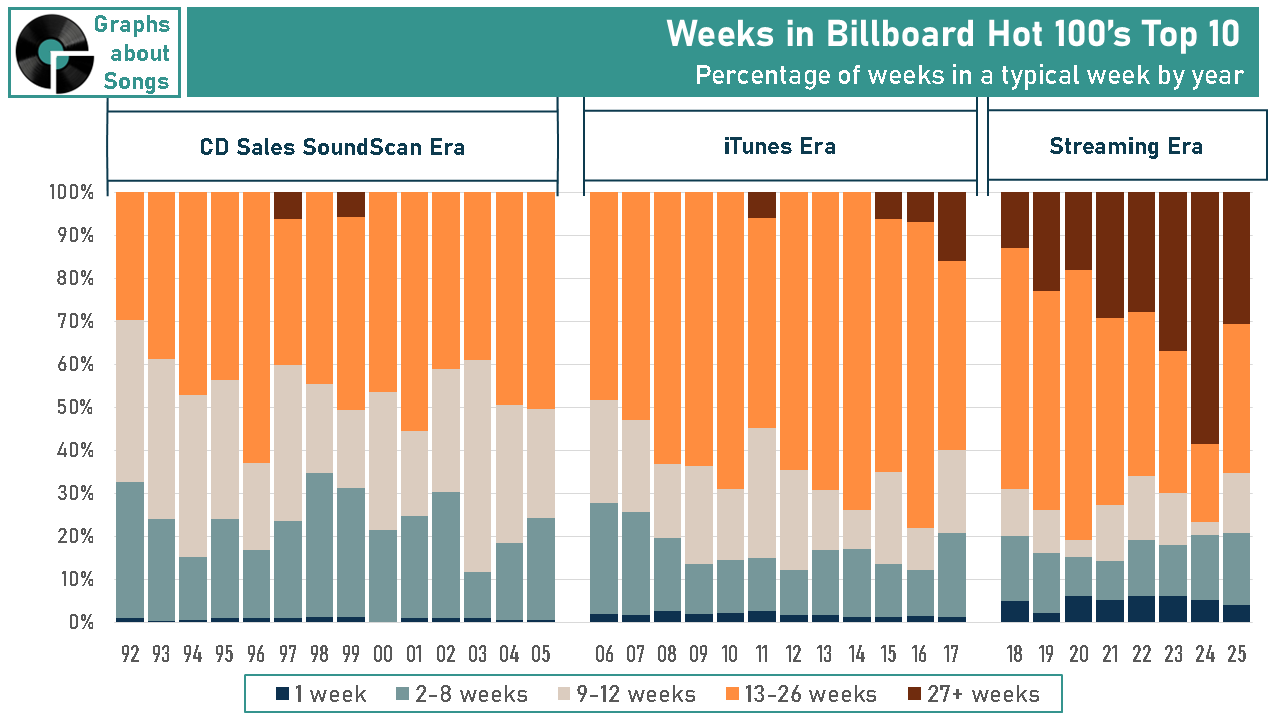
Yes, specifically the Streaming Era ended the iTunes era on Billboard’s Hot 100 chart in 2018. Three music consumption patterns unique to how we measure music streaming emerge on the Hot 100 that year:
1) In 2018, there was a jump in songs suddenly debuting in the Hot 100’s Top 10—even as high as #1—but then vanishing after that one single week. That’s a phenomenon only possible because streaming measures each time someone plays a song, not how many different people played it. (I detailed the emergence of these “one and done” hits caused by fans repeatedly binging new releases in “Does The #1 Song Even Matter Anymore?”)
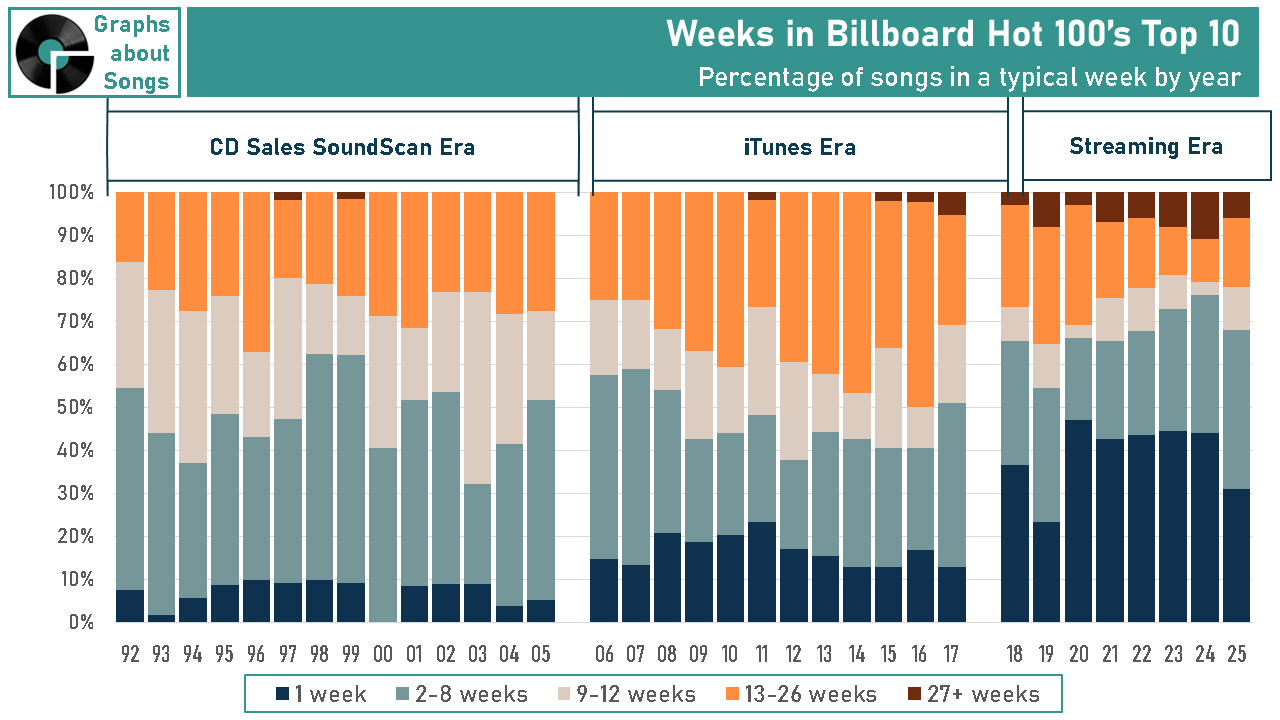
2) Starting around 2018, a new crop of megahits emerged that stay in the Top 10 for well over 26 weeks. That’s another phenomenon only possible because streaming shows us how long fans keep playing a song, not just the moment they buy it. (I showcased this issue in “Do You Have to Let it linger?”)
3)) Around 2018, artists begin debuting multiple songs simultaneously in the Hot 100’s Top 10.
On January 28th, 2017, for the first time in the history of the Billboard Hot 100, two new songs from the same artist debuted in the Top 10 the same week, specifically Ed Sheeran’s “Shape of You” and “Castle on the Hill.” The twin top 10 debuts stemmed from how we measure streaming: Instead of Ed Sheeran’s fans buying a CD that counted as one album sale on the Billboard 200, each play of each individual track counted on the Hot 100.
Drake became the next artist with a double debut in April 2017 and again in February 2018. But he was just getting started:
May 2018: J Cole launched three (3) tracks into the Top 10 the same day.
July 2018: Drake debuts (5) five tracks in the Top 10.
September 2021: Drake lands nine (9) out of the Top 10 slots on the Hot 100 simultaneously.
From 2018 through 2021, Travis Scott, Lil Uzi Vert, Lil Wayne , Juice Wrld, and 21 Savage would also all land multiple tracks from new albums in the Hot 100’s Top 10 simultaneously.
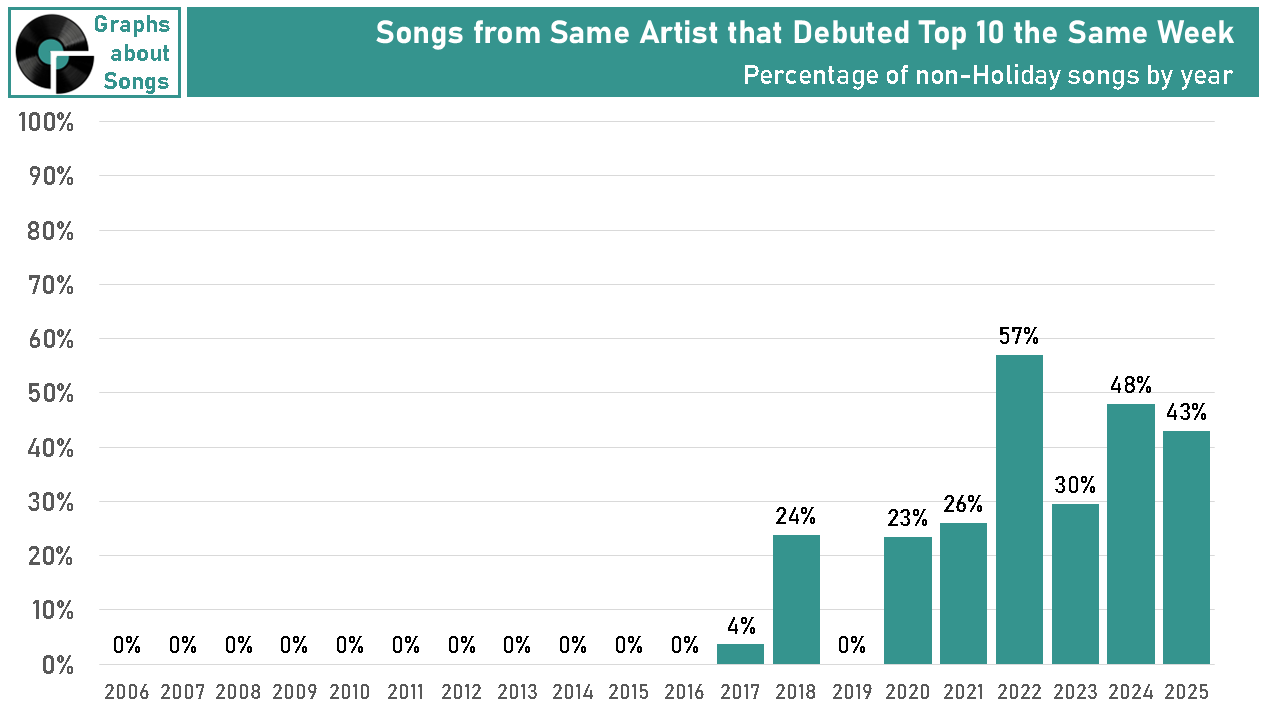
You’ll notice all of these artists are Hip Hop.
That’s because the first genre fans to make streaming their primary music consumption medium were Hip Hop fans. From 2018 through 2021, over half (55%) of the most streamed songs of the year were Hip Hop titles—over three times as many Hip Hop songs compared to the most played songs on the radio each year.
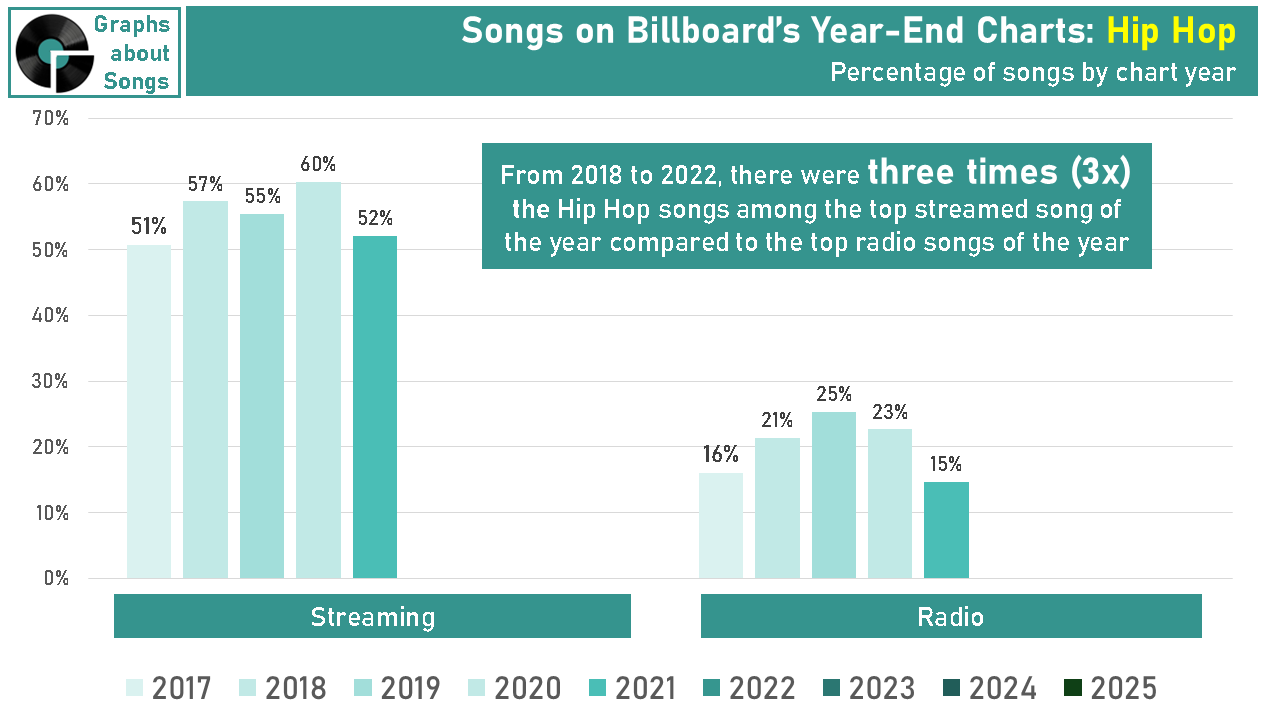
Then the next year, the percentage of Hip Hop songs topping Billboard’s year-end streaming songs chart plummeted from 53% in 2021 to only 23% in 2022.
Was Hip Hop suddenly passe?
Not according to radio programmers: The percentage of Hip Hop among radio’s most played songs of 2022 actually increased slightly. Since 2022, radio and streaming have fairly comparable percentages of Hip Hop titles among the year’s biggest.
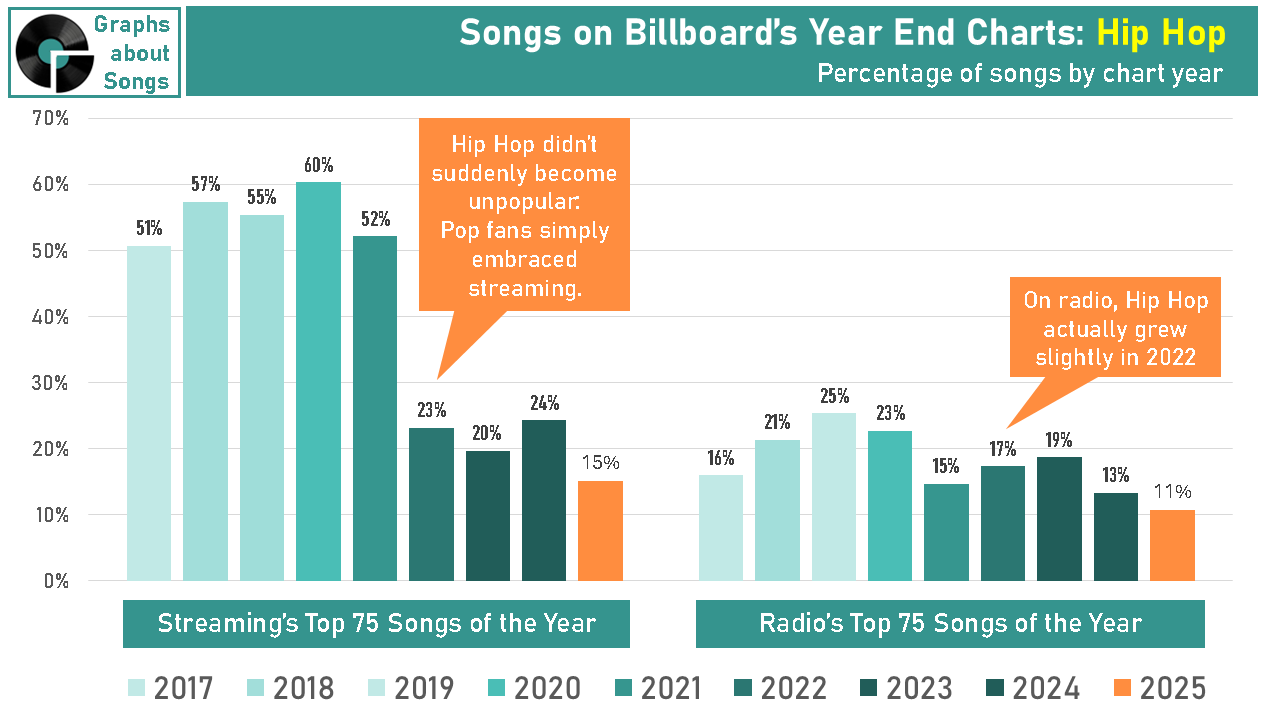
So, if Hip Hop didn’t suddenly become unpopular in 2022, what happened?
Simple. Pop fans fully embraced streaming.
2022: The Year Pop Fans Fully Embraced Streaming
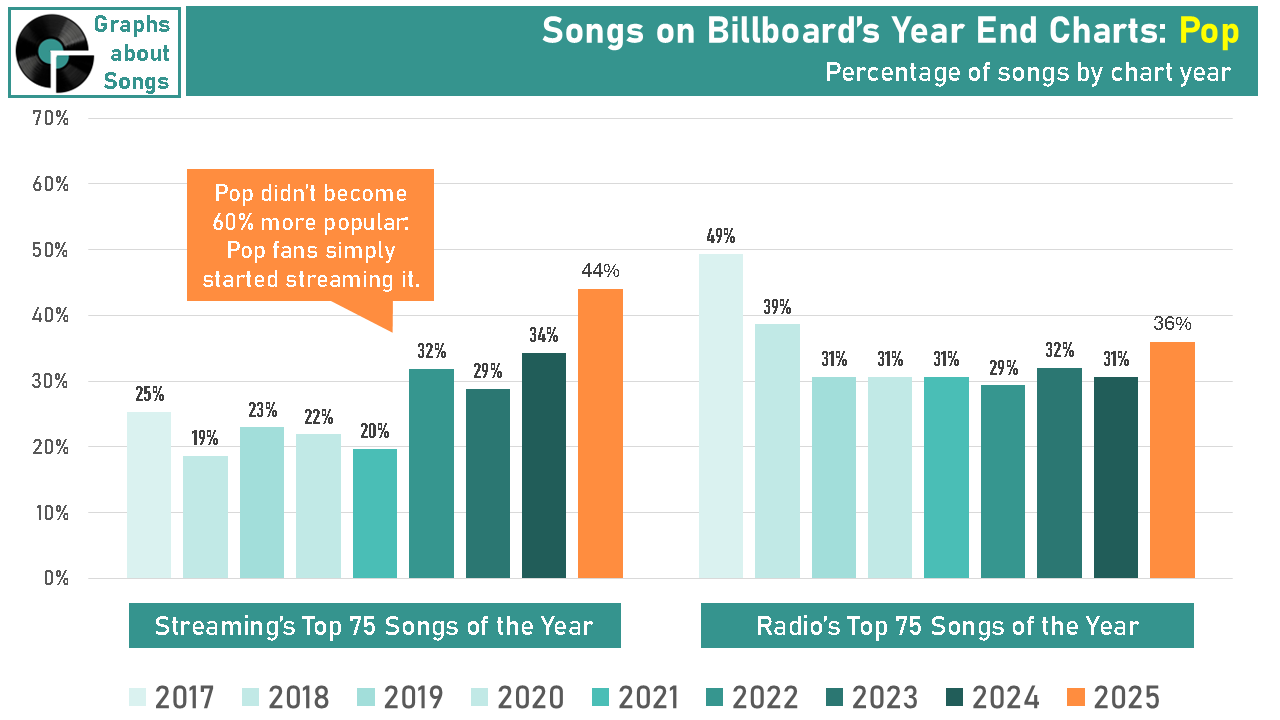
From 2018 through 2021, only one in five of the most-streamed songs each year were pure Pop titles. Then in 2022, that number jumped to an average of 35% each year from 2022 through 2025. As with Hip Hop, Pop didn’t suddenly become more popular: On Billboard’s charts of the most played songs on the radio each year, Pop barely budged from about a third of all songs.
Remember all those Hip-Hop artists whose fans binged their entire new albums, pushing multiple songs simultaneously into the Hot 100’s Top 10?
In 2022, Harry Styles became the first Pop artist to simultaneously debut three songs in the Billboard Hot 100’s Top 10. Then in November 2022, Taylor Swift overtook all 10 of the Top 10 slots on the Billboard Hot 100, the first artist in chart history to do so. Swift would repeat that feat in May 2024 and October of 2025.
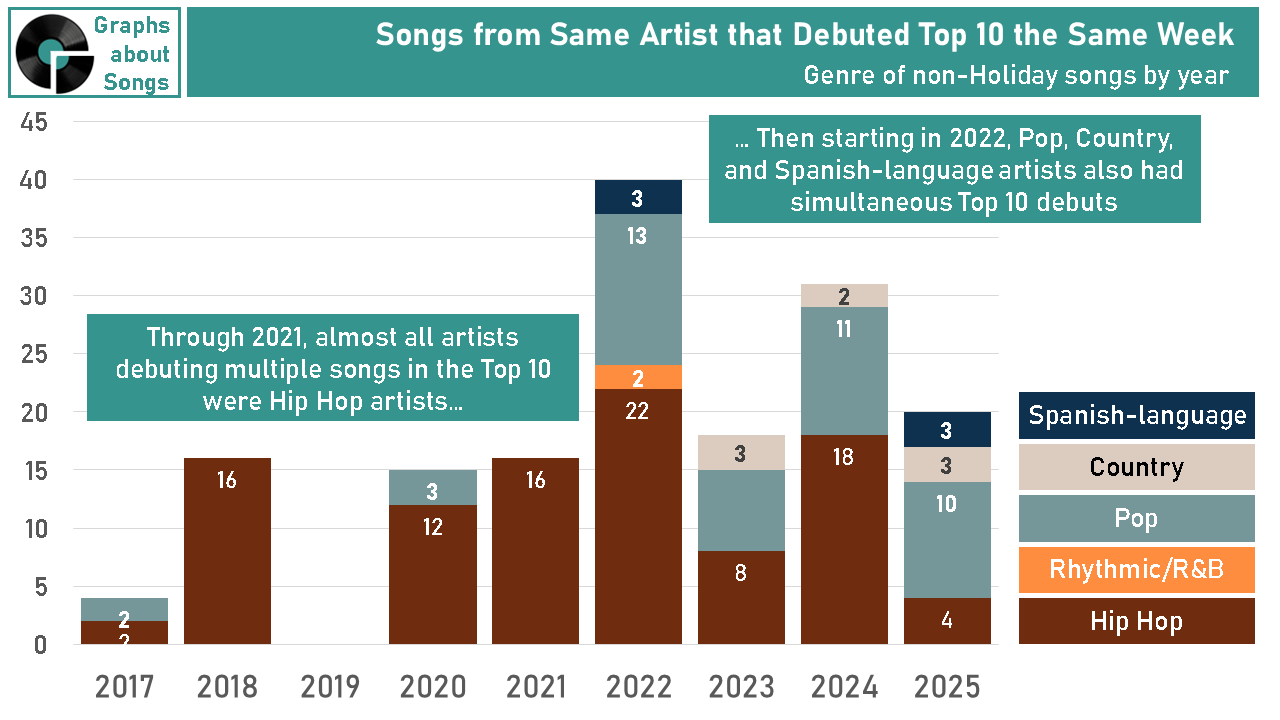
Why am I spotlighting these Top 10 simultaneous debuts? They show that it’s not just the Causal Fan getting to know a Pop song on the radio and eventually adding it to a “doing the laundry” playlist who is using Spotify: It’s also Pop artists’ most Active Stans fully embracing streaming to binge their favorite artists’ new material.
Country Fans Get on Board in 2024
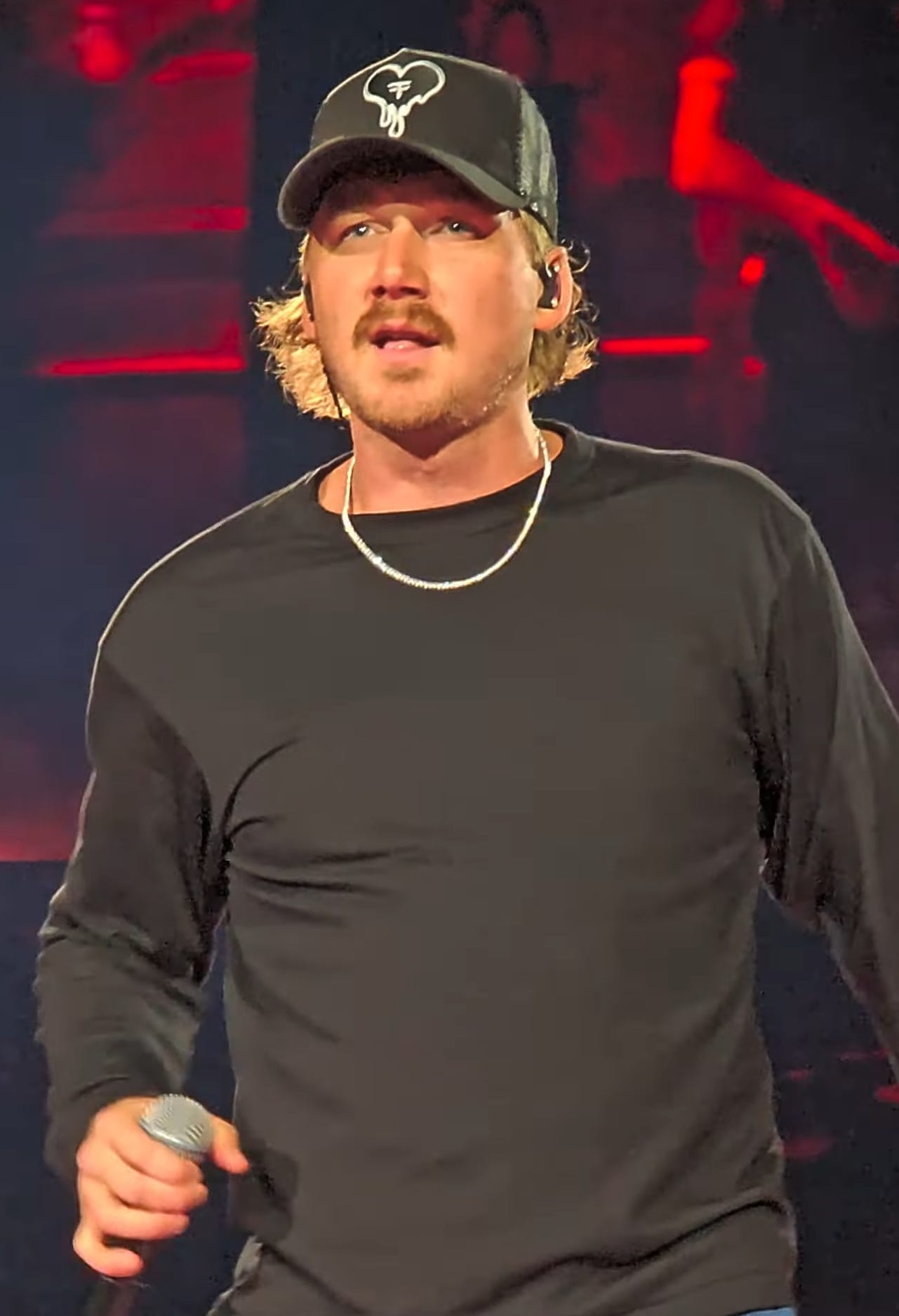
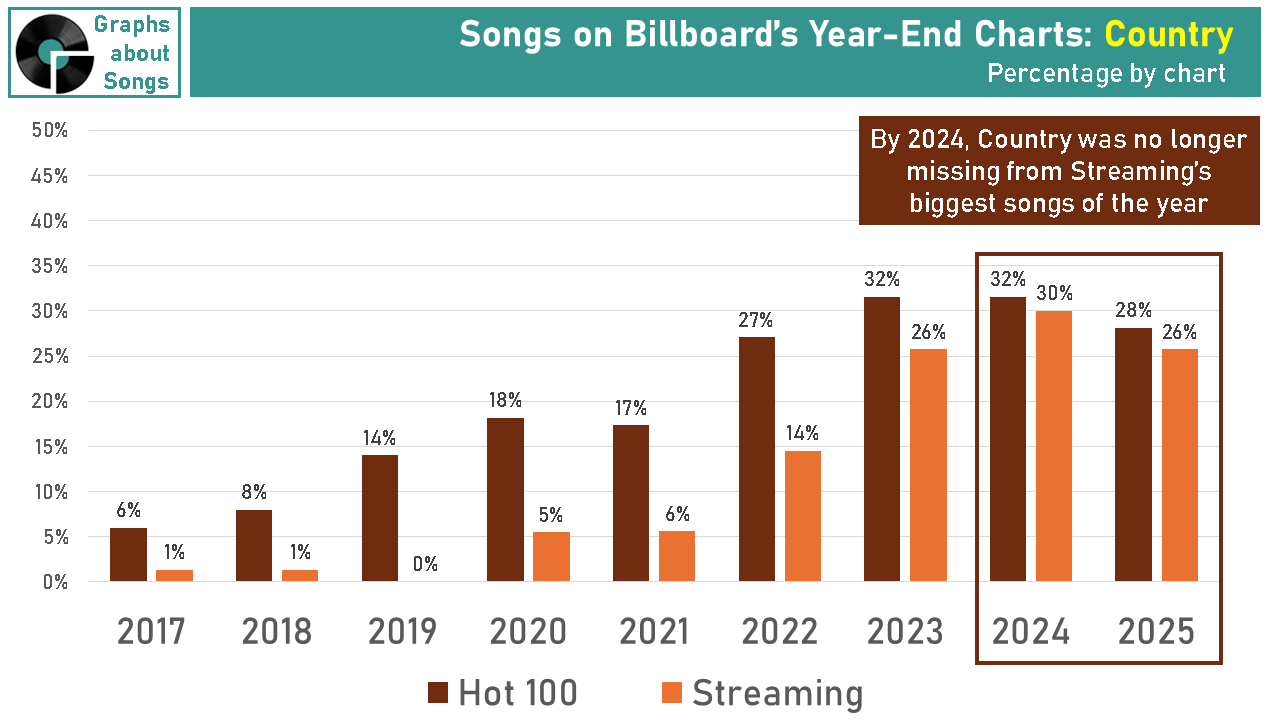
In 2023, Morgan Wallen became the first Country artist to debut multiple songs in the Hot 100’s Top 10. Wallen is the first Country superstar to tailor his album release tactics to streaming, such as launching his 2021 album “Dangerous” with 30 songs. By 2024, Country was no longer significantly underrepresented among the most-streamed songs of the year, with Zach Bryan, Luke Combs, and Bryson Tiller joining Morgan Wallen among the artists with the year’s biggest songs on streaming.
To sum it up:
When streaming songs on Spotify first surpassed buying digital downloads on iTunes in 2018, Hip Hop fans still dominated streaming’s userbase. Pop fans lagged. Country fans were non-existent.
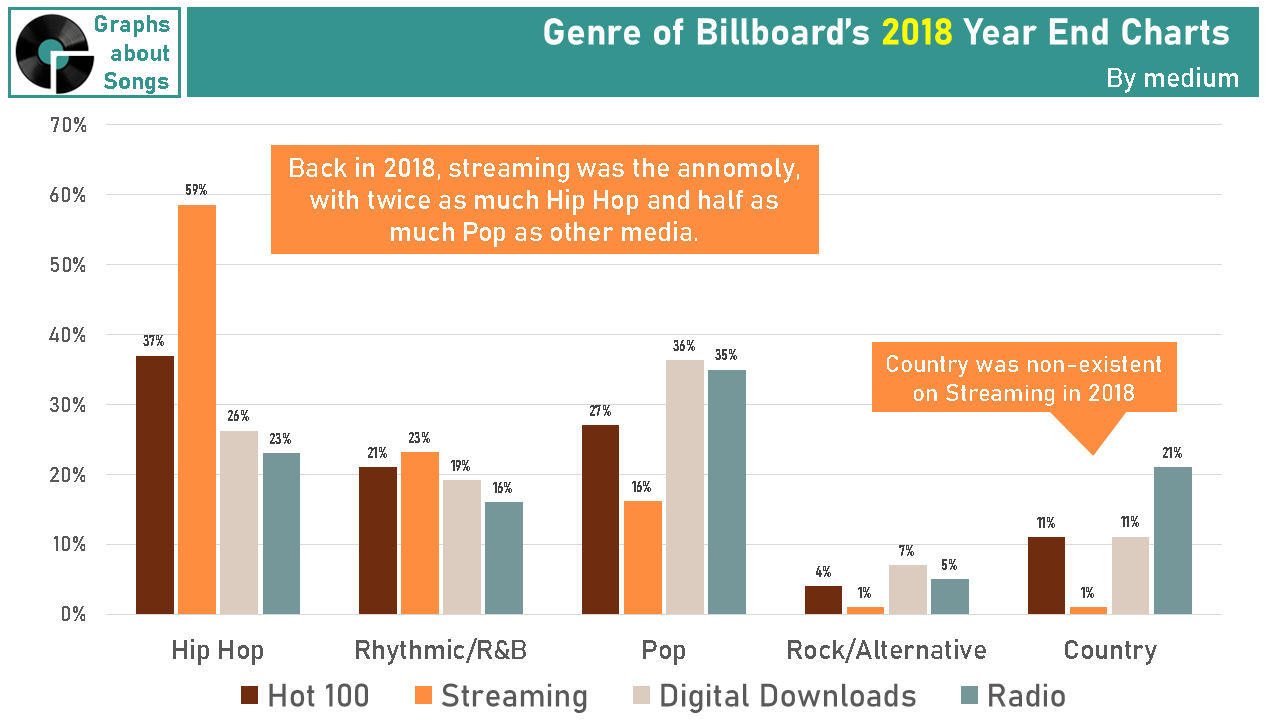
Seven year later in 2025, fans of all genres of contemporary music have embraced streaming.
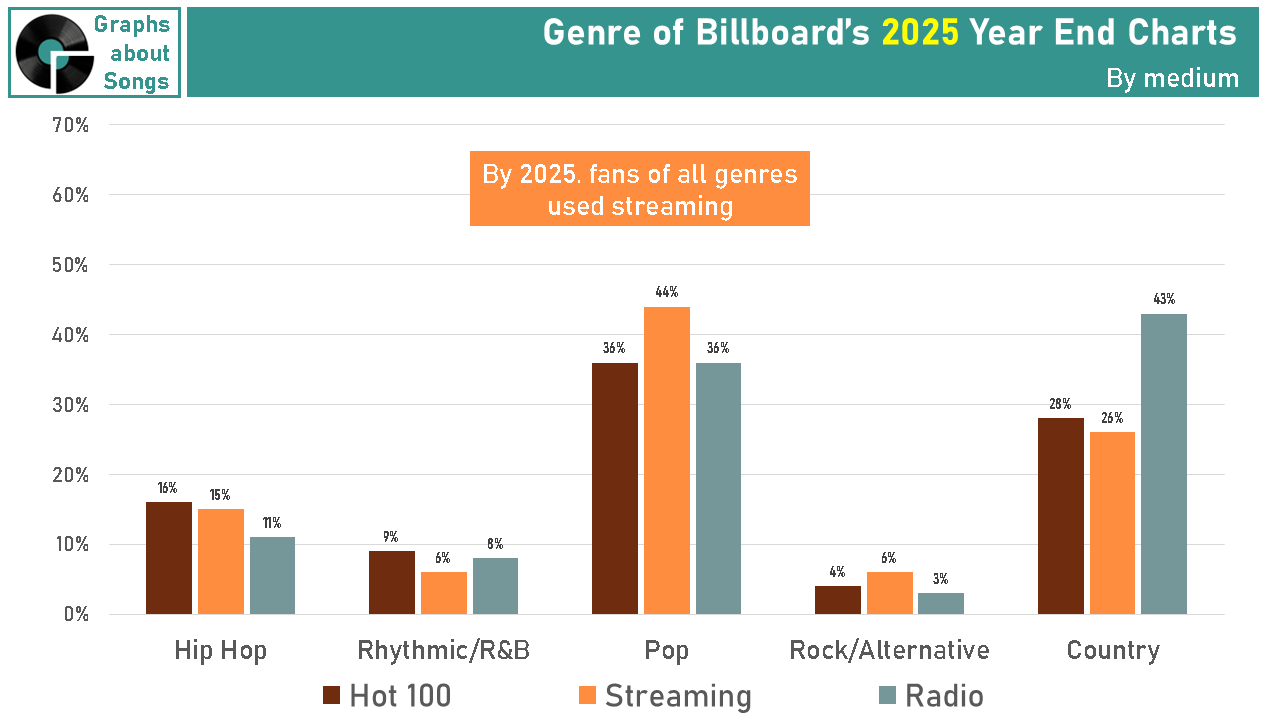
That means when we compare Hip Hop, Pop, and Country today, we’re no longer making comparisons between Hip hop fans’ Spotify plays, Pop fans’ iTunes downloads, and Country fans listening to US*99, as we were in the late 2010s and early 2020s. Now that streaming is truly mainstream, we can once again make fair comparisons.
To be clear, Hip Hop did enjoy stronger appeal from 2018-2020 than it does today. Examining radio’s most played songs of the year—a medium whose survey-based research tools haven’t changed in the past decade—Hip Hop’s biggest year was 2019. That’s when Lil Nas X’s “Old Town Road” owned the year, while Post Malone, Drake, DaBaby, and Lil Baby had big hits.
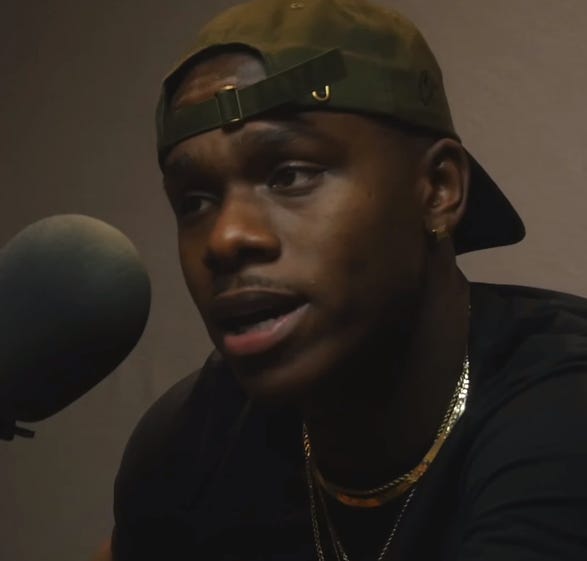
However, the dip seen in 2022 has nothing to do with Hip Hop’s fan base and everything to do with Pop fans finally fully embracing music streaming. (On the radio, Hip Hop actually grew slightly that year.) With Pop now on par, there’s simply less room for Hip Hop titles to dominate the year’s most-streamed songs chart.
Toi truly judge Hip Hop’s appeal in 2025, we need to compare it only to those years when streaming’s audience included all genre fans—and therefore—Billboard’s Hot 100 isn’t reflecting Hip Hop’s fans with streaming metrics and everybody else’s consumption based on sales and radio airplay.
Here’s that fair comparison:
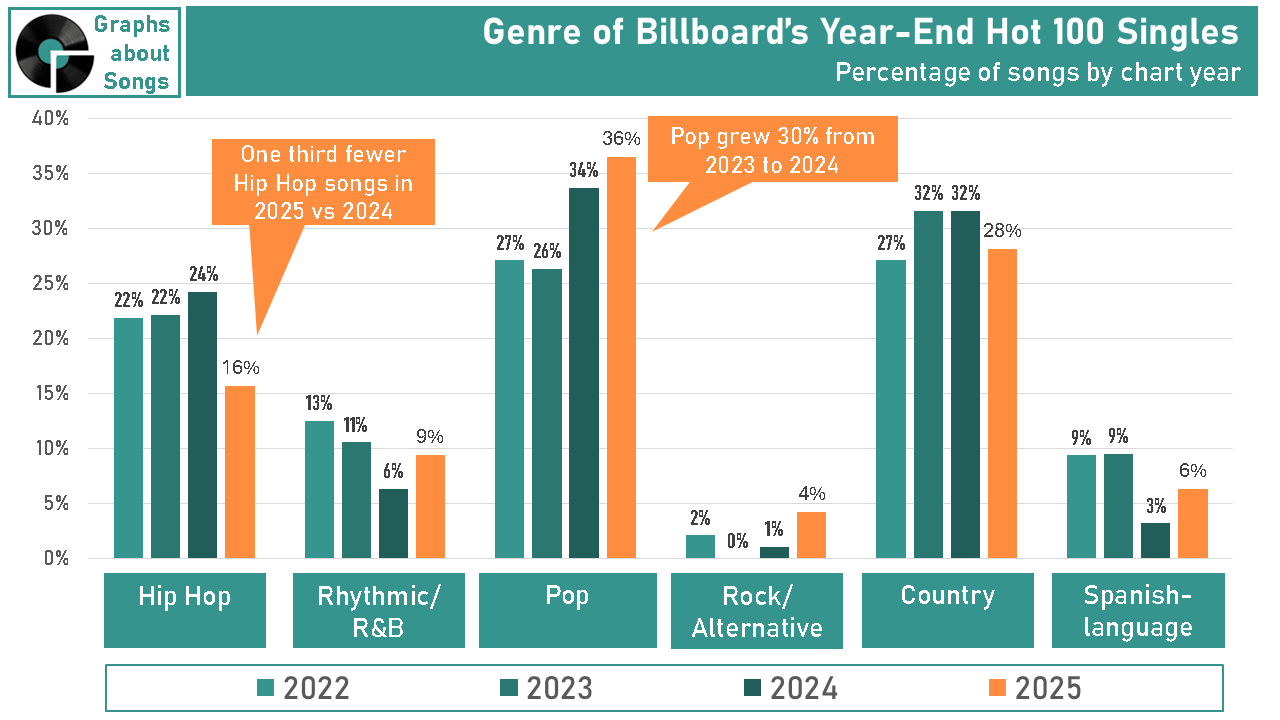
2025: More K-Pop, Adult Pop Ballads, R&B, and Alt Rock hits = fewer Hip Hop chart toppers
Last year was a pretty bad year for contemporary hit music, both critics and consumer data agree. What bright spots did emerge in 2025 were in other genres:
Pop songs were indeed popular. That includes pure Pop songs from Sabrina Carpenter, Gracie Abrams, and Chappel Roan, adult-oriented ballads like Alex Warren’s “Ordinary”, and the cultural phenomenon of K-Pop Demon Hunters, including Huntr/X’s “Golden.”
2025 also saw a rebound for R&B titles such as Leon Thomas’ “Mutt” and Ravyn Lenae’s “Love Me Not”
Several big songs for sombr, plus the streaming indie hit “Sailor Song” from Gigi Perez, bolstered Rock/Alternative songs on 2025’s year end list.
Coupled with no Hip Hop releases in 2025 that could match Kendrick Lamar’s GNX last year, Hip Hop simply had fewer songs among the year’s biggest hits than the genre scored last year.
Hip hop remains the dominant genre of youth culture today, a role it usurped from Rock around 2003. We’ll see it return in coming years, likely from emerging artists who connect with Generation Z.
Streaming is now mainstream—and the most streamed songs are mainstream hits
The other big takeaway here is that the songs Americans stream is now a complete, accurate, and balanced metric of the contemporary songs Americans love most.
Back in 2019, you could legitimately claim DaBaby’s “Suge,” which was on the Spotify 200 chart for well over a year, wasn’t a real hit because far fewer Pop and Country fans used Spotify than did Hip Hop fans.
In 2026, when Olivia Dean’s “Man I Need” is consistently a top song on Spotify, you can no longer argue Spotify users aren’t like the rest of America. It is a mass appeal hit.
Granted, my day job is analyzing streaming consumption to help radio programmers identify the real hits (and separate them from the songs only an artist’s biggest Stans are binge streaming). Some of radio’s brightest young professionals are expressing concern that ignoring massive streaming hits is hurting radio.

Consider Mason Kelter, host of the nationwide evening request show “LIVELINE!” He noted that radio quickly abandoned Stranger Things star Djo’s “End of Beginning,” while it remained a hit on Spotify for months and remains a frequent request on his show. Kelter also argues that Ella Langley’s “Choosin’ Texas” should be on Pop radio:
When you look at all the songs surrounding Choosin’ Texas, it becomes clear that this is not just built on passionate country music fans. It’s a solid hit, with the same numbers and appeal that Olivia Dean’s “Man I Need” had before radio picked up on it (a month too late). […] For those who think the song is too “yee-haw” for pop radio, I think about all of the Shania Twain Country classics which were top ten Pop Radio hits and are still mad popular at every wedding and club (yes, to this day),
Kelter then drops a timeless truth that Contemporary Hit Radio forgets in its weakest eras:
Pop Radio is strongest when it feature[s] the best hits from all genres and is not just “the Sabrina Carpenter format.”
In a future Graphs About Songs post, I’ll spotlight some of those streaming hits of 2025 that radio ignored, and the songs radio played instead—even though nobody was streaming them.
Hit “Subscribe” below and choose the “FREE” option to get Graphs About Songs in your inbox.
A paid subscription also gets you “The Hit Momentum Newsletter,” my weekly analysis of the Spotify 200 that spotlights the mass-appeal radio hits of today and tomorrow.
If you program a contemporary radio station and want a custom streaming report for a fraction of what old-school Callout costs, check out my day job at
Data sources for this post:
Billboard’s 2025 year-end charts: Hot 100 Songs: https://www.billboard.com/charts/year-end/2025/hot-100-songs/
Billboard’s 2025 year-end charts: Streaming Songs (Top 75): https://www.billboard.com/charts/year-end/2025/streaming-songs/
Billboard’s 2025 year-end charts: Radio Songs (Top 75): https://www.billboard.com/charts/year-end/2025/radio-songs/
(Data from previous years’ Billboard Year End charts archived)
The Billboard Hot 100: https://www.billboard.com/charts/hot-100
Wikipedia’s Billboard Hot 100 Top 10 singles: https://en.wikipedia.org/wiki/List_of_Billboard_Hot_100_top-ten_singles
Spotify 200 Weekly Charts for the USA - Weeks ending 1/3/2019-1-8/2026: https://charts.spotify.com/charts/overview/us
Fantastic anaylsis of this blind spot in the data. The 2022 inflection point where Pop fans finally migrated to streaming is way more significant than most people realize. I rmember when folks would dismiss streaming numbers as just 'what the kids listen to', but now its the most accurate snapshot of actual mainstream appeal. The Drake multiple top 10 debuts compared to Taylor doing the same thing years later basically tells the whole story of this shift.