


As a lifelong radio fanatic, I pick on my beloved medium a lot for sticking with the same old songs too long. (I discussed why poorly implemented research is a big part of that problem in this article.) Songs are staying around so long now that Billboard recently changed their rules to get squatters off the Hot 100.
There’s just one problem with blaming radio for today’s forever lingering tunes.

On streaming services, where fans are in control of their music, those fans are increasingly picking the same old songs over newer releases, too.
Today, we’re analyzing how long songs stay on the Spotify 200 chart in the U.S. and how it’s changed from 2019 through today. The change isn’t subtle.
How Long Do Songs Stay On The Spotify 200
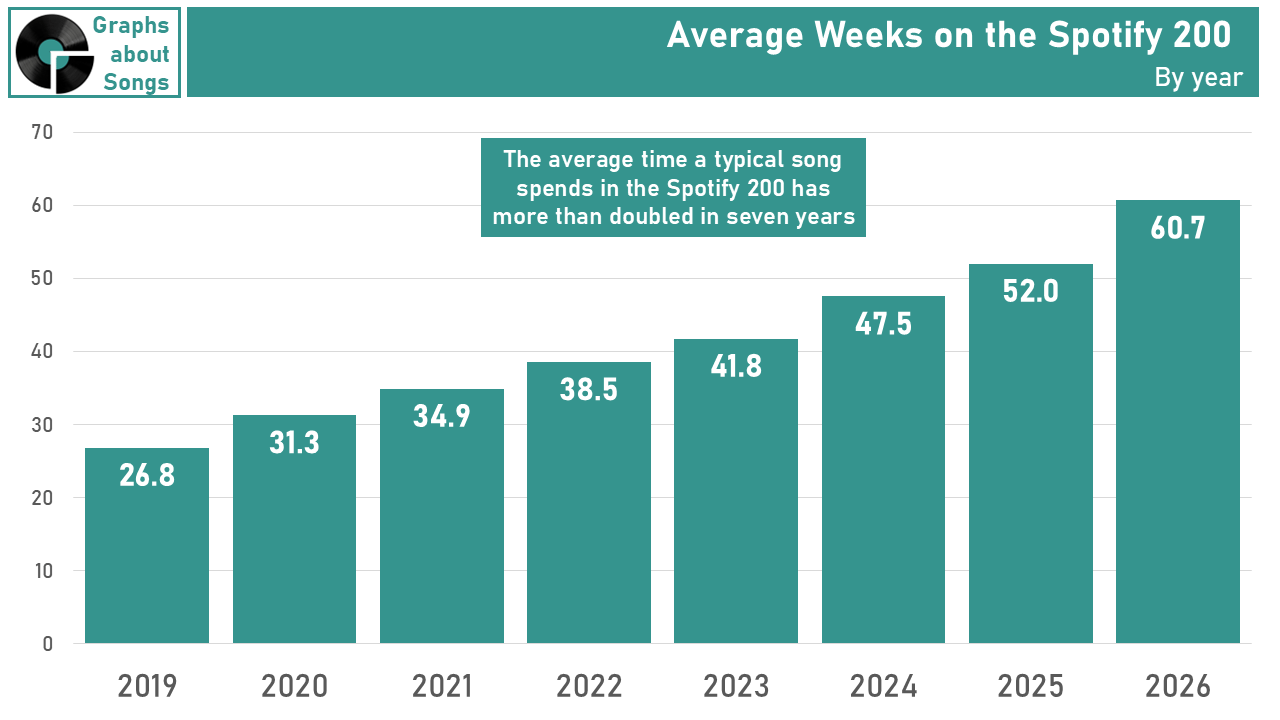
The time the typical song spends among Spotify’s 200 most-played songs has more than doubled since 2019. Back then, the typical song only spent half a year on the Spotify 200 chart. Today, a typical song stays in the Top 200 for well over a year.
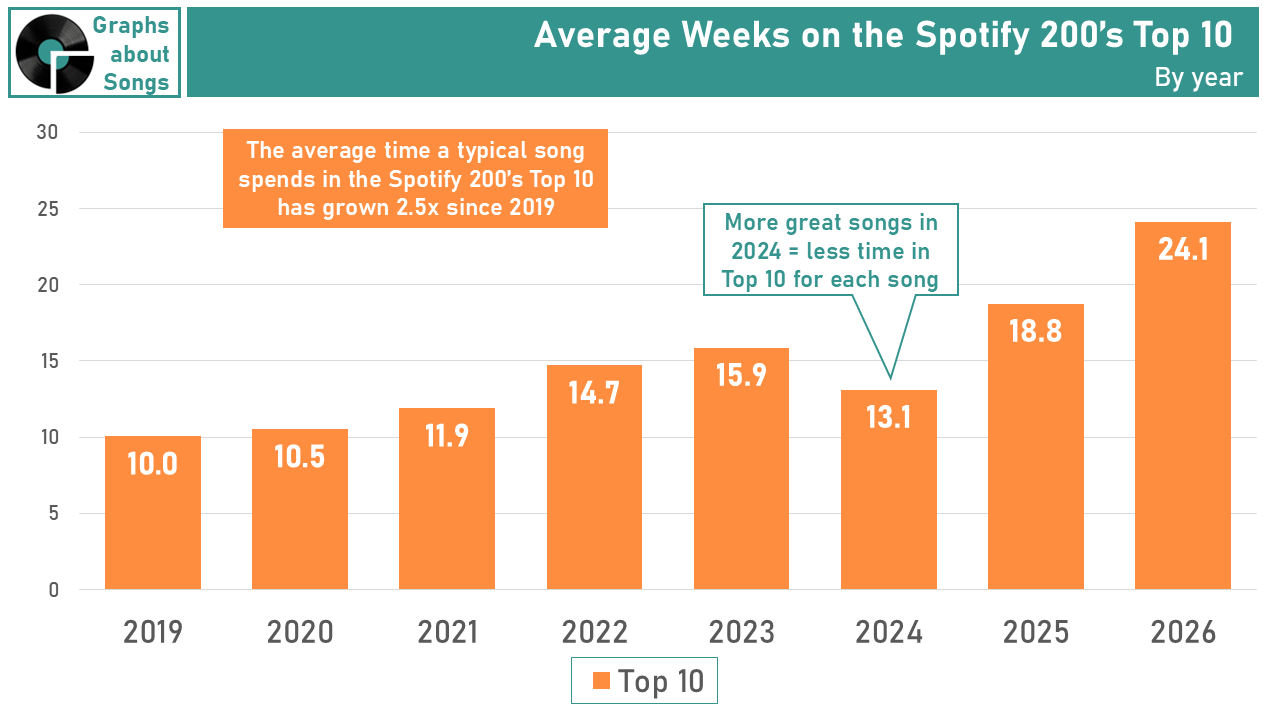
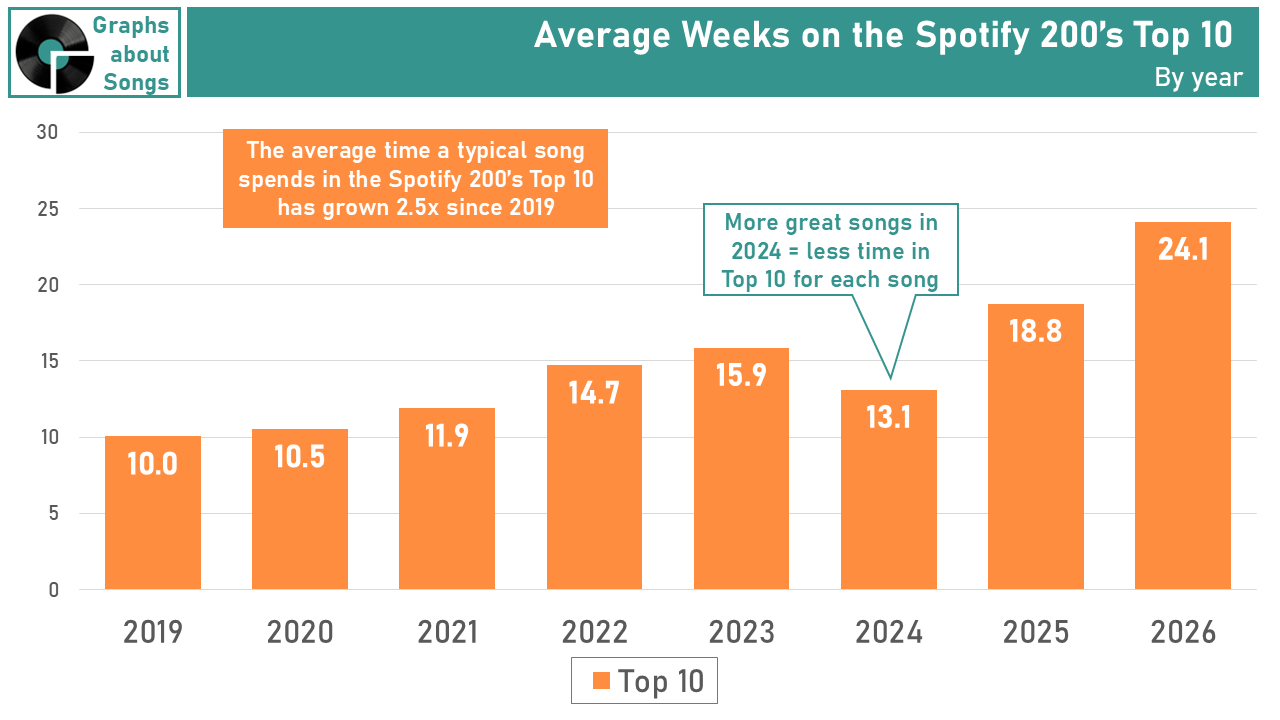
If we zoom in on the biggest hits—those songs that reach the Top 10 most-played songs on Spotify—the increase is even more dramatic. Back in 2019, the typical Spotify 10 stayed in the Top 10 for only 10 weeks. Today, it’s almost half a year.
That timeframe increased steadily every year---except 2024. That’s the year when Post Malone and Morgan Wallen’s “I Had Some Help,”, “Not Like Us” from Kendrick Lamar, Sabrina Carpenter’s “Espresso,” Shaboozey’s A Bar Song (Tipsy), and Chappel Roan’s “Good Luck, Babe” were all massive hits on both radio and Spotify. With so many mass-appeal hits vying for listeners’ play buttons, Spotify’s Top 10 turned over faster than it has ever since.
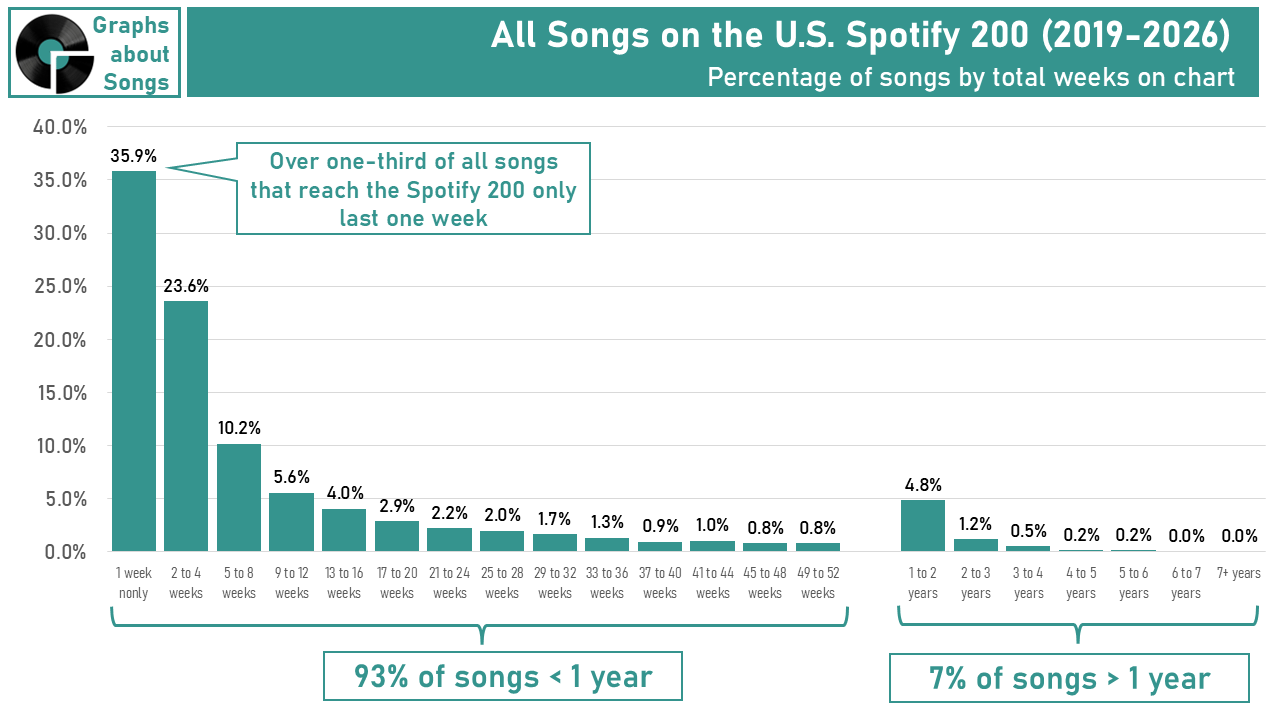
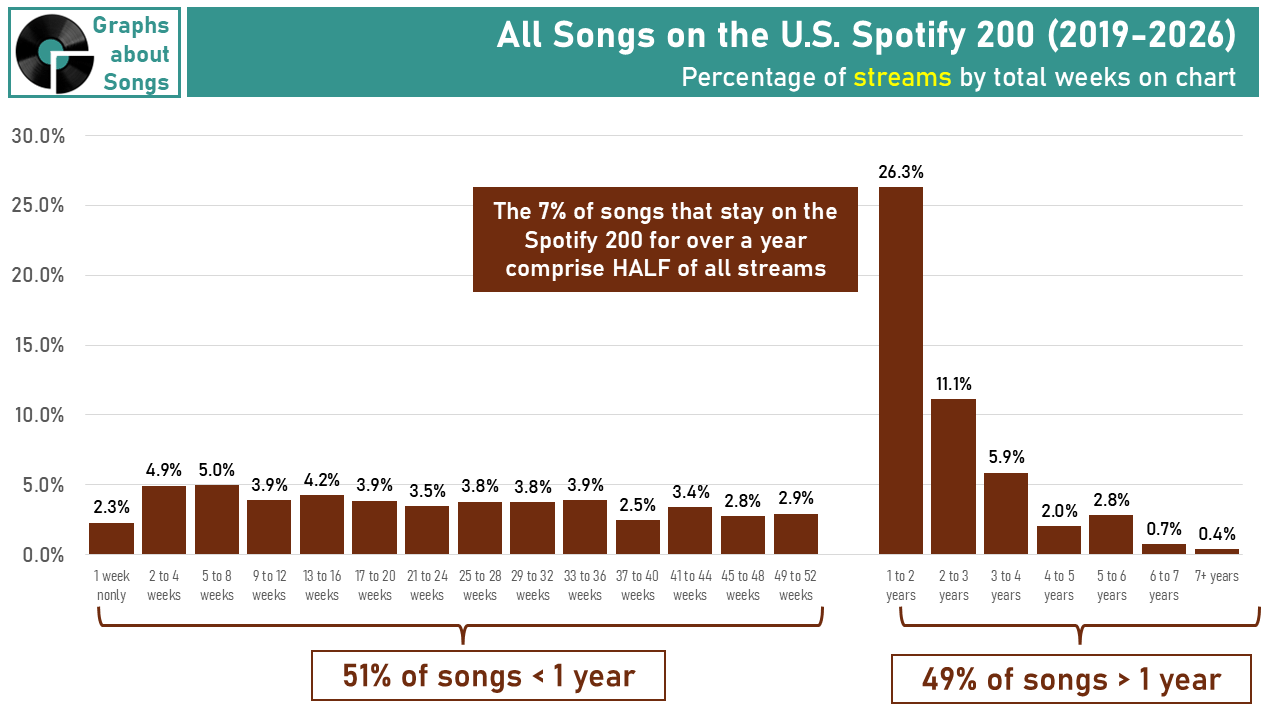
There’s wide variation on just how long an individual song stays a Top 200 hit on Spotify. Overall for 2019 through today, over a third of all songs are only Top 200 for one week. Most of these songs are album tracks from mid-tier artists that fans sample when the album releases, but don’t stream in subsequent weeks. Most spend their lone week in the Spotify 200 far closer to #200 than #1. Overall, only seven percent of all songs that reach the Spotify 200 stay there for over a year.
When we examine the songs that generate the most streams, however, almost half of the streams of songs reaching the Spotify 200 are for songs that stay in the Spotify 200 for a year or longer. That means about half of the Spotify streams for Top 200 songs come from only seven percent of the songs in the Spotify 200. That also means Spotify makes their money from the songs you never stop streaming.
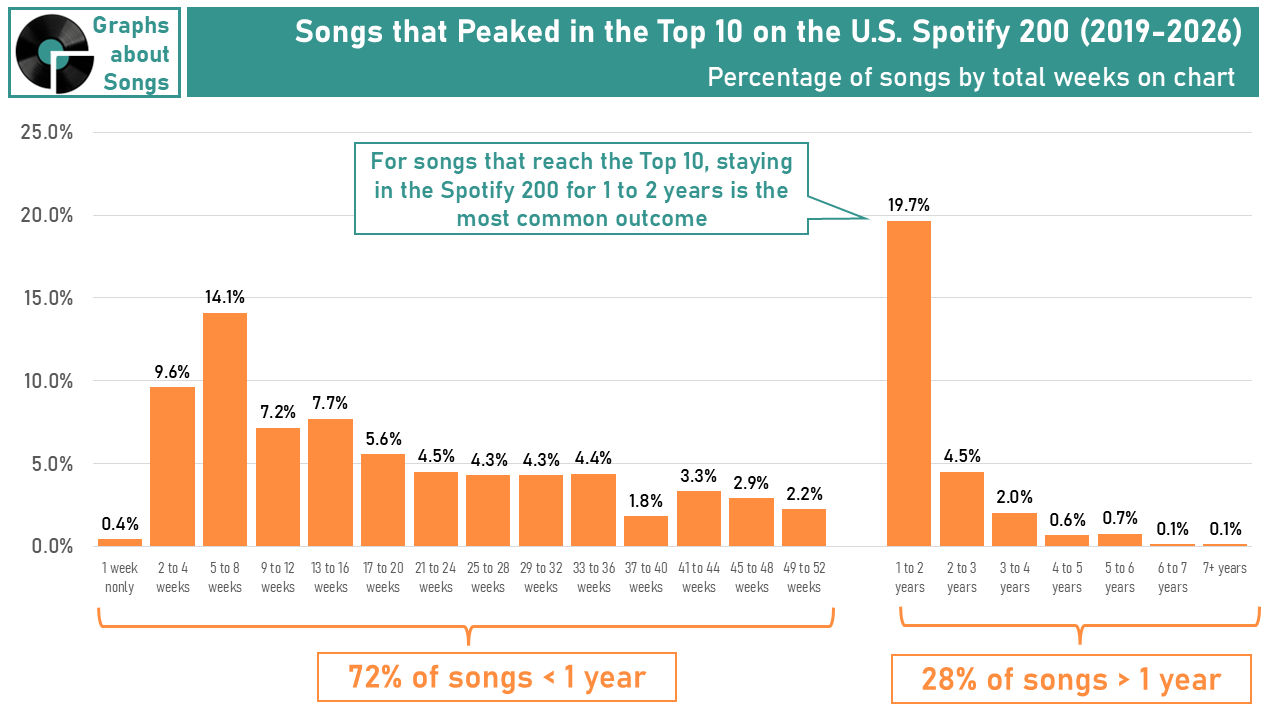
When we focus on those songs that peak in the Spotify 200’s Top 10, the most likely outcome (one-in five) is for that song to stay in the Spotify 200 for one to two years.
Finally, let’s examine the extremes year by year, specifically, the percentage of songs that only spend a week in the Spotify 200 versus how many songs stay in the Spotify 200 for a year or longer. From 2020 through 2025, the percentage of one week only songs fell by 37%, while the percentage of 1+ years songs almost doubled:
Three Reasons Fans are Streaming Songs Longer
Demographics: Back in 2019, primarily teens and younger adults used Spotify. The younger you are, the more time you typically devote to new music. Subsequently, the faster you move through your favorite new songs. During the pandemic, older adults embraced music streaming. Those 30- to 49-year-olds who are now on Spotify take longer to get to know new songs—and longer to get sick of them—than do 12- to 29-year-old listeners.
The Current Music Slump: So far, the 2020’s have not exactly been a golden age for contemporary hit music. When new songs fail to excite, folks keep playing the older songs they know and love. When we do have a bright spot for mass-appeal popular music, as we had in the Spring of 2024, the songs we stream most do indeed rotate faster.
Songs Designed for Streaming: While it’s the smallest and hardest to quantify, another reason songs are staying on the Spotify 200 longer is that music creators now understand how to maximize a song’s streaming performance. From release strategies to how the song itself is crafted, music makers now think first about maximizing streaming, not CD sales or radio exposure.
It’s not the biggest hits that fans keep playing forever.
The biggest hits aren’t always the longest lasting songs
The chart below shows the 25 most-streamed songs on Spotify from 2019 through today (left), compared to the 25 songs that stayed in the Spotify 200 the longest (right). Only nine of the 25 songs are the same.
Among the nine leaders in both total streams and chart longevity are big hits from the past decade, such as Post Malone & Swae Lee’s “Sunflower” and Morgan Wallen’s “Whiskey Glasses,” Gen Z favorites including Tyler, The Creator & Kali Uchis’ “See You Again,” and enduring classics like Fleetwood Mac’s “Dreams” and “Mr. Brightside” from The Killers.
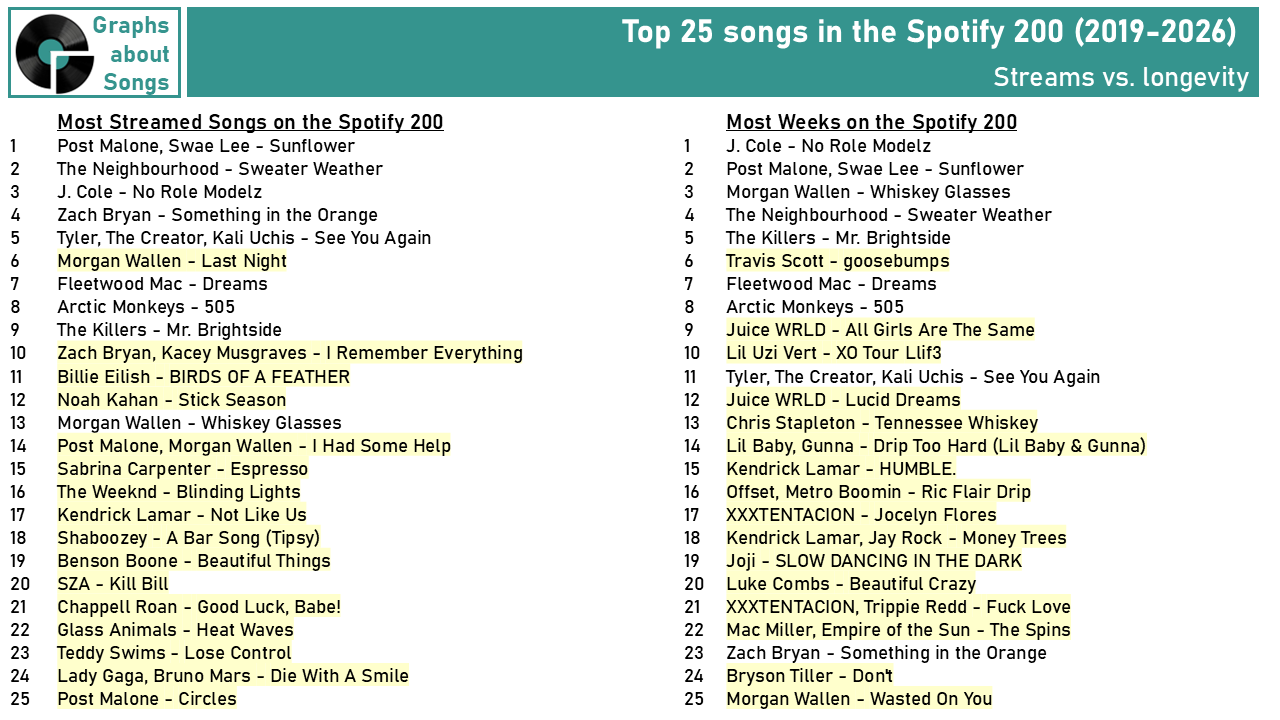
Among the 25 most-played songs are many more of the decade’s biggest hits, including Glass Animals’ “Heat Waves”, The Weeknd’s “Blinding Lights,” and Espresso from Sabrina Carpenter.
Among the longest lasting songs that are not among the most-streamed songs are lots of titles from Hip Hop artists with rapid fan bases, including Juice WRLD, XXXTENTACION, and Kendrick Lamar. There’s also younger Country starts with rabid fans, including Chris Stapleton’s “Tennessee Whiskey” and Luke Combs’ “Beautiful Crazy.”

Why are so many of the biggest hits not among the songs that fans stream forever? Simple: Fans eventually got tired of them and stopped playing them nearly as often as they did when they were big hits.
Familiarity still eventually breeds contempt.
It’s a timeless trait that radio is wise to remember.
Need help knowing when songs are in the sweet spot between familiarity and contempt? My day job can help…

Data Source for this article:
Spotify Charts (weeks of 1/1/2019 through 7/30/2026 for the USA): https://charts.spotify.com/charts/overview/us