


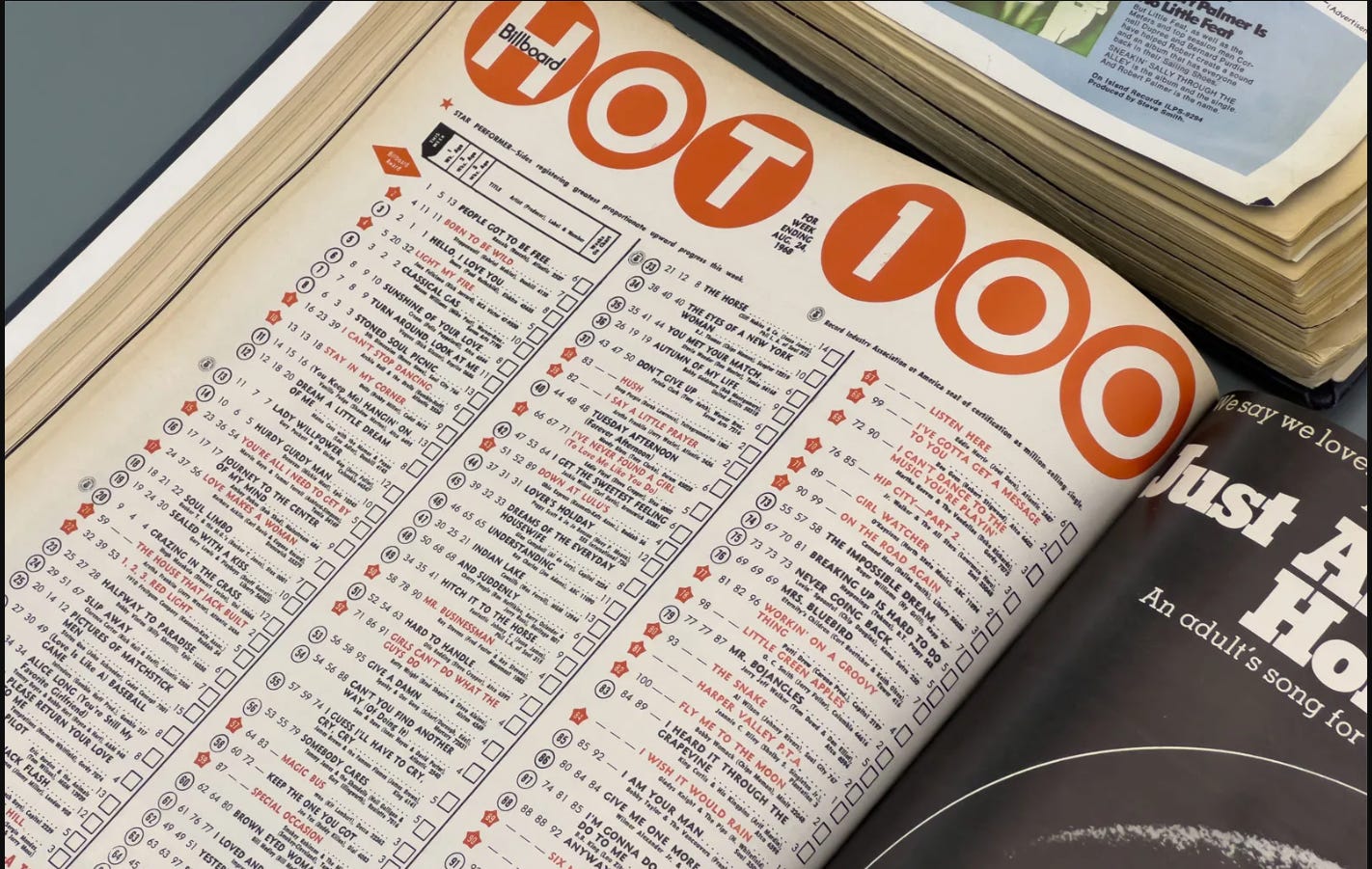
In 2025, something happened on the billboard Hot 100 that has never happened since the chart’s birth in 1958: Every Top 10 song was from an artist from the same generation, namely the Millennial Generation.
In June of 2024, Eminem became the last aging Gen Xer to reach the Top 10 at age 51 with “Houdini,” a song radio swore was a hit, but fans flatly rejected.
As of August 2026, no true Generation Z artist has reached the Hot 100’s Top 10. So far, the youngest artist to reach the Hot 100’s Top 10 is Sombr, born July 25th, 2005.
“But Matt,” I hear you shouting, “Plenty of Generation Z artists born after 1997 have hit the Top 10.”
Ahh, but where did this 1997 dividing line come from? Not from the experts who invented the name “Millennials.”
Straus/Howe Generational Theory

I rely on historians Neil Howe and his late partner William Strauss to define when each generation starts and ends. Their seminal work, Generations: The History of America’s Future, not only invented the term Millennial, it also predicted “The Crisis of 2020” – in a book they wrote in 1991!
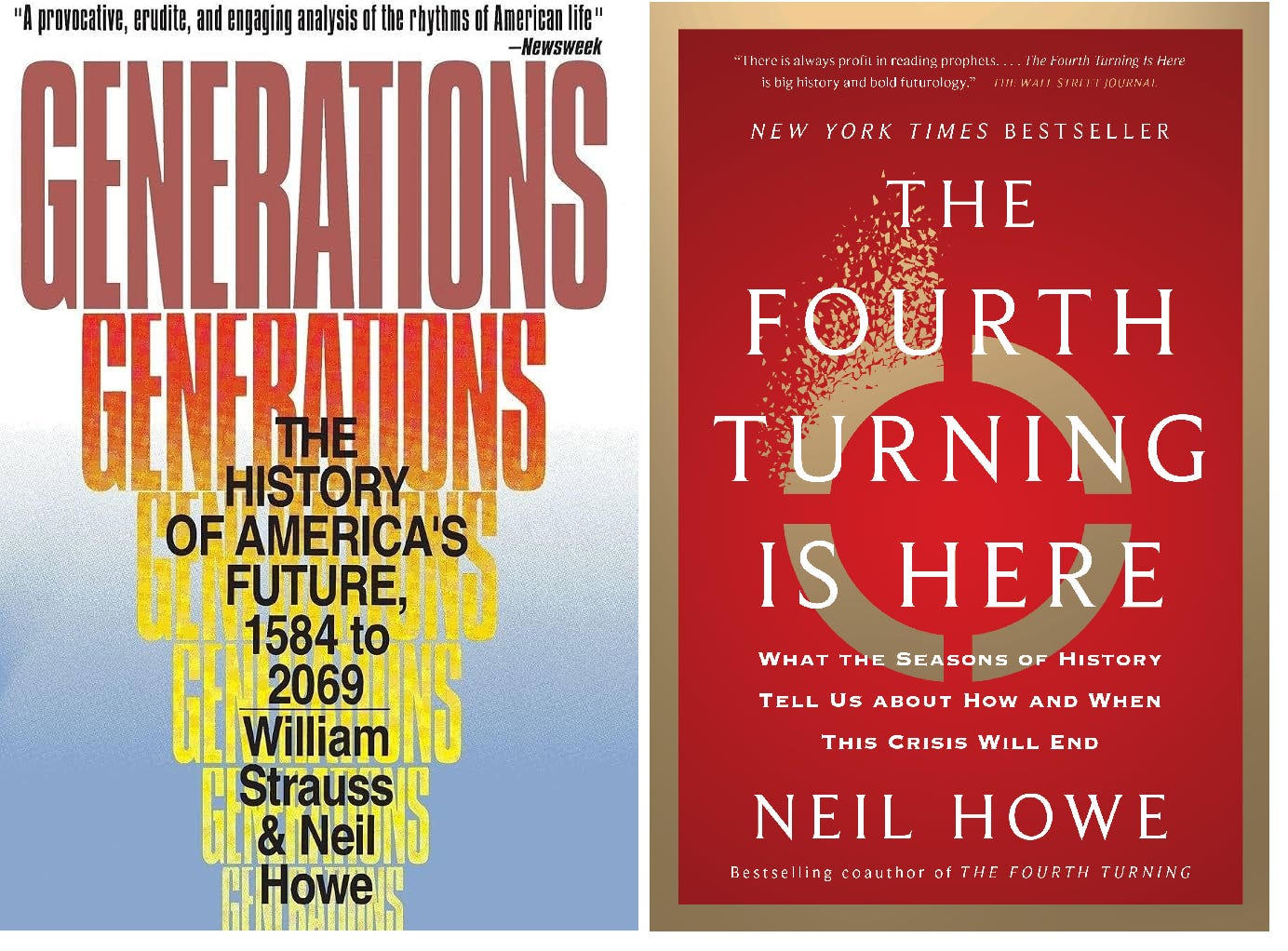
I dive deep into their work in The Generational Music Theorem. For now, just know that they define generational cohorts a bit differently than you might see elsewhere:
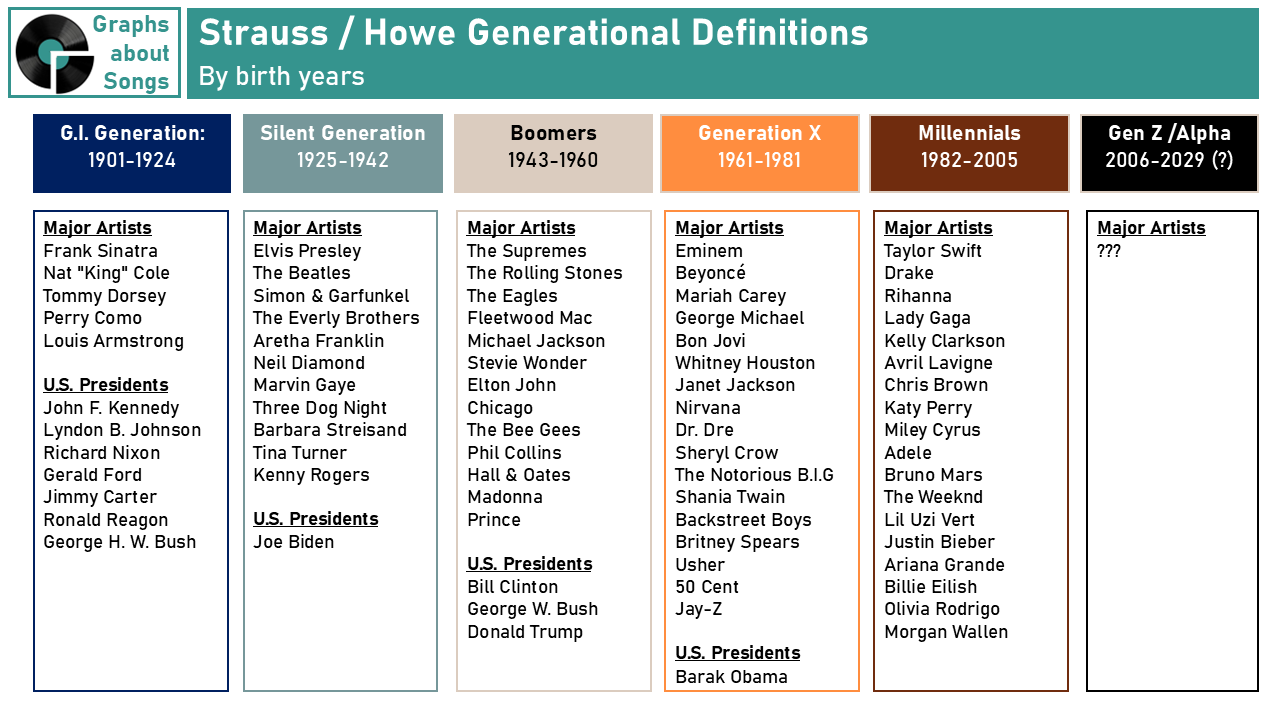
Boomers were born between 1943 and 1960, a few years earlier than the postwar birthrate boom. If you faintly remember World War II, you’re from the previous Silent Generation.
Xers were born from 1961 to 1981, which starts a few years before the baby bust the birth control pill spawned. If you can at least faintly recall the Kennedy Assassination, you’re actually a Boomer. If you’re too young to recall the Challenger explosion, you’re a Millennial.
Millennials stem from 1982 to 2005. That’s later than some cite, but consistent with the typical length of a generation Straus and Howe’s research finds throughout America’s history.
Generation Z emerged in 2006, according to Niel Howe’s latest book “The Fourth Turning.” If you’re old enough to remember a time before the Great Financial Crisis and the Obama administration, you’re a Millennial. If you can’t, you’re Gen Z. (Howe labeled this cohort “The Homeland Generation” before the generation itself embraced Generation Z.) Generation Alpha is simply a term today’s high schoolers invented to separate themselves from embarrassing six-seven-loving middle schoolers.
Here’s a summary of each generation, including their major recording artists and U.S. Presidents.
Generations Mix It Up on the Chart
Throughout chart history, at least two generations are crafting Top 10 hits.
Consider the early 2000s: Generation X artists dominated the chart, including The Backstreet Boys, Eminem, and Matchbox Twenty. Just as aging Boomer artists such as Madonna were finally ceding the Top 10, however, Millennials began scoring Top 10 hits. By 2008, Xers like Flo Rida and Millennials such as Rihanna were equally represented in the Top 10.
Or consider 1981. Boomers such as Rod Stewart, Diana Ross, and Blondie dominated the Top 10. However, Silent generation icons such as John Lennon and Smokey Robinson still scored hits and Tina Turner was about to have a major comeback. Meanwhile, Xer artists Culture Club and Wham! were waiting to replace those Silent icons. By the late 1980s, Xer artists such as Guns N’ Roses and Janet Jackson surpassed Boomer artists in the Top 10, but Silent legend Roy Orbison could still top the charts.
From the Hot 100’s inception in 1958 all the way through 2024, at least two generations are contributing hits to the Top 10. Even when one generation dominates the Top 10, such as Boomers in 1981 or Xers in 2000, a few gaining icons from the previous generation and a few fresh faces from the younger generation reached the Hot 100’s Top 10.
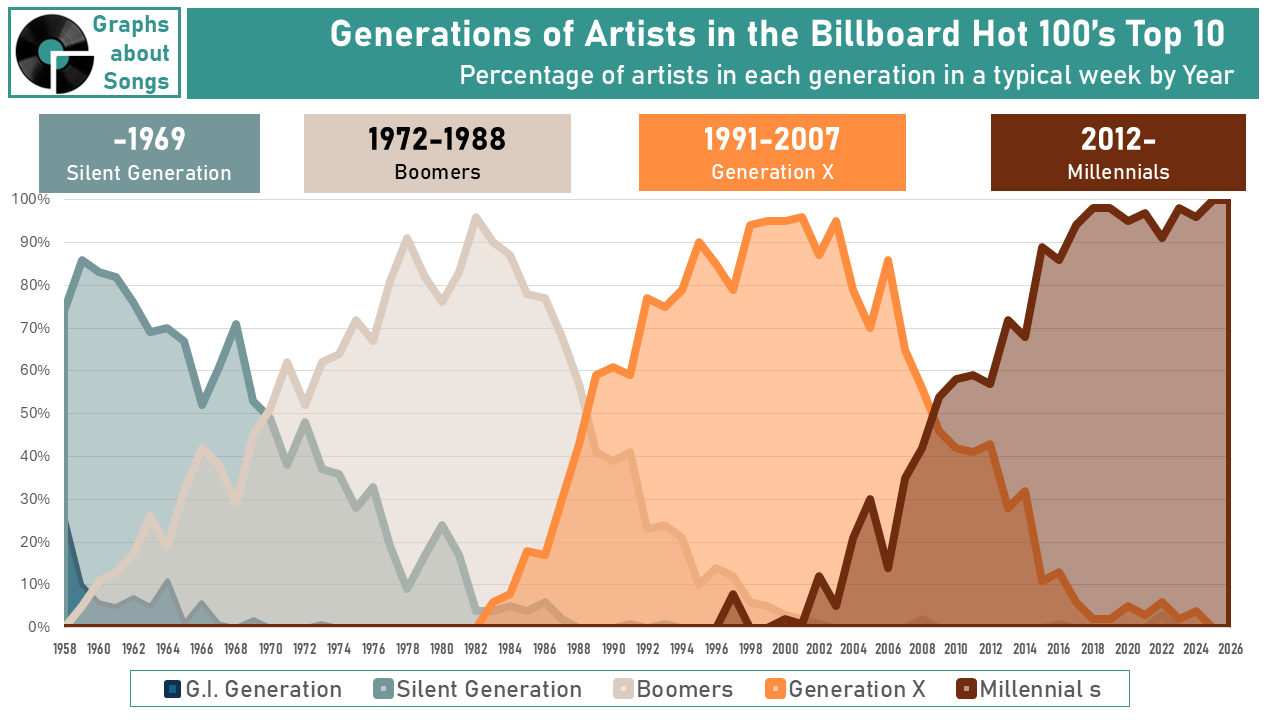
So how is it that Millennials have fully owned the Top 10 for two years now?
It’s a matter of age:
The typical age of a hitmaker
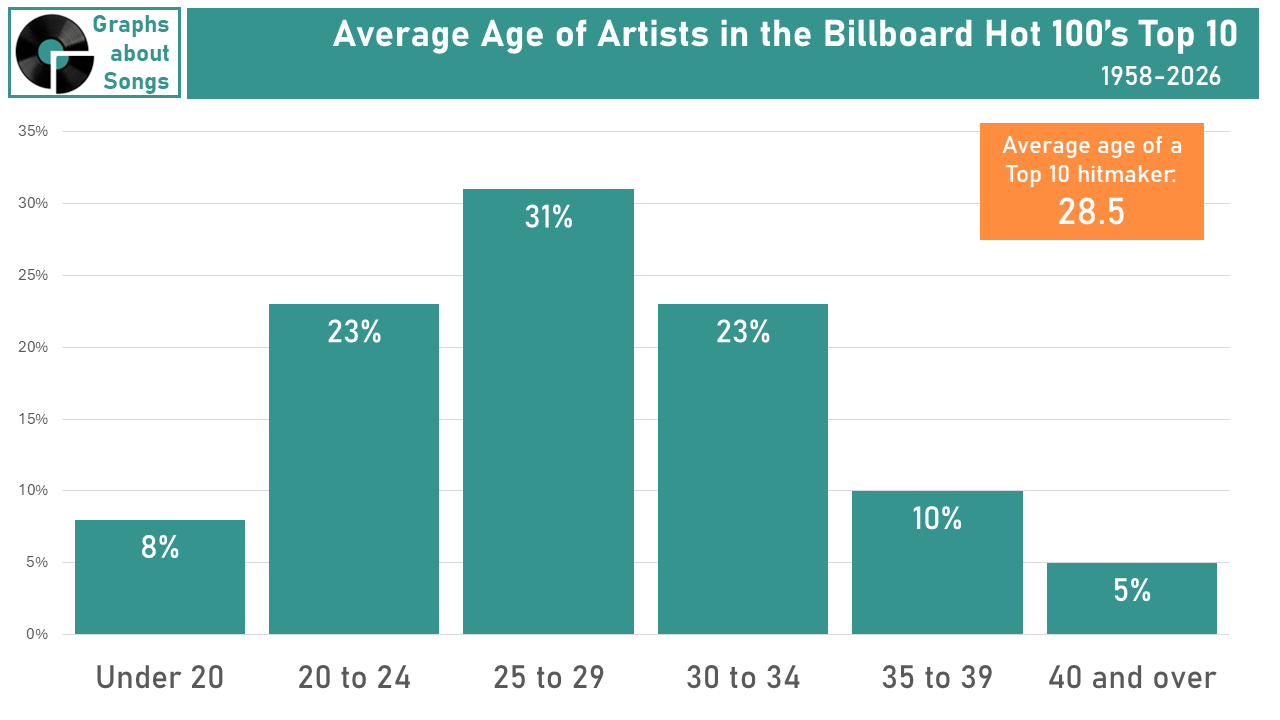
Historically, the typical age of a Top 10 hitmaker is 28.5 years old. About a third of Top 10s are from 25- to 29-year-olds, 38% are from artists 30 and older, while 28% are from artists 24 and younger.
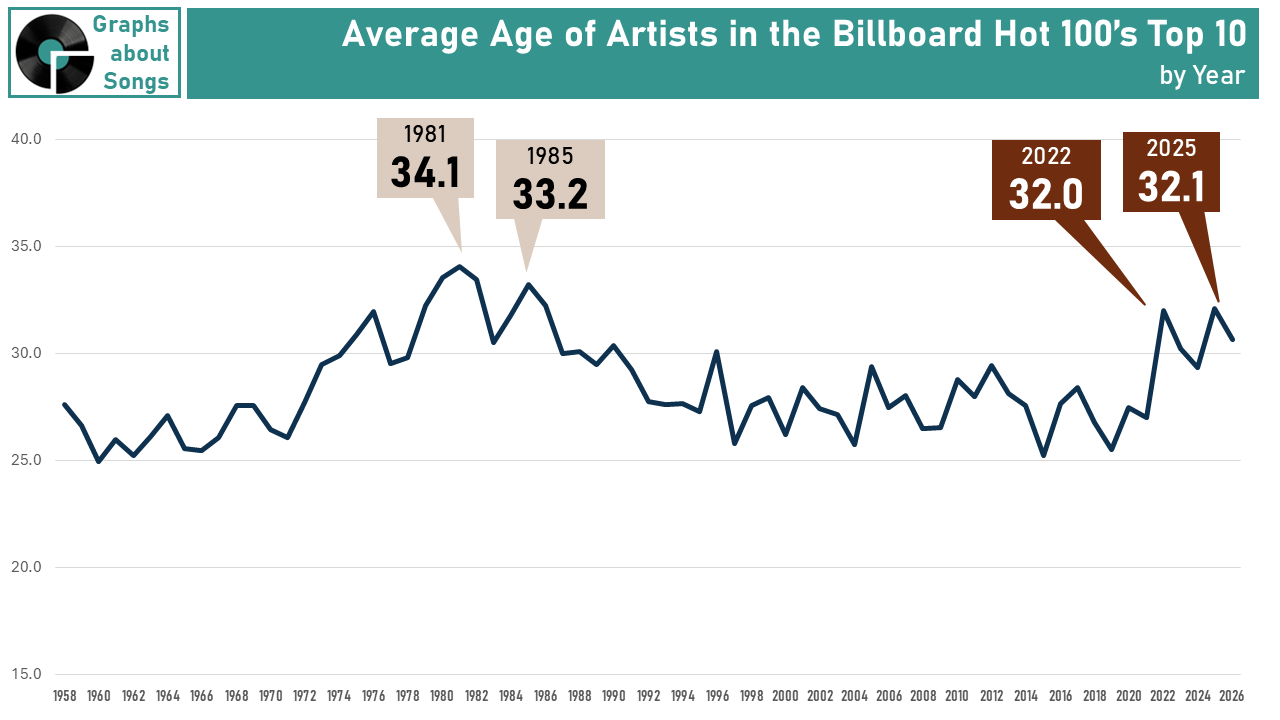
The average age does change throughout the years and with different generations. The all-time oldest year was 1981, when the typical Top 10 hit was from a 34-year-old, followed by 1985 at 33.2 years old. However, the second oldest era is now: In 2025, the average Top 10 hitmaker was just over 32 years old
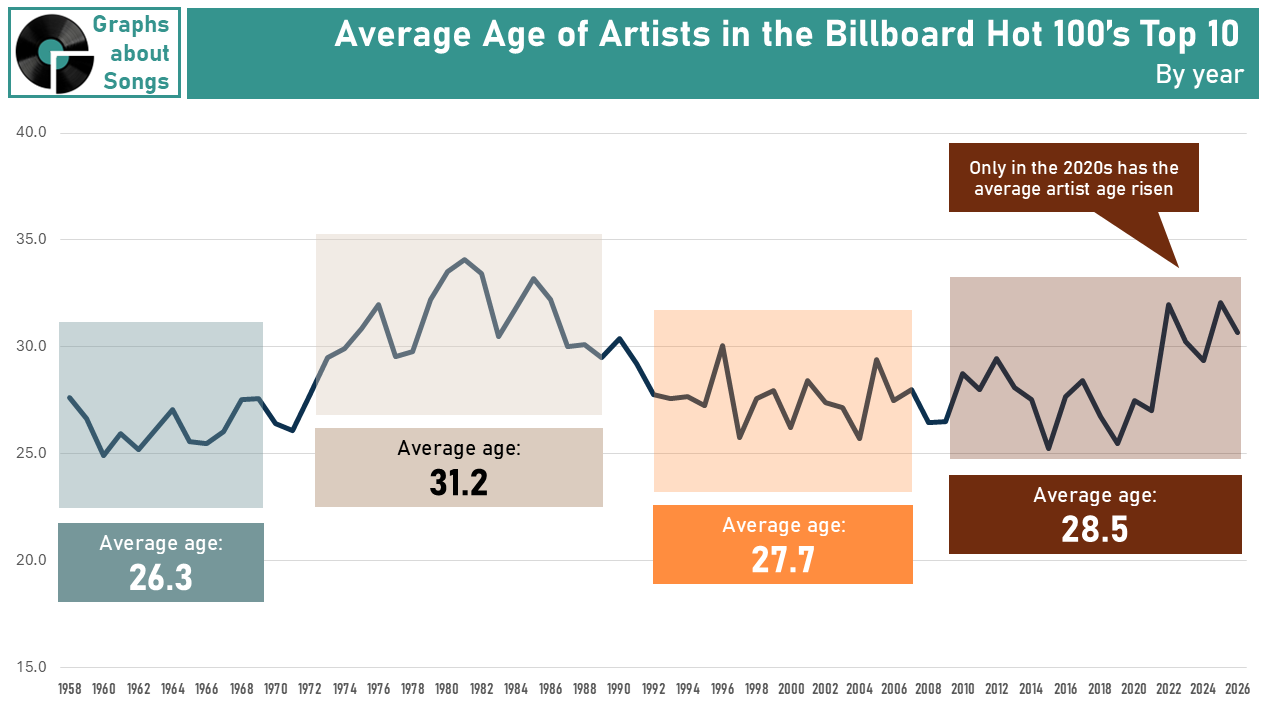
With boomers, it’s generational: During the years they dominated the Top 10, the typical Top 10 artist’s age was 31.2, higher than any other generation’s dominant era.
For Millennial hitmakers, however, it’s only a recent phenomenon. Until the early 2020s, Millennial artists were of comparable age to the Xers that dominated before them, specifically 27 years old. Suddenly in 2022. However, the average age jumped to 32-years-old.
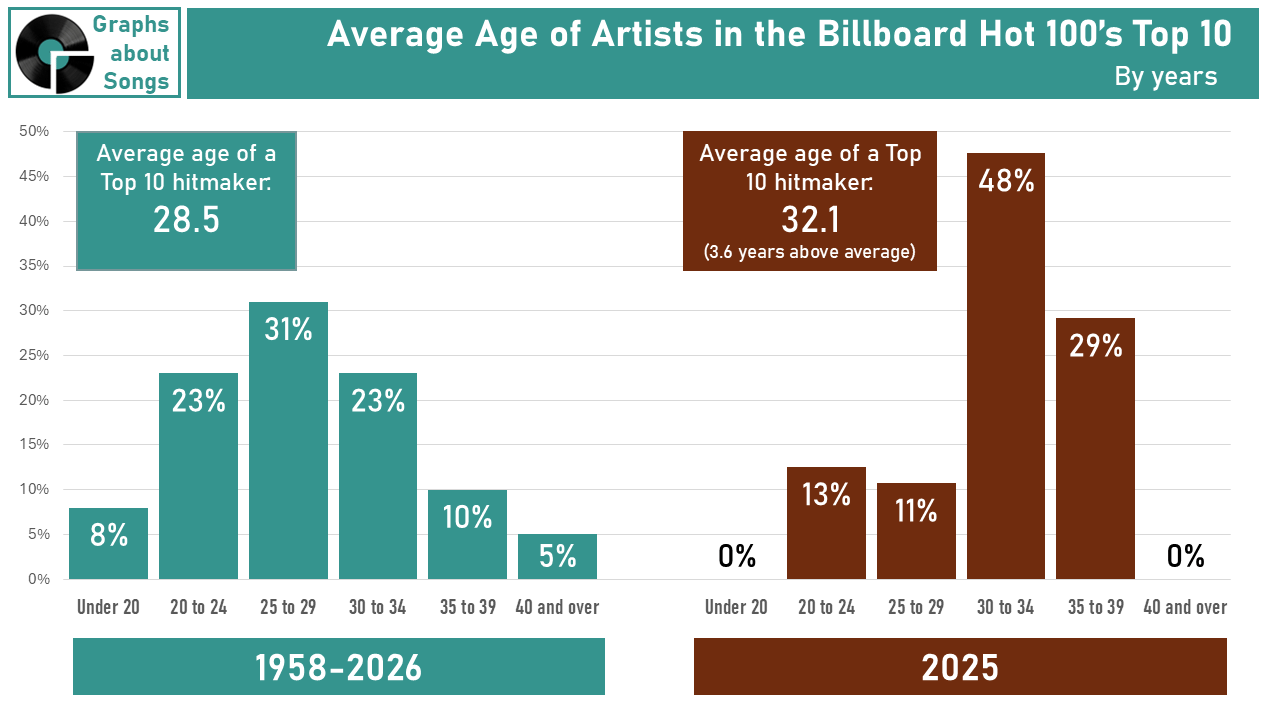
Almost half of the Top 10 hitmakers in 2025 were 30-to 34-years-old, five years older than the 25- to 29-year-old age range that typically is the largest plurality in the Top 10.
As for the lack of Gen Z artists, no teenaged artist has scored a Top 10 hit since Gayle took “abcdefu” to #3 in March 2022. Billie Eilish and Olivia Rodrigo started as teen wonders and were still teens for their 2021 hits, but they’re now 24 and 23, respectively.
Throughout the 2020s, artists have simply aged in place, with few younger artists emerging to take their place.
That’s largely the fault of who is picking the hits, namely, aging Millennials.
Generation Z began influencing which artists score Top 10 hits: Starting with Lil Nas X and Billie Eilish in 2019 and continuing with Olivia Rodrigo, Noah Kahan, and Chappel Roan this decade, A few Millennial artists that primarily appeal to Gen Z fans have successfully dominated streaming and radio.

Other Gen Z favorites, however, such as Steve Lacy, Tyler, the Creator, and Gigi Perez, have top tier hits on streaming, but have been largely absent from Top 40 FM radio, largely keeping them out of the Hot 100’s Top 10.
Radio may no longer play the hits first, but it still validates which hits are the biggest.
Instead, aging millennial icons such as Taylor Swift, Bruno Mars, Drake, and Miley Cyrus, alongside traditional Pop creators such as Sabrina Carpenter and Gracie Abrams, fill the airwaves.

A major factor is that radio increasingly ignores the tastes of listeners in their early- to mid-20s. There’s logic there. Generation Z simply doesn’t spend nearly as much time with FM radio as do older generations, so FM radio programmers are increasingly focusing their music research on the tastes of Millennials in their late 20s, 30s, and early 40s.
Three songs in particular have cumulatively spent years in the Hot 100’s Top 10 this year because of radio’s aging audience research: Teddy Swims’ “Lose Control,” Benson Boone’s “Beautiful Things,” and Alex Warren’s “Ordinary.”

Gen Z’s Streaming Hits
Consider Malcom Todd’s “Earrings” It’s consistently been among the most streamed songs on Spotify in the U.S. It’s 29 weeks old (for the chart date ending July 23, 2026), and is still #2 on the Spotify 200, behind only “Choosin’ Texas” by Ella Langley.
What will break this stronghold of aging Millennials?
Historically, we experience a resurgence in mass-appeal hit music when an emerging generation turns 21 and becomes the dominant generation consuming contemporary music—and thereby becoming the generation picking the hits. It happened before:
In 1983 when Gen X tastes replaced Boomers, replacing Christopher Cross and Air Supply with Michael Jackson and New Wave.
In 1964 when the Beatles led the British invasion. Those screaming teens at the Ed Sullivan Theatre were Boomers, and their tastes suddenly made the Silent Generation’s sounds obsolete.
In 2003, when Millennials had finally had enough of Generation X’s biting reality: They rejected 90s-style gangster rap and ushered in fun-clubbing Crunk.
If Straus and Howe correctly pegged the first birthyear for the new generation’s cohorts as 2006, Generation Z’s moment to pick the hits will finally emerge in 2027.
The bigger question will be if radio will be ready to play more Malcom Todd and less Ales Warren.
This article is brought to you by my day job…

Data sources for this article:
The Billboard Hot 100: https://www.billboard.com/charts/hot-100
Wikipedia’s Billboard Hot 100 Top 10 singles: https://en.wikipedia.org/wiki/List_of_Billboard_Hot_100_top-ten_singles