



Once upon a time, every town’s Top 40 radio station had a live evening disc jockey who took listeners’ requests. They’d play back phone calls from listeners saying what they wanted to hear, and maybe some crazy antics they were up to that night.
(Domino on Atlanta’s Power 99 takes requests and… other stuff… live in the studio in 1991.)
Stations often counted down the night’s requests with a “Top 5 at Nine.” The radio personalities who hosted nights were celebrities at local high schools. Even teens who’d already abandoned Top 40 for Led Zepplin and Rush knew these night jocks’ names.
(John Records Landecker hosts nights on 89 WLS Chicago in 1977 at the height of his Boogie Check.)
Those shows are long gone in most towns. Challenges in the radio industry replaced the live evening host with cost-saving pre-recorded patter. With no one to answer the phones, people don’t call radio stations like they used to, either. People don’t call anyone like they used to.
There is one place where the request-driven evening show is alive and well—and even growing: Liveline with Mason Kelter is a nationally syndicated show airing on over 90 radio stations in the U.S., in cities as big as Seattle and as small as Keene, New Hampshire.
The premise of the show is simple: You call 1-85-LIVELINE, request a song, and Mason plays it. He’ll get you to admit to something hilarious if he can and put you on the air. With its nationwide audience, Mason has no trouble attracting callers.
(You can also text in your request if you insist on being asocial.)
Every week, Liveline publicly publishes its Top 20 requests on Instagram and in the “Mason’s Observations” column on RadioInsight and in Sean Ross’ “Ross on Radio” newsletter.

For me, those requests are valuable data about song popularity---and I’m here to analyze them.
I’ve gathered one year’s worth of those requests from the week ending September 12th, 2025 through September 12th, 2026, to find out what we can learn from what America’s Pop radio listeners call in to hear. For this analysis, I’m excluding Holiday songs (namely songs listeners request at Christmas, Independence Day, or Halloween), as well as older gold titles listeners requested that weren’t current hits. To define how old each song is, I’ll compare each song to the week it debuted in the U.S. Spotify 200 chart.
Here are five things I learned from Liveline’s Top 20 requests:
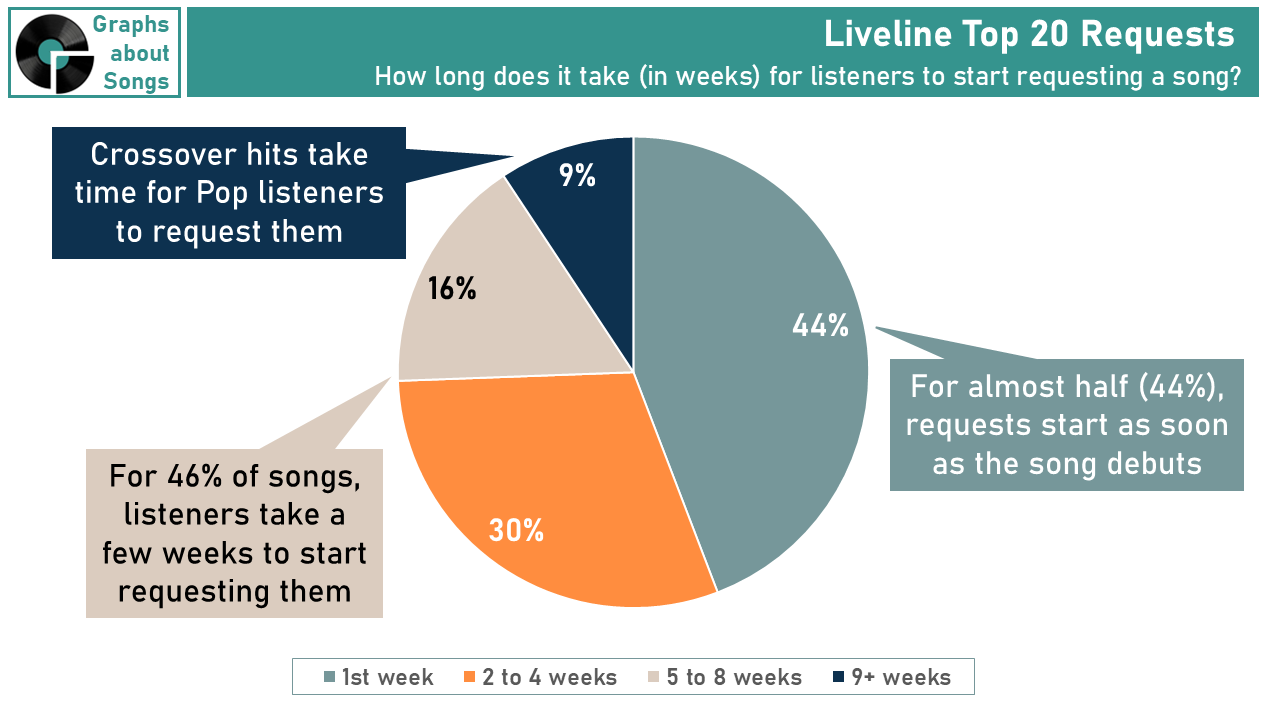
#1: Fans start requesting songs from big artists before they’ve even heard them.
When artists with huge fan bases release a song—think Taylor Swift, Olivia Rodrigo, Bruno Mars, Ariana Grande, or sombr—listeners start requesting those new releases immediately.
“The Fate of Ophelia,” “drop dead,” I Just Might,” “hate that I made you love me,” and, “Homewrecker,” all were among Liveline’s Top 20 requests within a week of debuting. That means fans not only were anticipating the release of these songs but were requesting to hear them before they had ever heard them.
That’s congruent with streaming, where Artist Stans binge new releases. Since streaming measures plays—not people—-those new songs from big artists are huge on streaming long before the vast majority of causal fans have even heard them.
But not every song gets requested immediately…
#2: Other songs take time for fans to start requesting.
For other songs, listeners have to hear them and get to know them before they start requesting them enough to make them among the Top 20 requests: That’s especially true of songs that crossover to Pop radio from other genres, such as Ella Langley’s “Choosin’ Texas” and Dexter and the Moonrocks’ “Freskin Out,” which Country and Alternative listeners, respectively, had been enjoying for months before becoming Pop hits got on board.
However, some pure Pop songs also take time to develop requests: Zara Larsson’s “Midnight Sun,” ADÉLA’s, ”Ain’t In LA,” SIENNA SPIRO’s “Die On This Hill,” Noah Kahan’s “Orbiter,” and even Taylor Swift’s :”Opalite” were all popular on streaming for at least four weeks before listeners started calling Liveline to request them.
#3: Listeners get sick of some songs very quickly—often the same songs that tank quickly in streaming.
After her hugely popular album The Rise and Fall of a Midwest Princess, Chappell Roan’s fans were primed for what was next. “The Giver,” her foray into Country, quickly tanked. Her next single, “The Subway,” was more in her wheelhouse—except it wasn’t. It lacked the fun melodies and direct lyrics of her hits, instead sounding like a Taylor Swift Pastiche.
Listeners responded accordingly.
On Spotify, after debuting with an outstanding 16 million plays in its first week, it’s streams fell in half in its second week. After 13 weeks, “The Subway” was off the Spotify 200 entirely, while several of her hits from the previous year stayed on the 200.
At Liveline, Roan fans stopped requesting “The Subway” after only four weeks.
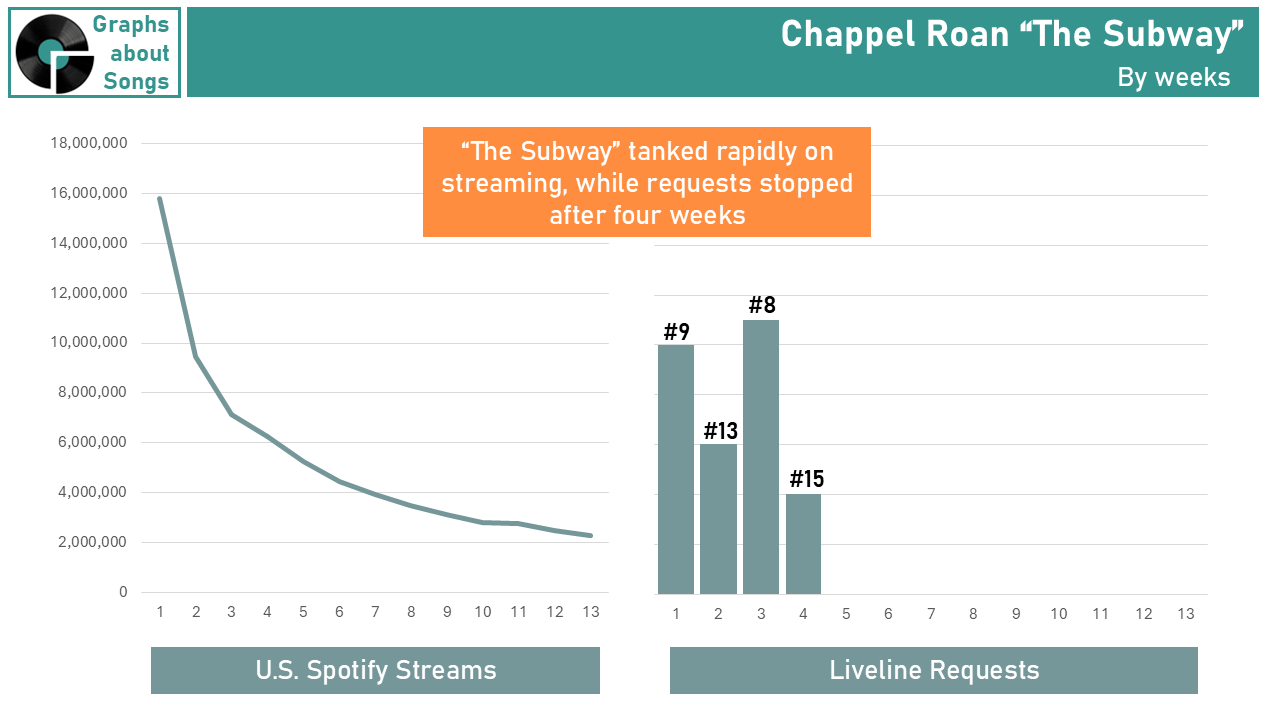
Harry Styles’ “Aperture,” BTS’ “SWIM,” and Alex Warren’s “FEVER DREAM,” also stopped receiving requests after less than four weeks. Listeners still love the artists, but didn’t gel with these specific songs.
#4: Listeners still request the huge hits month after month—usually the same songs that keep testing well in callout research.
I pick on Teddy Swims’ “Lose Control” and Alex Warren’s “Ordinary” as the songs radio keeps playing even after they’re years old. The fact is, radio keeps playing them because listeners still love them: “Lose Control” still made Liveline’s Top 20 requests three years after it debuted. “Ordinary” still got requests as late as 21 months after it was new.
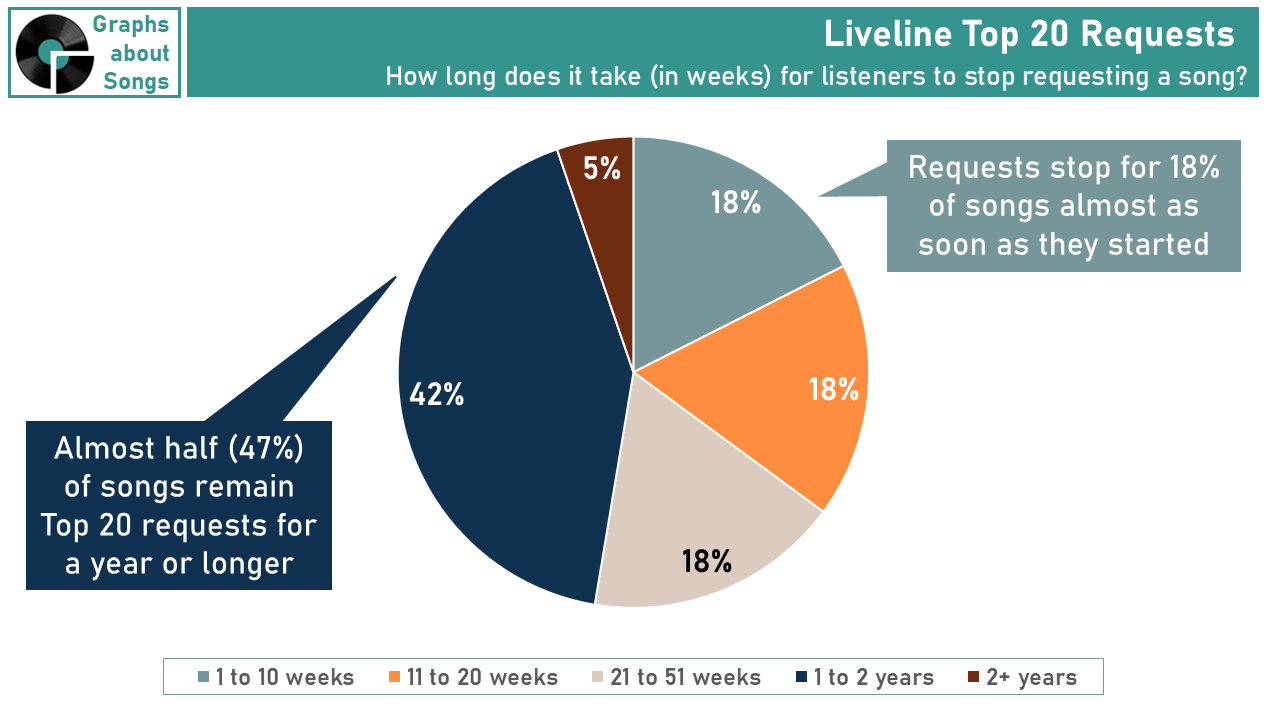
Sabrina Carpenter’s Espresso, Chappell Roan’s “Pink Pony Club,” Billie Eilish’s “BIRDS OF A FEATHER, Post Malone and Morgan Wallen’s “I Had Some Help” were all Top 20 requests a year and a half after debuting. The weeknd”s Blinding Lights even made the Top 20 over six years after its debut.
#5: Requests are slower than streaming but faster than callout
So how do Liveline’s listener requests compare to other common song popularity metrics?
Here’s the vintage distribution of the Liveline’s Top 20 requests during the past year: The majority of those requests are for songs that are 1 to 20 weeks old:
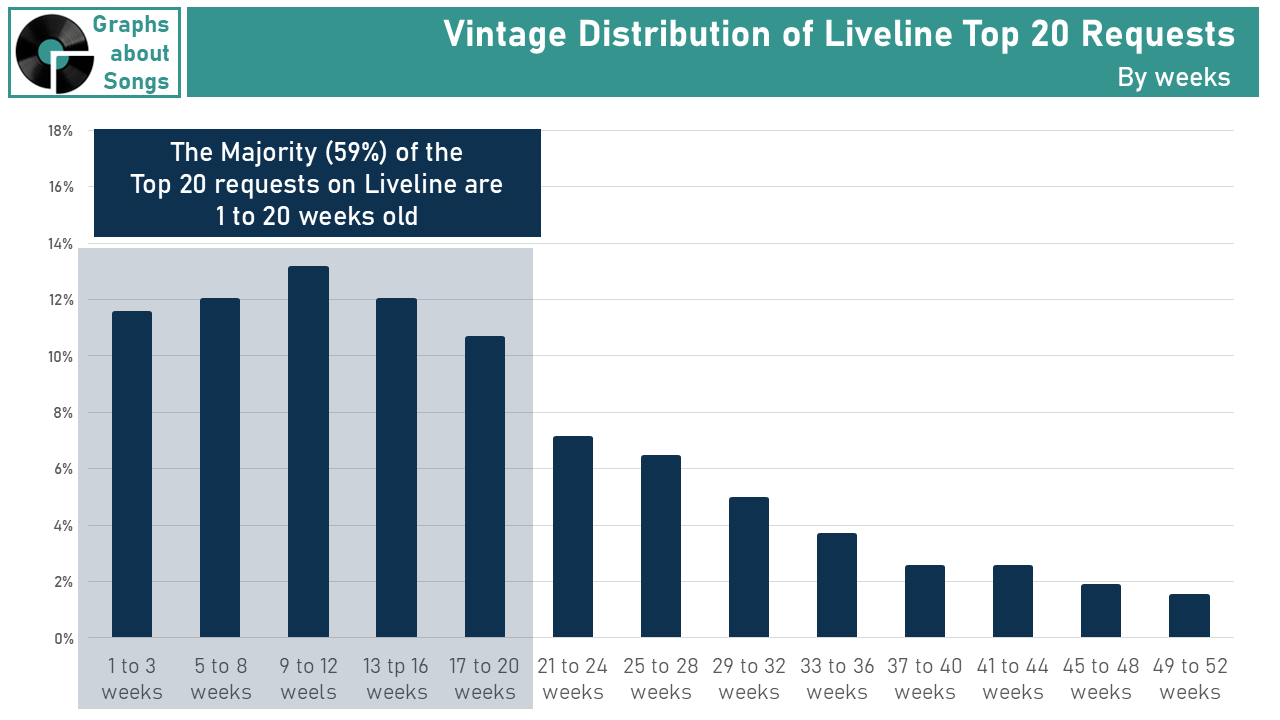
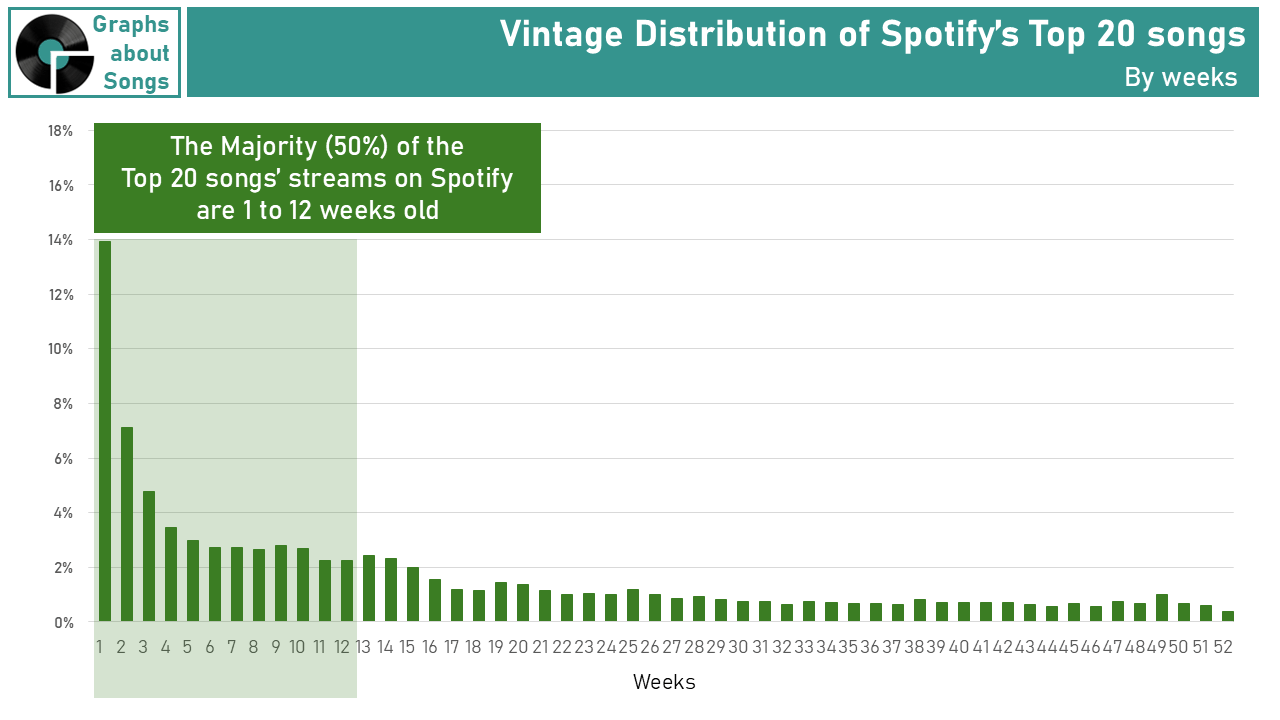
That’s slower than streaming. As I’ve harped on consistently here on Graphs About Songs, since streaming measures how many times people play a song, not how many individual people play it, raw stream counts are heavily skewed towards brand new songs from big artists, whose fans repeatedly play them as soon as they drop. While the most popular songs can remain Top 20 on Spotify for years, the majority of Top 20 songs on Spotify in a typical week are 1 to 12 weeks old. (The chart below is for Spotify data covering 1/1/2025 through 9/17/2026):
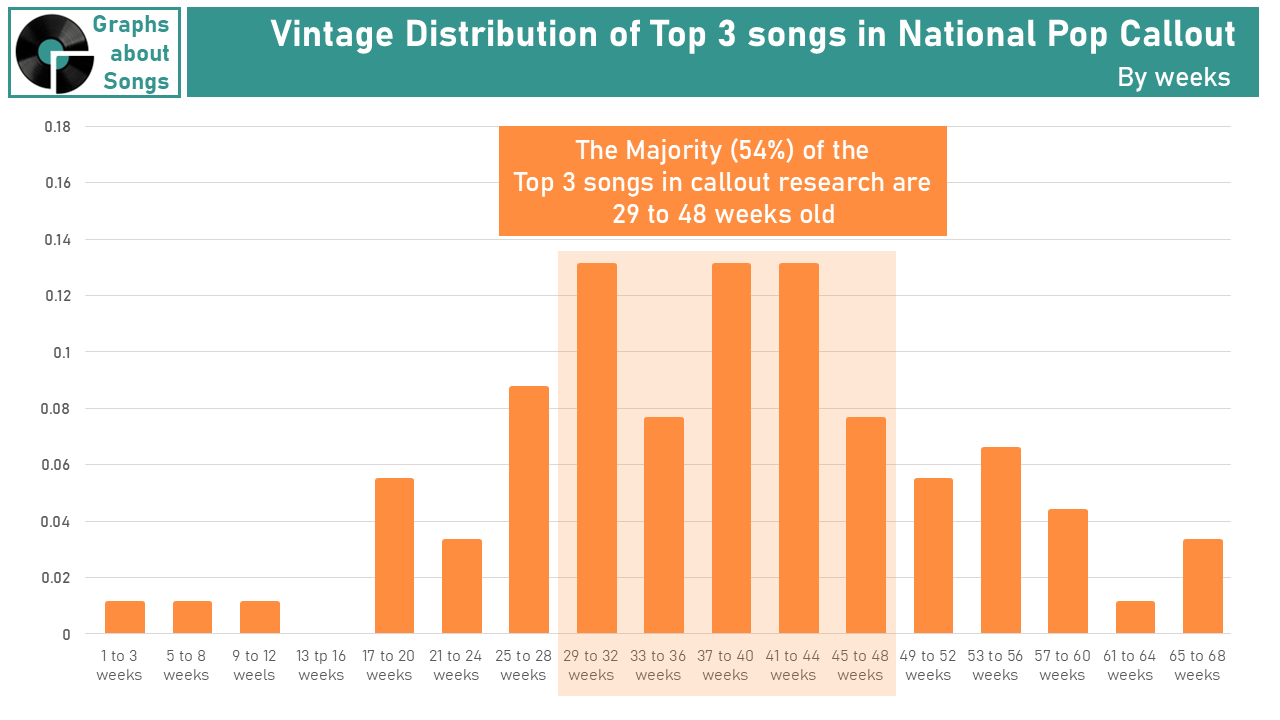
On the other hand, the songs listeners request are significantly newer than the best-testing songs in callout research. I don’t have access to the Top 20 national callout for the same timeframe, which would be a truly fair comparison: The only publicly published callout data I have is Coleman Insights’ Integr8 USA (Bias disclosure: I oversaw Coleman’s callout research division from 2009-2024). Top three songs from September 2024 through March 2026, which they published in various radio trade outlets and on their own social media during that time.
The majority of songs typically aren’t reaching the panicle of callout until they’re half a year to almost a year old. That’s weeks—and months—after requests for most songs have dried up.
What have we learned here?
A significant number of listeners are interested in hearing brand new songs from their favorite artists. Not all of those songs will ultimately become big hits—but listeners tend to reject those songs rapidly. It would behoove Pop music radio to play those songs while listeners are interested in hearing them.
Listeners’ interest in most songs is highest when the song is in its first 20 weeks. That’s consistent with what pre-pandemic era callout showed before changes in music consumption and research methodology slowed it significantly. Throughout the 2010s, listeners would increasingly say they were tired of hearing big Pop hits after they were 20 weeks old.
Those songs you’re sick of? Fans keep requesting them for years. From Teddy Swims’ “Lose Control” and Alex Warren’s “Ordinary” to Sabrina Carpenter’s “Espresso” and even the weeknd’s “Blinding Lights,” the songs that listeners know and love most in radio research and that streaming users keep streaming forever are also songs listeners keep requesting month after month and even year after year.
Liveline’s Top 20 requests are a valuable data point because—unlike streaming data which measures plays—requests measure how many individual people request a song. Additionally—unlike callout—requests capture passion for songs when it peaks, not merely when a song achieves universal familiarity.
Why do they call?
You might wonder why anyone would call a radio show to hear their favorite song when that song is a few clicks away in their pocket.
It’s not about hearing the song.
It’s about having a voice in the show. It’s the thrill of hearing your voice on the radio. (Yes, people still feel like celebrities when they’re on the radio.) It’s about being a part of a community.
Even back in the day when we recorded our favorite songs from the radio onto cassettes, it was about these things.
After all, a good radio personality is a star. The best radio personalities make you feel like a star.

Data Sources for this article:
Liveline Top 20 requests, retrieved from https://www.instagram.com/livelineradio/
Coleman Insights’ Integr8 USA Pop Top 3, provided by RAMP: Radio and Music Pros, https://ramp247.com and retrieved from https://www.facebook.com/colemaninsights
Spotify Charts (2025-2026 for the USA): https://charts.spotify.com/charts/overview/us