



For the week ending August 8th, 2026, the Top 5 songs on the Billboard Hot 100 chart were all Country songs. That’s never happened in the chart’s entire 68-year history
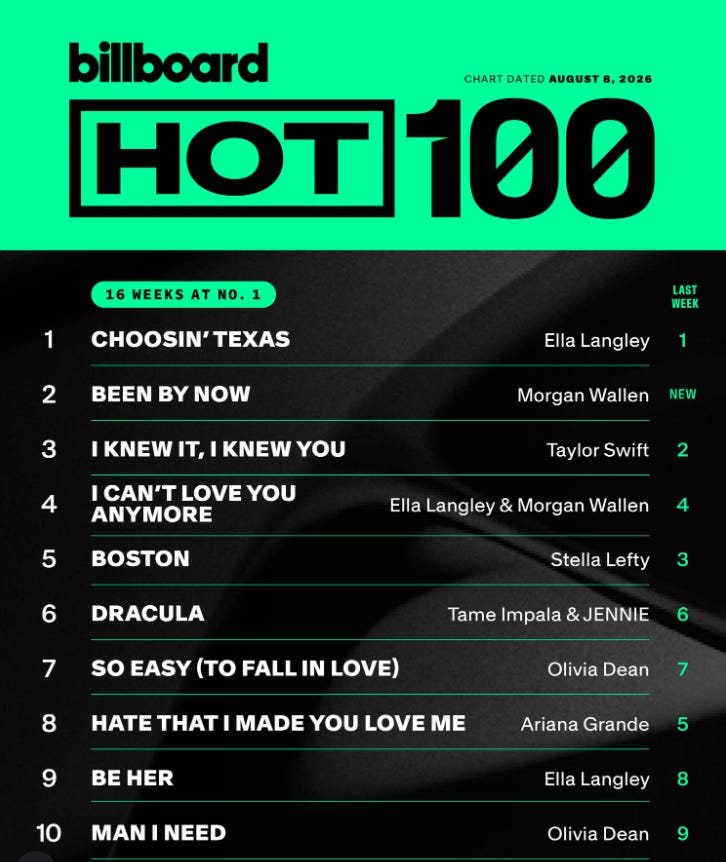
At #1 that week was Ella Langley’s “Choosin’ Texas,” which now holds the record for the most weeks at #1 on the Billboard Hot 100 of not just any Country song, but of any song. That’s especially remarkable because there have only been about 35 to 40 Country songs (depending on what you consider Country) that reached #1 on the Pop charts.

2026 is on track to be the biggest year for Country music on the nation’s Pop chart. As of early October, 3 of the Top 10 songs in a typical week were Country songs. That’s remarkable, because there are years—as recently as 2014-2016—when not a single Country title reached the Hot 100’s Top 10.
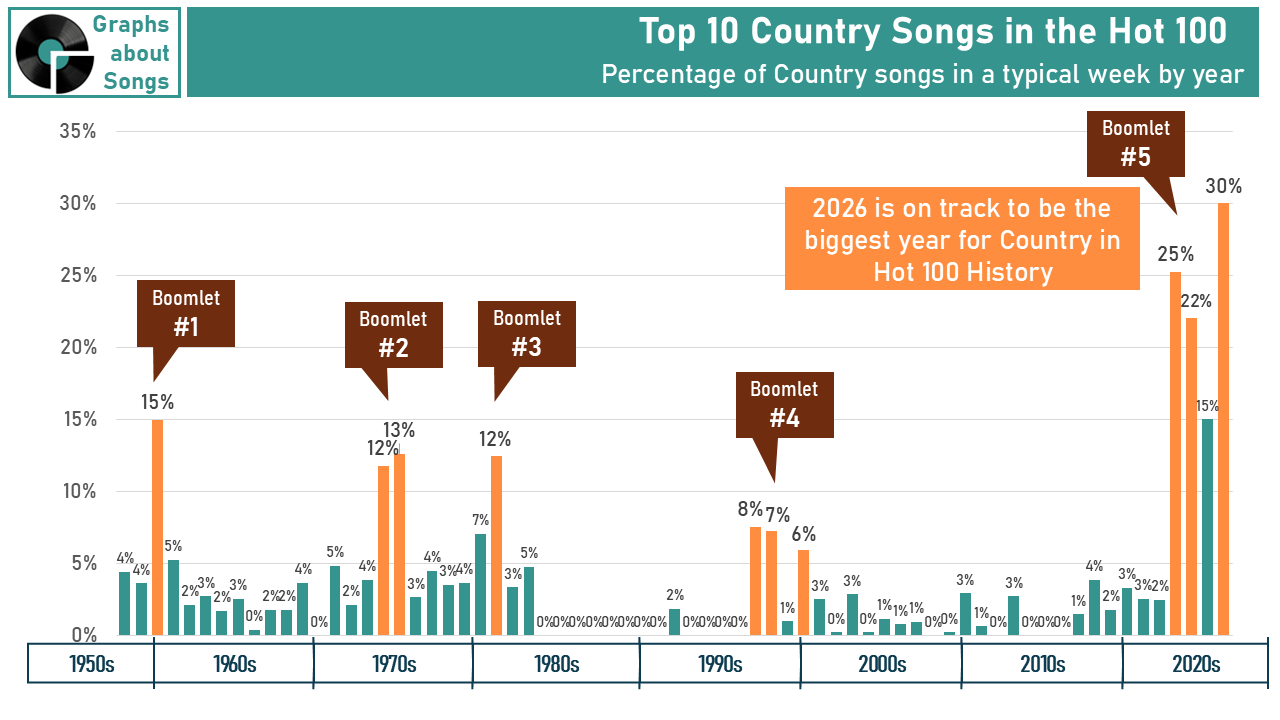
The chart above shows the percentage of Country titles in the Hot 100’s Top 10 by year. You can clearly see that Country’s success on the Pop chart comes in boomlets, sometimes only lasting a year. Why does Country suddenly become popular among Pop fans, then seemingly vanish from the chart? What can we learn from examining the last four times Country has surged into the Top 10 on the Pop charts that explains Country’s record-setting chart performance today?
Let’s take a tour of the four previous Country Crossover boomlets
Boomlet #1: Crooners and Comedy (1960)
After a plane crash in Iowa killed Buddy Holley, Ritchie Valenz, and The Big Bopper in 1959 (Yes, the one that made Don Mclean rich), they seemingly took all of the original Rock ‘n’ Roll with them. The Army drafted Elvis. Little Richard found Jesus.
The following year, the Hot 100 was awash in corny Country. There were sappy and sad tales, such as Conway Twitty’s “It’s Only Make Believe” and Jim Reeves’ “He’ll Have To Go.”
What truly made the 1960-peaking Country Crossover era faddish were the onslaught of truly terrible novelty records: Johnny Horton’s “The Battle Of New Orleans,” attempts to be funny enough to make a forgotten 1815 military battle memorable. Stonewall Jackson (the name alone says it all) gave us “Waterloo,” where historical figures face their final curtain in another attempt at comedy.
The biggest Country crossover hit was Marty Robbins’ “El Paso,” a tale of how his love for a “Mexican maiden” led to his murder.
Country continued crossing over until the Beatles and The Rolling Stones revived Rock ‘n’ Roll during the British invasion. A decade later, Country would infuse itself with the sound of Rock.
Boomlet #2: The Mellow Outsiders (1974-1975)
In 1974, Olivia Newton John hadn’t yet become a Pop icon. Grease was four years away. She was a Country artist with twangy tunes such as “Let Me Be There” and “If You Love Me (Let Me Know),” plus softer songs such as “”Have You Never Been Mellow”” and “I Honestly Love You.” All four of these songs were Top 10 Country hits—but also massive hits on pop-oriented Adult Contemporary radio stations.
So when this Australian with pop sensibilities won the Country Music Association’s Female Vocalist of the Year award in 1974, the Nashville establishment lost their hats: George Jones and Tammy Wynette even formed the Association of Country Entertainers (ACE) to keep Country pure, feeling the CMA wasn’t adequately gatekeeping the genre.
You’ll notice a theme here.
The following year, when another non-Nashvillian John Denver won the CMA Entertainer of the Year award, a drunk Charlie Rich set fire to the card announcing Denver’s victory before presenting him the award. That was—well—rich coming from Charlie, who himself scored a #1 Pop crossover hit with his Countrypolitan tune “The Most Beautiful Girl”
It wasn’t simply the performers that spooked traditionalists: Fans of Olivia Newtron John and John Denver’s kind of Country were not the traditional rural American fans. They were young adult urban-dwelling Boomers who saw Country as a way to mellow out, not as a way of life. To them, Modern Country didn’t sound that different from The Eagles, Bread, and Credence Clearwater Revival. That new audience would be pivotal to Country’s most famous boomlet.
Boomlet #3: The Urban Cowboy (1981)
After Saturday Night Fever’s success, they decided to move it from a Brooklyn disco to a Houston honky-tonk. Urban Cowboy portrayed a new kind of Country fan; he’s young, lives in the city, and works an industry job, not the middle-aged rural farmer stereotypically loyal to the genre. It spawned a wave of Country songs ascending the Pop chart, many who had nothing to do with the movie, from Eddie Rabbit, Ronnie Milsap, Johnny Lee, Juice Newton, Kenny Rogers, and Dolly Parton.
It certainly didn’t hurt Dolly Parton becoming a moviestar.
Two years later—after Rogers and Parton reached #1 with “Islands In The Stream”—the Urban Cowboy fad was over. Generation X was now picking the hits, and they made MTV-style New Wave the in sound.
Nashville felt burned by the rejection of mainstream Pop fans:
Collectively deciding to dance with the fans that always loved them, a new crop of neo-traditionalist artists wanted nothing to do with the Pop audience: Randy Travis, The Judds, Ricky Skaggs, Patty Loveless, and George Straight all emerged as superstars among Country’s core fanbase, but virtually unknown among Top 40 partisans.
This was by design.
In the 1990s. as Country exploded (and changes in chart methodology proved the Country audience was bigger than previously estimated), Garth Brooks, Clint Black, Reba McEntire:, and Books & Dunn not only didn’t court Pop fans, they aggressively avoided promoting songs beyond Country’s base. Garth Brooks famously refused to release singles so his songs would be ineligible for the Hot 100 chart, even as his albums routinely debuted at #1 on the Billboard 200 album chart. They’d been burned before by the fickle tastes of Pop fans—they weren’t going to risk their careers on their whims again.
With the lone exception of Billy Ray Cyrus’ “Achy Breaky Heart,” no Country title reached the Hot 100’s Top 10 from 1983 until 1997.
The absence finally ended with three women too big to ignore.
Boomlet #4: The Women of Country (1997-2000)
LeAnn Rimes never reached #1 on the Hot 100 with her 1997 hit “How Do I Live”. It spent so much time on the chart, however, that Billboard named it the #1 song of the decade. Its record 32 weeks in the Hot 100’s Top 10 stood until the streaming era gave us the mega-hit.
The following year, Canadian newcomer Shania Twain’s “You’re Still the One” spent 23 weeks in the Hot 100’s Top 10. “This Kiss” from Faith Hill was the first of several pf her hits that would become Top 10 Pop hits.
Unlike past Country crossover boomlets, where a dozen artists had major Pop hits, these three artists---Rimes, Hill, and Twain—almost exclusively created the first half of this boomlet. with a handful of massive crossover hits that stayed on Country, Top 40, and Adult Contemporary radio stations for months.
In 2000, Faith Hill struck again with three songs in the Hot 100’s Top 10, the biggest being “Breathe.” It only reached #2, but it stayed in the Top 10 for 19 weeks.
The biggest crossover hit of 2000, however, was Lonestar’s “Amazed,” the first #1 Country hit on the Hot 100 since “Islands In The Stream.”
Like other songs during this boomlet the labels released two versions of “Amazed:” One for Country stations, and a version that toned down the steel guitars and other country signifiers for Top 40 and Adult Contemporary radio stations. Billboard counts them as the same song.
So what do these boomlets have in common? Are they predictable? And what do they tell us about the state of music in 2026?
#1: Country fills Pop music vacuums
The 1960 boomlet occurred when the biggest Rock ‘n’ Roll stars were no longer there, but before the Beatles invaded. The Urban Cowboy fad of 1981 was after we overdosed on Disco, but before MTV made New Wave happen.
When Pop music is in a slump., fans often turn to Country . That’s definitely happening now in the 2020s. And who is unhappy with Pop matters, too:
#2 Country becomes popular when adults are p picking the hits
Contemporary Country has always enjoyed far broader age appeal than other Contemporary genres. Right now, in Knoxville, there are septuagenarians listening to 107.7 WIVK—and they know every artist. Mathematically, that means when the tastes of adults dominate the Pop chart, Country becomes more popular:
In the early 1960s, the Silent generation teens who loved Elvis, the Coasters, and Buddy Holley were growing up, but Baby Boomers weren’t old enough yet to control which songs became popular. They would when the Beatles invaded.
In the early 1981s, Boomers were aging into Yuppies, but Gen X hadn’t yet gotten control of the Pop charts with New Wave, Michael Jackson, and Prince.
In 2000, Generation X were no longer teens and their Alternative Rock and Rap were mellowing out, but Millennials hadn’t yet transformed streetwise Gangsta Rap into Clubbing Crunk.
As you’ll notice on the chart below, Country boomlets—with the exception of the mid-70s mellowists—coincide with adults picking the hits:
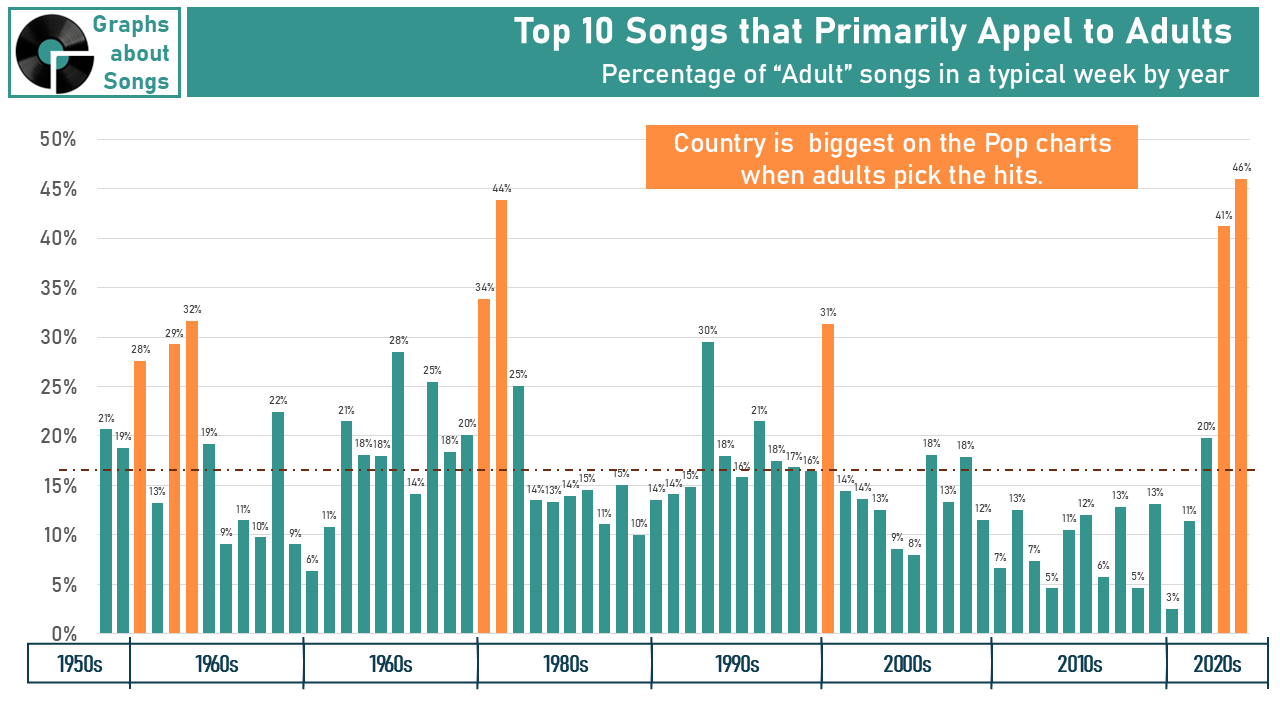
As I detailed in When The Adults Pick The Hits, we’re experiencing an adult dominated chart right now in the mid 2020s: The same demographics making Teddy Swims “Lose Control” and Alex Warren’s “Ordinary” massive hits are also a part of the coalition making Ella Langley famous beyond Nashville.
#3 Country becomes popular when it courts Pop fans---until now.
Historically, Country has only succeeded on the Pop charts when artists and labels actively courted the Pop audience. Until the 1990s, The Hot 100 only counted airplay on Top 40 radio stations. Unless a record label actively courted airplay from Pop radio, they weren’t going to appear on the Hot 100.
They did so by actively promoting songs with crossover potential to Pop radio stations and, starting in the late 1990s, releasing Country and Pop mixes of the same recording. Without this intentional effort, Country songs stayed exclusively on Country charts.
Furthermore, until late 1998, Country artists could make themselves ineligible for the Hot 100 simply by not issuing a retail single—a chart rule Country artists like Garth Brooks exploited to avoid competing with Pop stars.
Today, the Hot 100 chart works very differently.
In a follow up, I’ll show why today’s boomlet is different from past ones—including why boomlet #5 is so much bigger than the first four Country crossover boomlets.
And yes, it’s because of streaming.
Data sources for this article:
The Billboard Hot 100: https://www.billboard.com/charts/hot-100
Wikipedia’s Billboard Hot 100 Top 10 singles: https://en.wikipedia.org/wiki/List_of_Billboard_Hot_100_top-ten_singles

BTW, if you want to hear The Battle of New Orleans the way Jimmie Driftwood wrote it as a history lesson, look no further than Jimmie's original, which actually was a minor country charting single and Jimmie also wrote the oft-covered country and folk standard Tennessee Stud.