


Young folks unearthing obscure old songs is nothing new. Decades ago, adventurous music fans dug through album crates at used record stores.
Some still do.
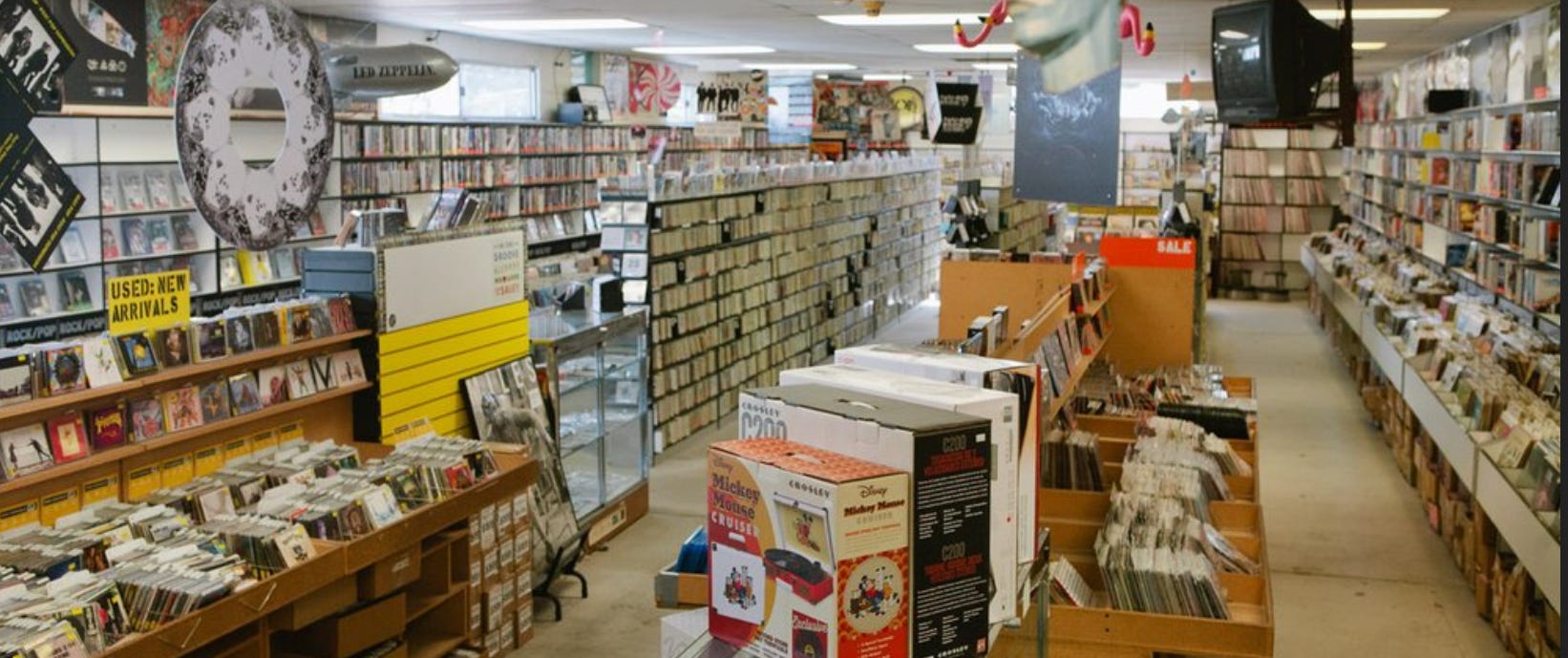
Back in the day, those discoveries rarely made it past a few friends gathered around the turntable unless the crate diver was in the mass media.
Nowadays, you can check out music you’ve never heard simply by opening the Spotify app. The real difference, however, is that you can now share the songs you find as Tik Tok memes. When those memes become viral trends, that unearthed song can reach millions.
Today on Graphs About Songs, we’re checking out those old classics that young people discovered recently. I’ve examined every song that reached the Spotify 200 chart in the U.S. from January 2025 through February 2026, tagging those songs released before this decade.
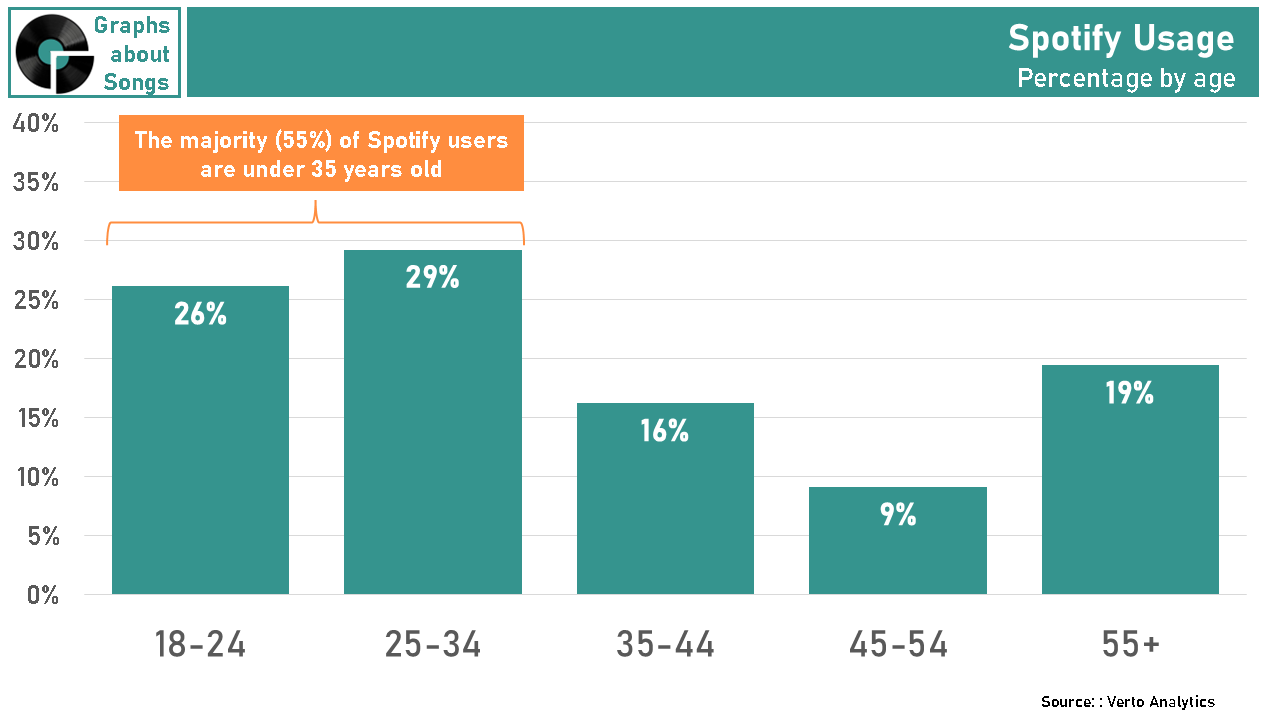
How do we know that younger adults are the ones streaming these songs? Because Spotify usage in the U.S. is biggest among younger Millennials and Generation Z: While older users are growing rapidly, the majority of Spotify users in 2026 are still under age 35:
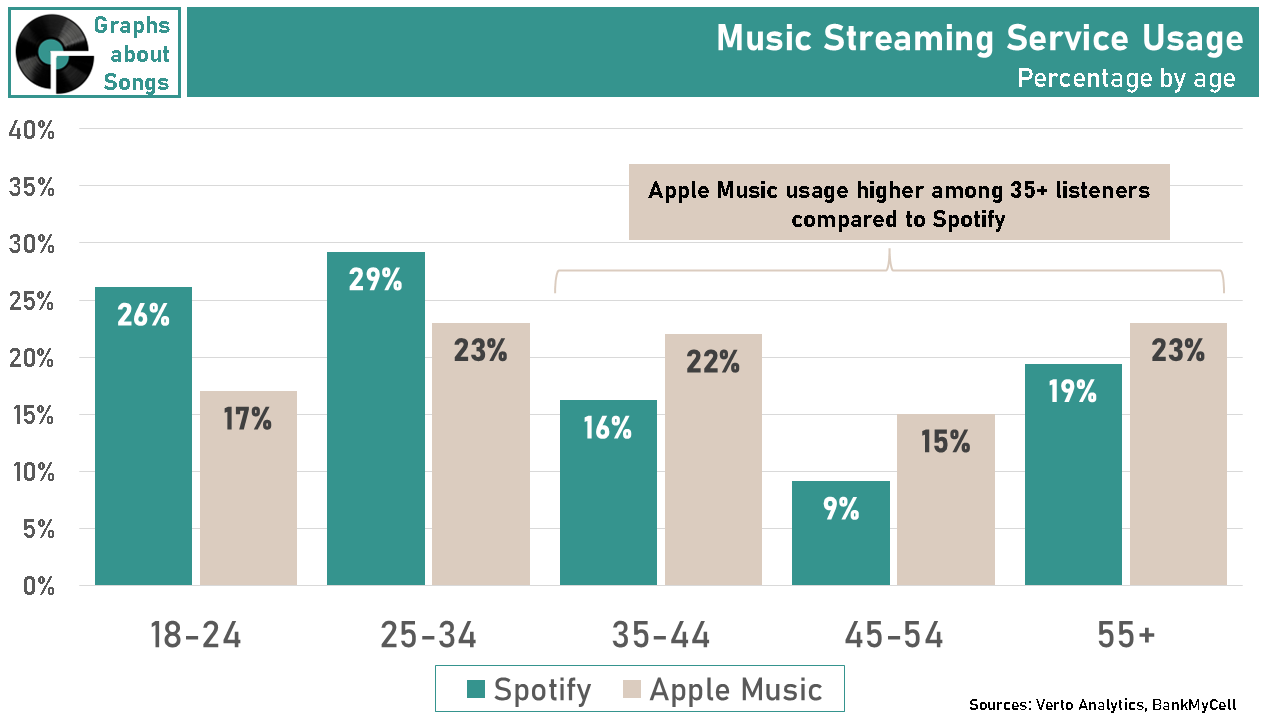
Note that Spotify users are younger than music streaming users in the U.S. overall. Sixty (60%) of Apple Music listeners are 35 and older, compared to 44% of Spotify users. Amazon Music is even more popular with Boomers and Xers (45+).
(That’s why, at my day job helping contemporary radio stations pick the mass appeal hits, I use proprietary data combining all music streaming platforms. Here on Graphs About Songs, however, I generally cite Spotify because their data is freely available for you to access and analyze yourself.)
Note:
I’ve removed songs that people only stream during holidays. That includes Christmas, obviously, but also includes classics fans now associate with Halloween, such as Michael Jackson’s “Thriller,” or Independence Day, such as Bruce Springsteen’s “Born In The U.S.A.” If a song only appears in the Spotify 200 during a holiday week, I didn’t include it.
I did include songs that retroactively became bigger hits in the 2020s than they were when they were new, such as “Running Up That Hill” from Kate Bush. I’ll note those songs when mentioned.
I’ll compare these songs with the songs we examined in last year’s series, This year’s data covers January 2025 through Feburary 2026, while the data in last year’s articles covers January 2024 through February 2025
More classics, fewer currents, among the Spotify 200
The vast majority of streams among songs reaching the Spotify 200 are still for current songs from the 2020s. Since our last examination, though, the percentage of streams for pre-2020 songs has increased. Almost one in five plays is for a song from a previous decade.
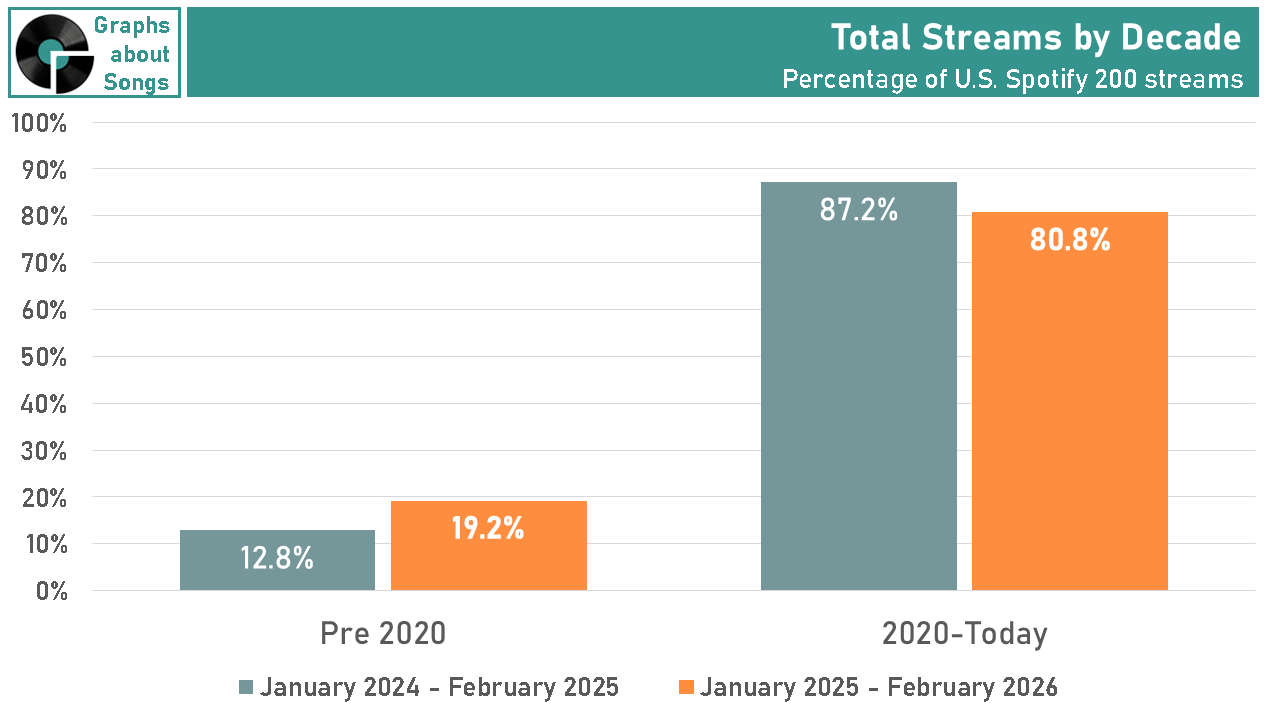
Streaming of 1990s and 2000s classics increases
That growth stems from songs released between 1990 and 2010, the formative years for many Millennials. In contrast, streaming of songs from the previous decade (2010-2019) has declined in the last year.
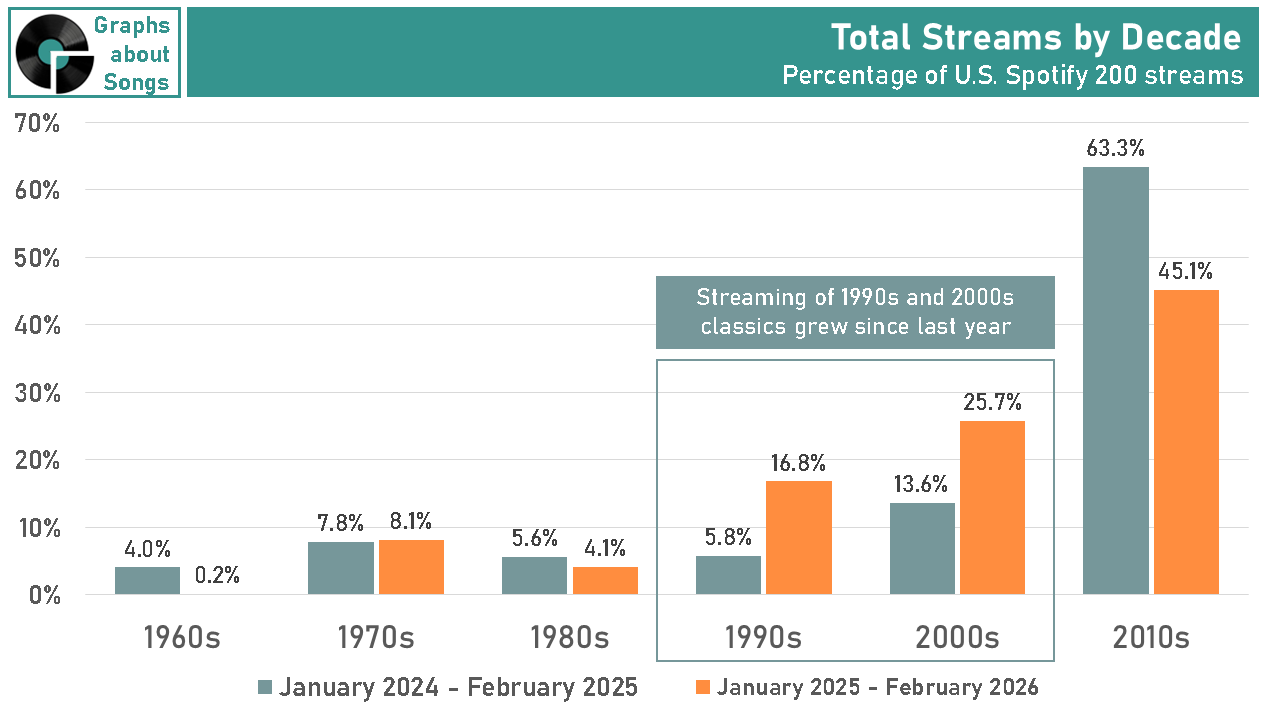
What songs from the 1990s and 2000s are fans streaming? Not the Hip Hop and 2K throwbacks you might expect…
Alternative Classics are Huge—but not the ones you think
Almost half (47%) of all streams for pre-2020 classics are for Alternative songs, followed by Pop and Hip Hop.
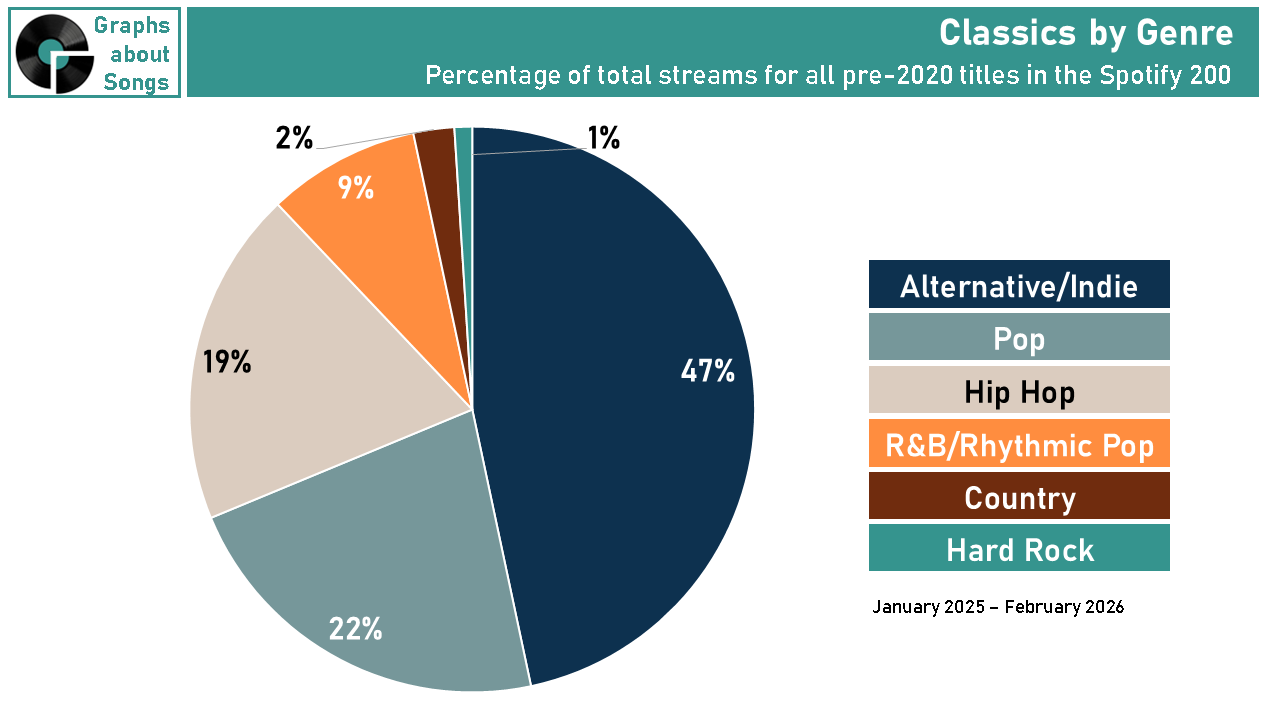
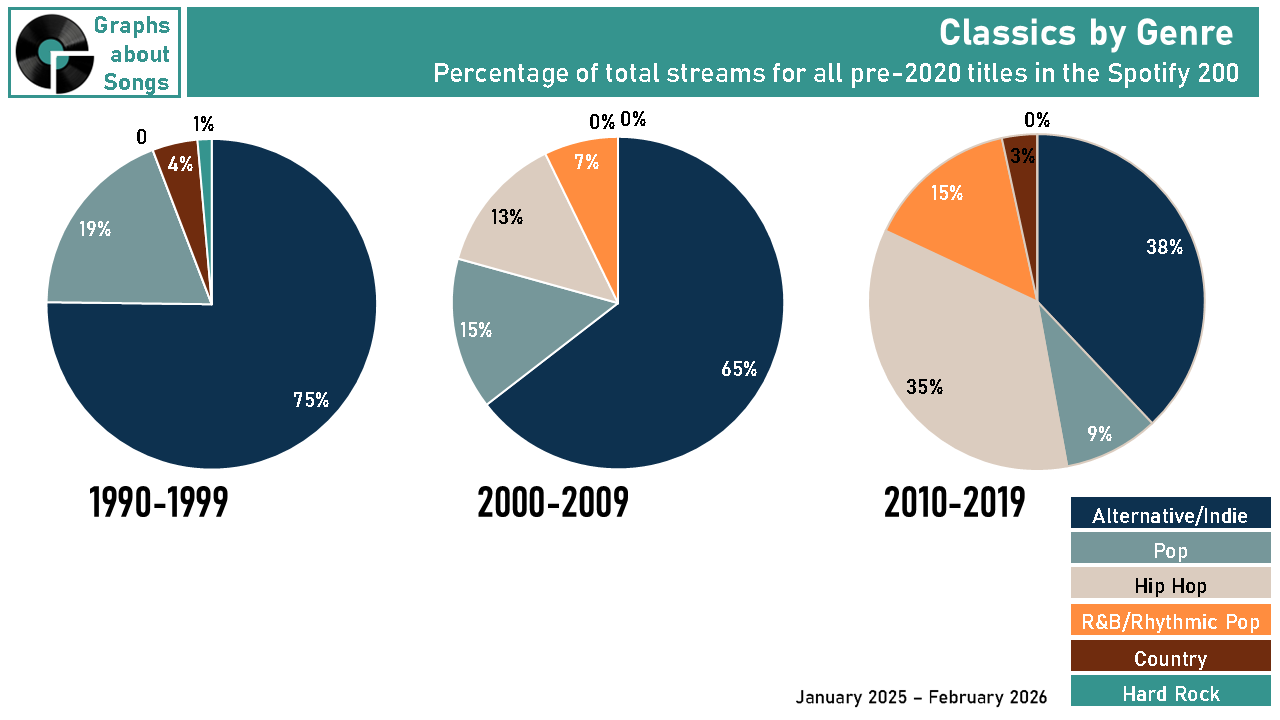
However, the classics fans play from each genre aren’t from the eras you’d expect:
The 1990s: Alternative classics dominate the 1990 from Nirvana, Radiohead, and the Red Hot Chili Peppers. Surprisingly, none of the foundational Hip Hop songs from this decade reached the Spotify 200.
The 2000s, In a decade often remembered for Crunk ‘n’ B, Alternative classics dominate as well, specifically from artists that were the soundtrack of Millennials’ formative years; Coldplay, Linkin Park, Three Days Grace and Empire Of The Sun. Meanwhile, Kanye West leads for Hip Hop. The only Crunk Classic reaching the Spotify 200 is Yeah! From USHER feat. Lil Jon & Ludacris.
The 2010s: This decade reflects Generation Z’s old favorites. For Alternative, that’s largely from Indie artists such as TV Girl and Cigarettes After Sex. For Hip Hop—for which the 2010s accounts for more streams than any previous decade—the leading artists are Generation Z stars Fetty Wap, Drake, Kendrick Lamar, Tyler, the Creator, and XXXTENTACION.
What songs have Spotify listeners revived from each decade?
1960s: One final hit for a forgotten Pop icon
Only three songs from the 1960s reached the Spotify 200 recently, including perennial favorites “Brown Eyed Girl” from Van Morrison and CCR’s “Fortunate Son”.
The other song reached the Spotify 200 for only one week in May 2025. It’s from an artist who hasn’t been on the radio in decades, even on Oldies stations that still play 60s tunes. According to calculations from radio consultant and music guru Sean Ross, this artist had more hits disappear from the radio than any other 1960s artist. Despite 15 Top 10 hits on the Hot 100 in her day, her recently unearthed classic wasn’t one of them. It was an obscure album cut before album cuts mattered.
Connie Francis’ “Pretty Little Baby” went viral last year as the soundtrack for Tik Toks about cute or nostalgic things like babies, pets, or outfits. Celebrities including Kylie Jenner and Kim Kardashian pushed the meme.
Connie Francis died in July 2025, just two months after “Pretty Little Baby” because a meme soundtrack. I hope she enjoyed returning to cultural relevance and having one more hit on the Hot 100.
1970s: A hitmaker urges you to touch grass
Fleetwood Mac’s “Dreams” remains the most-played 70s song on Spotify. It’s been on the chart every week since January 2025, peaking as high as #11. Creedence Clearwater Revival’s “Have You Ever Seen The Rain,” Hall & Oates’ “Rich Girl,” and fall favorite “September” from Earth, Wind & Fire also still are regularly among Spotify’s 200 most played songs.
Fans are now going deeper into Fleetwood Mac’s catalog: Both “The Chain” and “Landslide” have regularly reaching the Spotify 200 since summer 2025, while “Silver Springs” began charting in January 2026.
Ozzy Osbourne’s death generated new streaming for three Black Sabbath songs, including “Paranoid,” which spent five weeks in the Spotify 200.
The 1979 original single version of The Cure’s “Boys Don’t Cry” is now reaching the Spotify 200 thanks to Tik Tok memes and bolstered by the re-release of the 1986 version on vinyl.
The biggest unearthing of a 70s song recently is Billy Joel’s “Vienna.” The album track from Joel’s 1977 album The Stranger is loosely based on his dad who left the family and moved to Vienna. Joel stated in 2008:
“you don’t have to squeeze your whole life into your 20s and 30s trying to make it, trying to achieve that American dream, getting in the rat race and killing yourself. You have a whole life to live. I kind of used ‘Vienna’ as a metaphor, there is a reason for being old, a purpose”
Congruent with Joel’s intentions, Tik Tokers are using “Vienna” in videos about slowing down, enjoying a nostalgic memory, and taking care of your mental health.
1980s: Nothing Strange about reviving this classic
Journey’s Don’t Stop Believin’,” “Everybody Wants To Rule The World” from Tears for Fears, and Michael Jackson’s “Billie Jean” remain the most-streamed songs from the 80s on the U.S. Spotify 200. TOTO’s “Africa” and Billy Joel’s “Uptown Girl” also remain mainstays.
Ozzy Osbourne’s “Crazy Train” returned for a month following his death.
Randy Travis’ “Forever and Ever, Amen,” also began making occasional appearances among Spotify’s 200 biggest songs in 2025, now that Country fans have fully embraced streaming.
However, most of the 80s songs that recently surged in streaming can all thank Stranger Things: ‘ After becoming a bigger hit in 2022 than it originally was in 1985, Kate Bush’s “Running Up That Hill (A Deal With God)” rejoined the Spotify 200 for seven weeks starting in late 2025 because of the show’s finale. The Clash’s “Should I Stay or Should I Go” reached the Spotify 200 for the first time ever after the finale.
But the Stranger Things song that received the most interest was also the song that was the biggest hit in its time: Prince’s “Purple Rain.”
1990s: A posthumous legend
Alternative Classics dominate the songs fans stream most form the 1990s The most-streamed 90s song is The Goo Goo Dolls’ “Iris,” a Pop smash from an (originally) Alternative band that’s become the go-to track to evoke 90s nostalgia. “Iris” is second only to Fleetwood Mac’s “Dreams” as the most-streamed classic on Spotify.
The 90s song listeners unearthed this past year isn’t from one of the decade’s alternative hitmakers. Instead, it’s from an artist who only released one album before he drowned in a Tennessee river in 1997:
Fans first discovered Jeff Buckley’s interpretation of Leonard Cohen’s “Hallelujah.” (Buckley’s version is based on John Cale’s reimagining of the song.) The next track on the album Grace, “Lover, You Should’ve Come Over” has become a standard for Tik Toks evoking sentimental, romantic, and heartbreak.
2000s: An early hit from a 21st century superstar
Historically, The Killers’ Mr. Brightside was the most played classic from this decade. It’s as big among Millennials as “Don’t Stop Believin’” is among Xers. This past year crowed a new 2000s Spotify Streaming king: Arctic Monkeys’ “505” has grown even bigger than the perennial Killers’ classic, now the 2nd most played song from the 00s on Spotify.
Rihanna’s “Breakin’ Dishes,” Nelly Furtado and Timbaland’s “Promiscuous” “Bring Me To Life from Evanescence, and the CVS staple “Unwritten” by Natasha Bedingfield remain popular.
The biggest song Spotify users have rediscovered from the decade is an Indie song that hardly anyone noticed when it was released in 2008: She & Him’s “I Thought I Saw Your Face Today” is now streaming as if it were a brand-new current hit. It reached the Billboard Hot 100 for the first time in late 2025, 17 years after its release. Of course it’s a Tik Tok thing, with users pairing the song with TV and film clips to evoke a sentimental vibe.
2010s: Generation Z’s biggest Classics aren’t on FM radio
Just as The Killers’ Mr. Brightside has become an all-time favorite among Millennials, Generation Z’s equivalent is The Neighbourhood’s “Sweater Weather” from 2013. Like “Mr. Brightside,” “Sweater Weather” was originally an Alternative hit that ultimately went mainstream. Unlike “Mr. Brightside,” you didn’t—and still won’t—hear “Sweater Weather” on mass-appeal Pop radio.
After its original run, “Sweater Weather” first became a coded social media signifier for bisexual teenagers. It has since grown larger than that audience. Every fall, Spotify streams surge when the weather gets cold enough to---uh—wear sweaters.
The other song that’s a Generation Z stalwart is 2015’s “See You Again” from Tyler, The Creator featuring Kali Uchis.
Bruno Mars’ recent hits have revived interest in seven of his biggest 2010 hits, including “Locked out of Heaven “, “That’s What I Like,“ and,“ Just the Way You Are,”
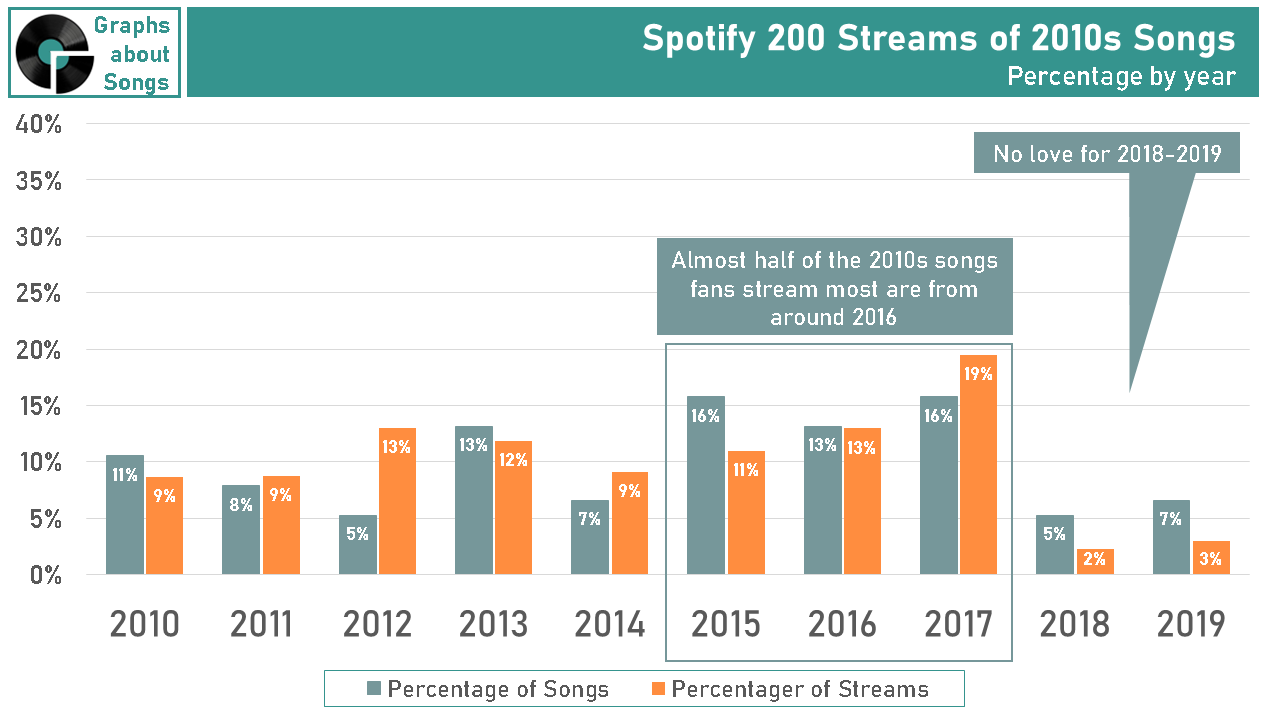
There’s also a lot of listening to the songs Gen Zers enjoyed around 2016. Some artists’ songs have surged thanks to 2016 nostalgia, such as The Weeknd, Fetty Wap, and The Chainsmokers. Other artists from the era, including Frank Ocean, Kendrick Lamar, and TV girl, have been perennial presences in the Spotify 200 for years. As you’ll see below, there’s no love for the last two years of the decade:
The 2010s song listeners have revived as a current hit is from an artist who currently has new music on Top 40 radio, where you’d typically hear her 2025 releases “Crush” or “Midnight Sun”. But the song from this artist that’s blowing up recently on Spotify is a 2015 song this artist has revived at her European concerts: Zara Larsson’s “Lush Life.”
Recently, a video of a fan on stage flawlessly performing the dance moves for “Lush Life” went viral. That moment launched the song back into the Top 10 globally and also taps into 2016 nostalgia. For the week ending March 12, 2026, fans streamed “Lush Life” 25% more often than “Midnight Sun,” her current hit your local Top 40 station is playing,
Want to stay on top of what the kids are digging these days?
If you’re a fellow chart nerd: Choose the “FREE” option to get Graphs About Songs’ directly in your inbox.
If you program a CHR station: “The Hit Momentum Newsletter” analyzes the Spotify 200 to find the songs that could be huge hits on your station. It’s yours every Monday for a $22 a month subscription below.
Date source for this post:
Spotify Charts (weeks of 1/3/2019 through 2/26/2026 for the USA): https://charts.spotify.com/charts/overview/us
