


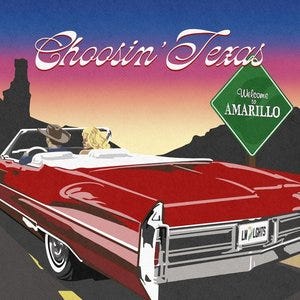
On February 14th, 2026, Ella Langley’s “Choosin’ Texas” was still exclusively on Country radio when it first reached #1 on the Billboard Hot 100 chart. By September 26th, when it broke the record for the most weeks at #1 for any song in Hot 100 history, “Choosin’ Texas” was a hit among Pop fans who never even listen to Country. It was even the official Song of the Summer for 2026.
Today’s country boom isn’t just Ella Langley.
The previous month, for the week ending August 8th, 2026, the Top 5 songs on the Billboard Hot 100 chart were all Country songs. That’s never happened in the chart’s entire 68-year history. Ella shared the top of the chart with Morgan Wallen, Stella Lefty, and Taylor Swift’s foray back into Country.
As I showcased in my previous Graphs About Songs, Country charting on the all-genre Hot 100 chart occurs in boomlets—and the current Country boomlet, which started in 2023, is bigger than all of them.
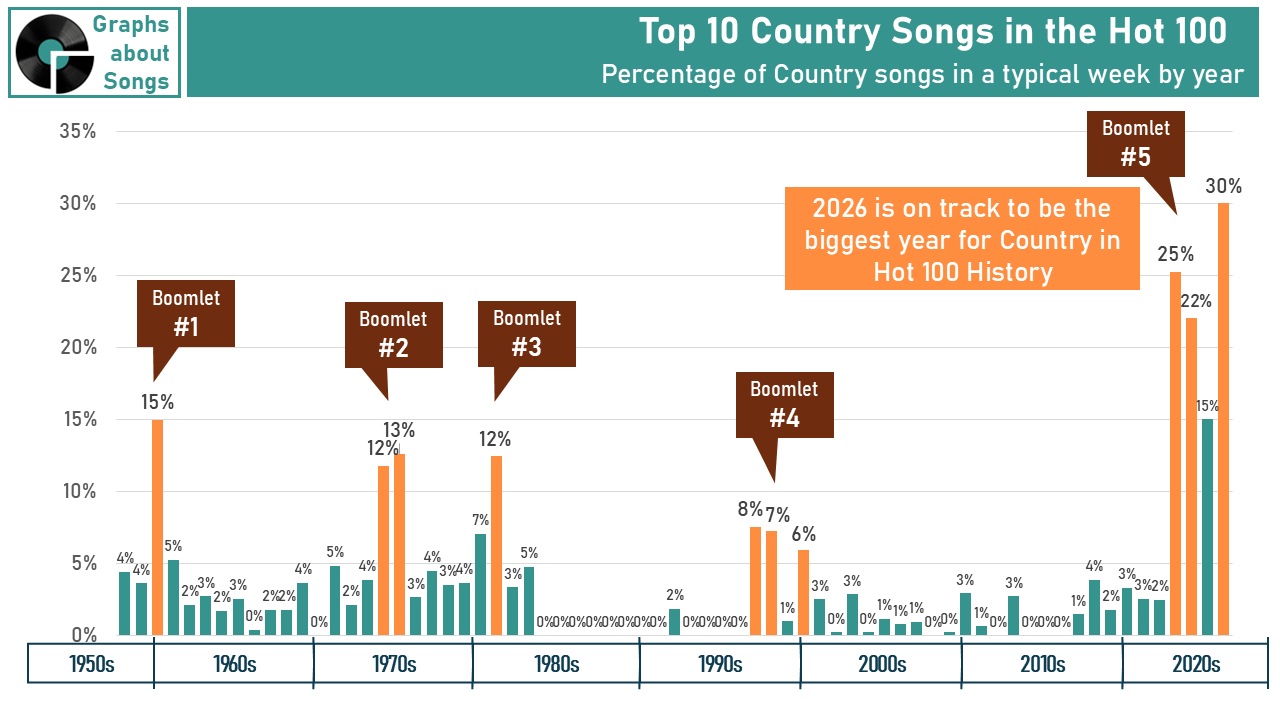
The current Country boomlet directly corresponds to Country fans finally embracing streaming. They were the last genre fanbase to do so, with Hip Hop fans shifting to streaming from paid downloads back around 2017 and Pop fans embracing streaming during the pandemic.
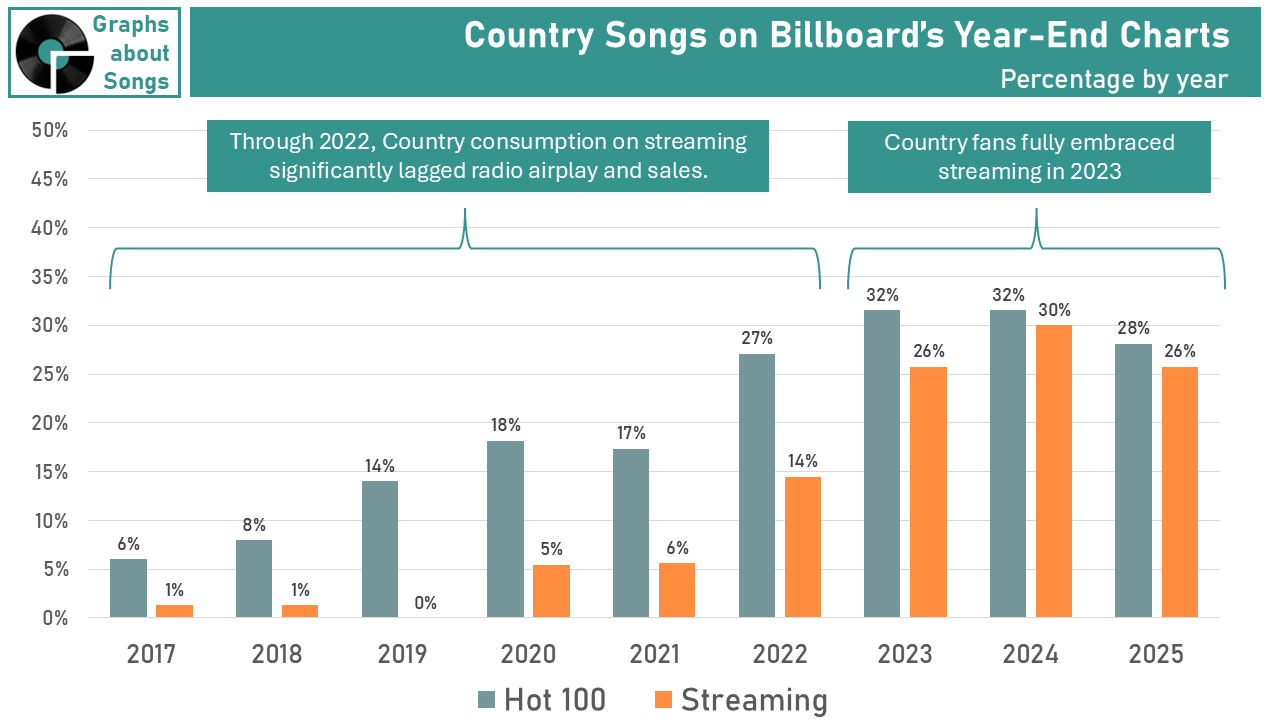
Streaming introduces a fundamentally different way of measuring music consumption: Instead of gauging how many individual fans like a song (as measured by purchasing a 45, a CD, or an iTune), streaming measures how many times someone plays a song.
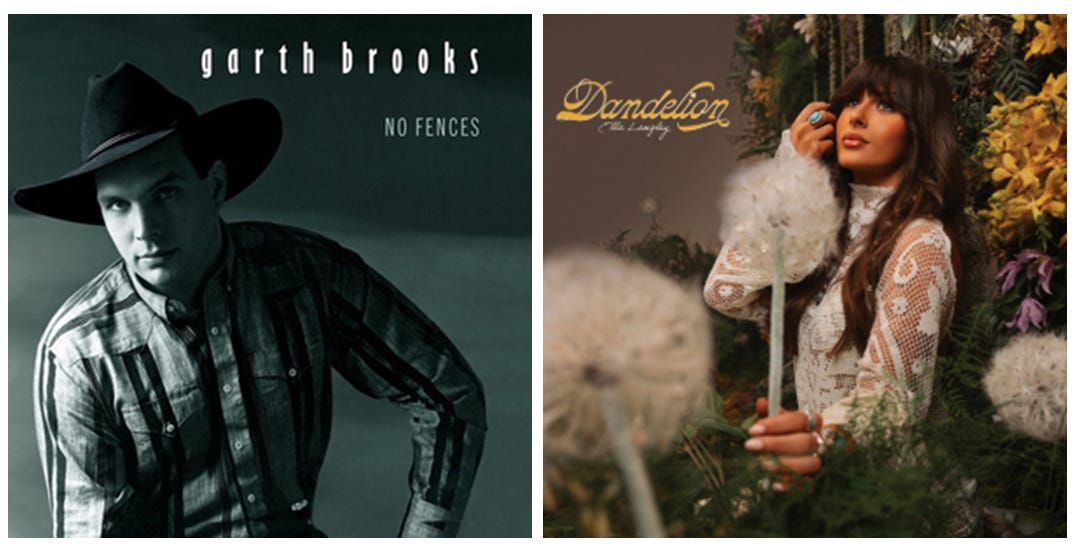
If you loved “Friends in Low Places,” your fandom only counted when you bought Garth Brooks’ No Fences CD, no matter how many years you kept playing it. When you stream Ella Langley today, every time you hit play is your vote for “Choosin’ Texas” on the Billboard charts.
That change from people to plays has changed Country’s trajectory on the charts in three ways.
Three ways Streaming has changed how we measure Country
1) Songs no longer need a presence on Pop radio—which means more Country songs are reaching the top rungs of the Hot 100.
for all past Country boomlets, Billboard only counted airplay from Top 40 Pop stations towards a song’s place on the Hot 100 Pop chart. No matter how many listeners tuned into Country radio, those spins on Country radio didn’t count. It was possible for a Country hit to reach the lower rungs of the Hot 100 based solely on its single song sales. For a song to reach the Top 10, such as Dolly Parton’s “9 to 5” or “Rhinestone Cowboy” from Glen Campbell it took Top 40 radio playing the song to take it to #1.
Billboard eliminated that rule in 1998, but it’s streaming that has truly leveled the playing field. As a genre-agnostic platform, if a song is big enough among Country partisans, it can make the Hot 100 without crossing over to Top 40 Pop radio.
The chart below shows how many individual Country songs reached the Billboard Hoit 100’s Top 10 each year, regardless of how long each song remained in the Top 10. You can clearly see how Country fans embracing streaming correlates with more Country songs in the Top 10 than ever before.
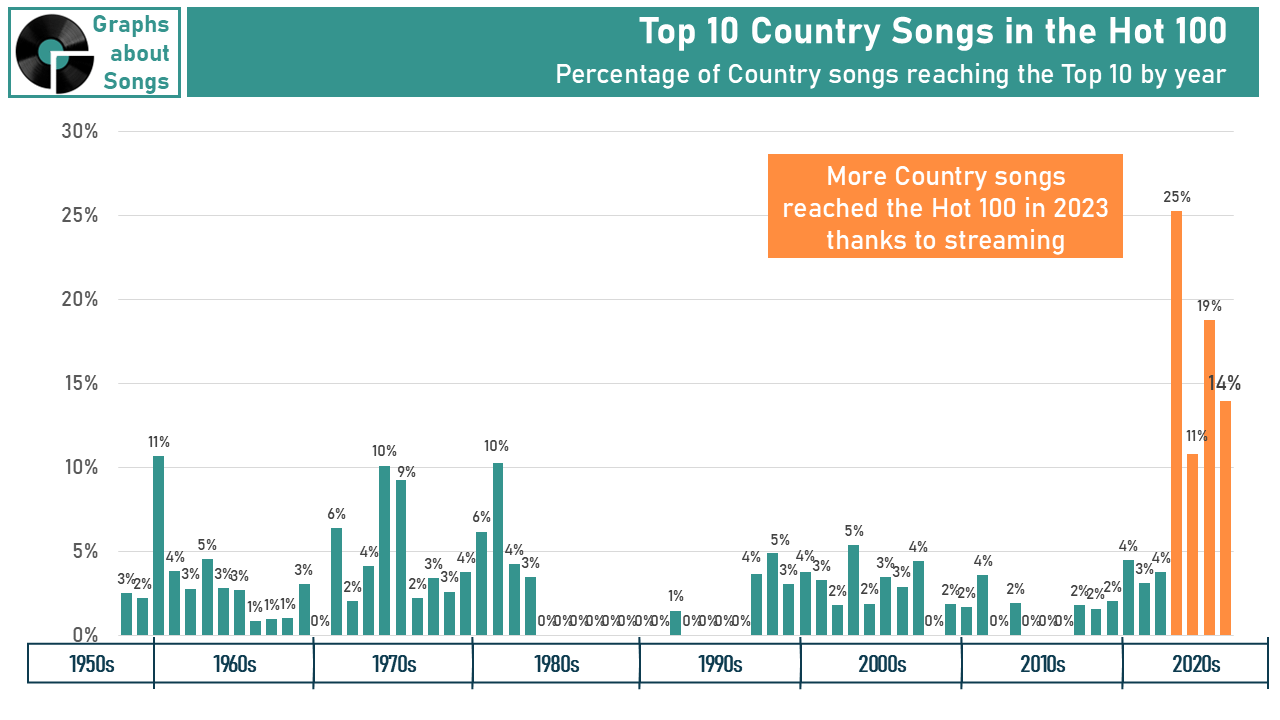
As we’ll see in #3, however, crossing over to the Pop fanbase can still make a big song massive.
2) Streaming rewards Country songs’ longevity on the Hot 100—because when fans keep playing a song, that song stays on the chart.
For most Pop fans, songs have a season. Even the biggest hits lose their luster after half a year or so. Country fans, however, simply don’t get sick of their favorite new songs the way Pop fans do.
Since streaming measures every time someone plays a song—including songs fans keep playing for months—the switch from measuring the moment someone buys a song to every time someone plays a song keeps the big Country hits on the charts much longer than the typical Pop hit.
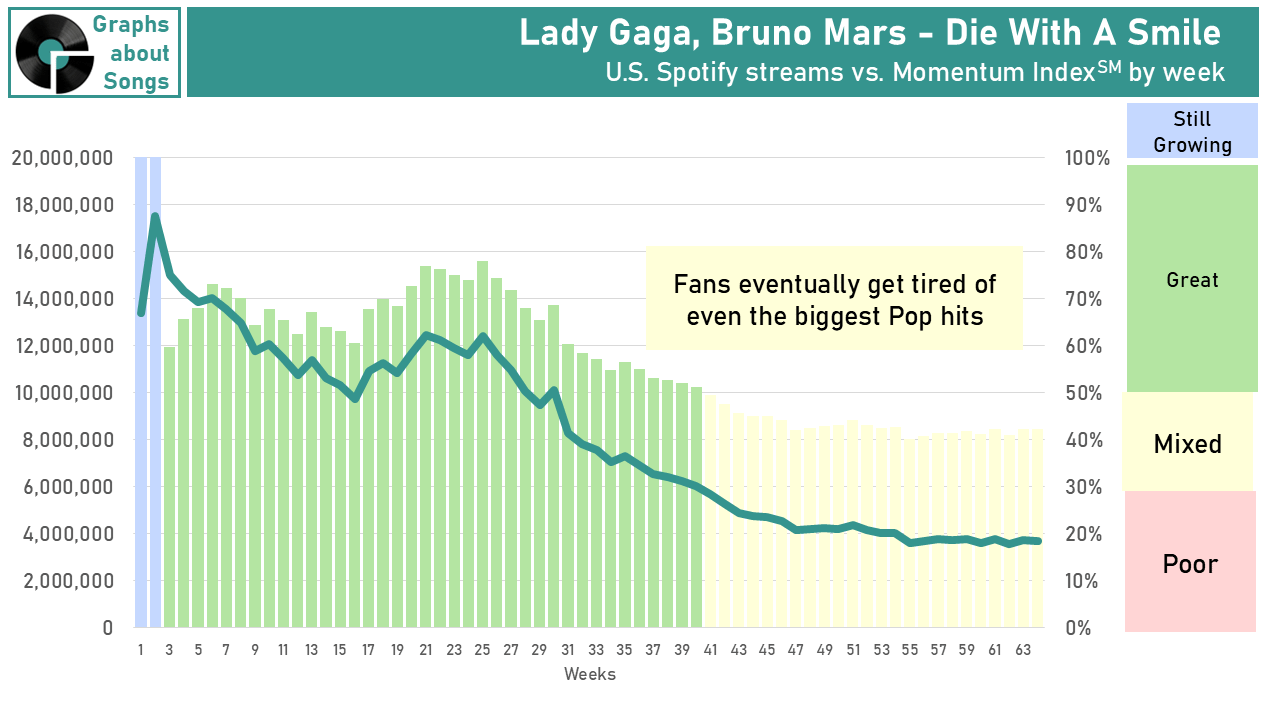
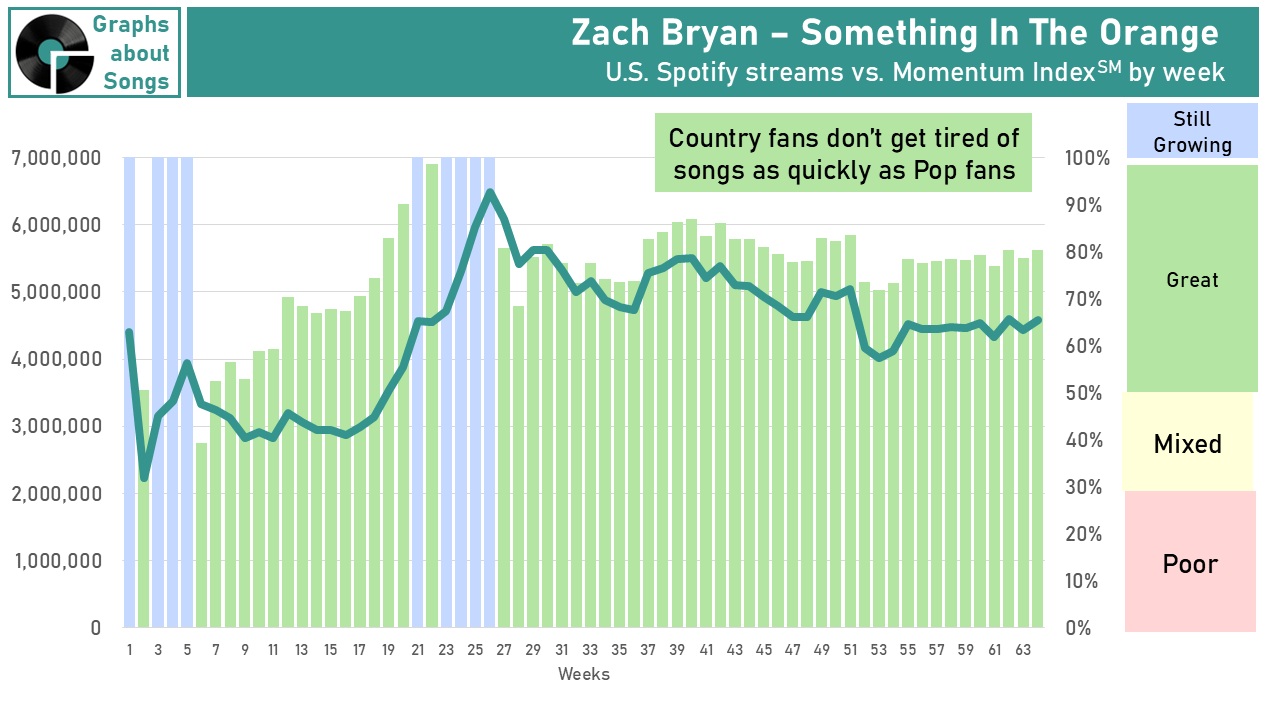
Consider the streaming patterns for “Die With A Smile,” a massive Pop ballad for Lady Gaga and Bruno Mars, compared to Zach Bryan’s “Something In The Orange,” one of the first Country songs to become a huge hit on streaming.
On the graphs below…
Spotify Streams: The green line is the number of Spotify streams the song received each week
Momentum IndexSM: The bars underneath the green line show the song’s Momentum Index, a proprietary algorithm I developed to calculate how a song’s streaming week to week compares to other proven, mass-appeal hits. For this example, simply know that
Light blue means new fans are still discovering the song
Green means the song is still a relevant hit
Yellow means fans are increasingly listening to the song less as they get tired of it.
“Die With A Smile” performs like a typical hugely popular, mass appeal ballad: After 40 weeks, fans began streaming the song less and less as they grow tired of it. They might still love the song, but they now think of it as last season’s hit:
In comparison, even after well over a year, fans weren’t getting sick of “Something In The Orange. They kept playing it at comparable levels week after week:
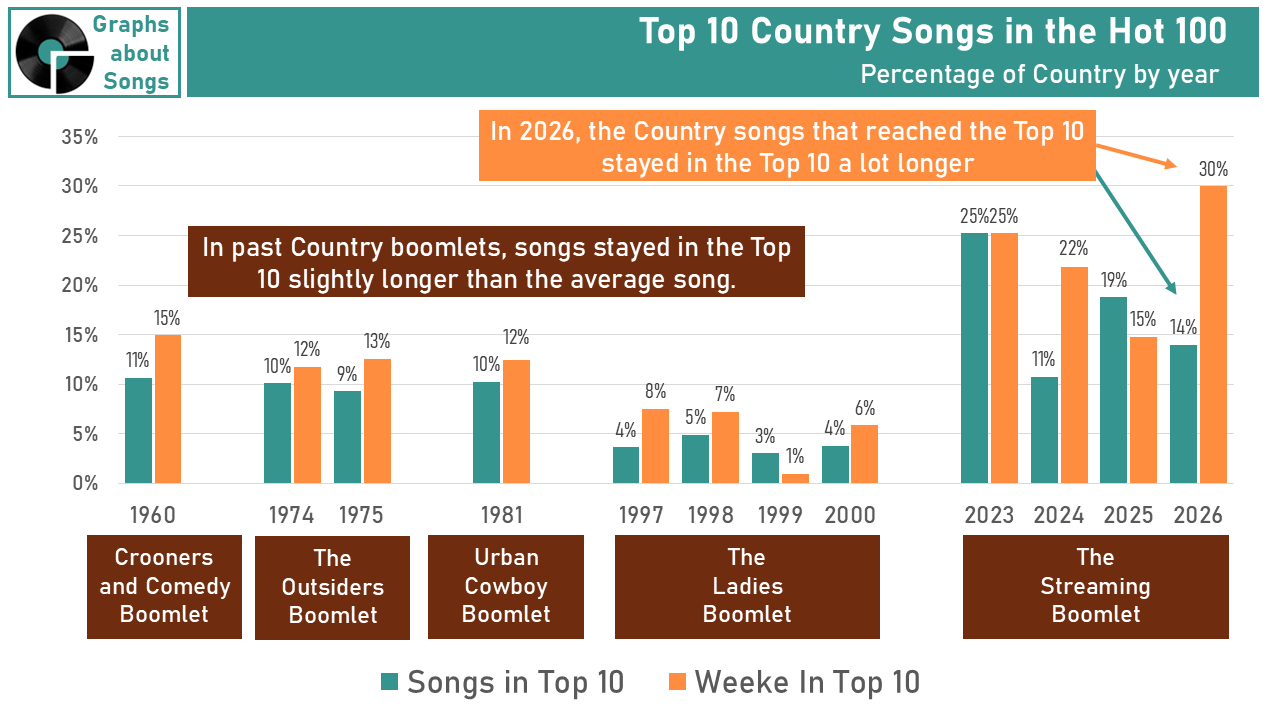
This longer lifespan for Country songs—which streaming is finally capturing—means that today’s biggest Country hits are spending an above average number of weeks in the Top 10.
3) When songs do cross over, they get two back-to-back chart runs.
In the past, songs were hits concurrently among Country and Pop partisans. In today’s streaming era, a song can go months as a Country-only hit before Pop fans embrace it.
That means Country songs that become Pop hits nowadays are essentially getting two consecutive chart runs—one as a Country hit, the second as a Pop hit.
Ella Langley’s “Choosin’ Texas” is a great example of a song that first enjoyed months of strong appeal among Country partisans before it crossed over to Pop
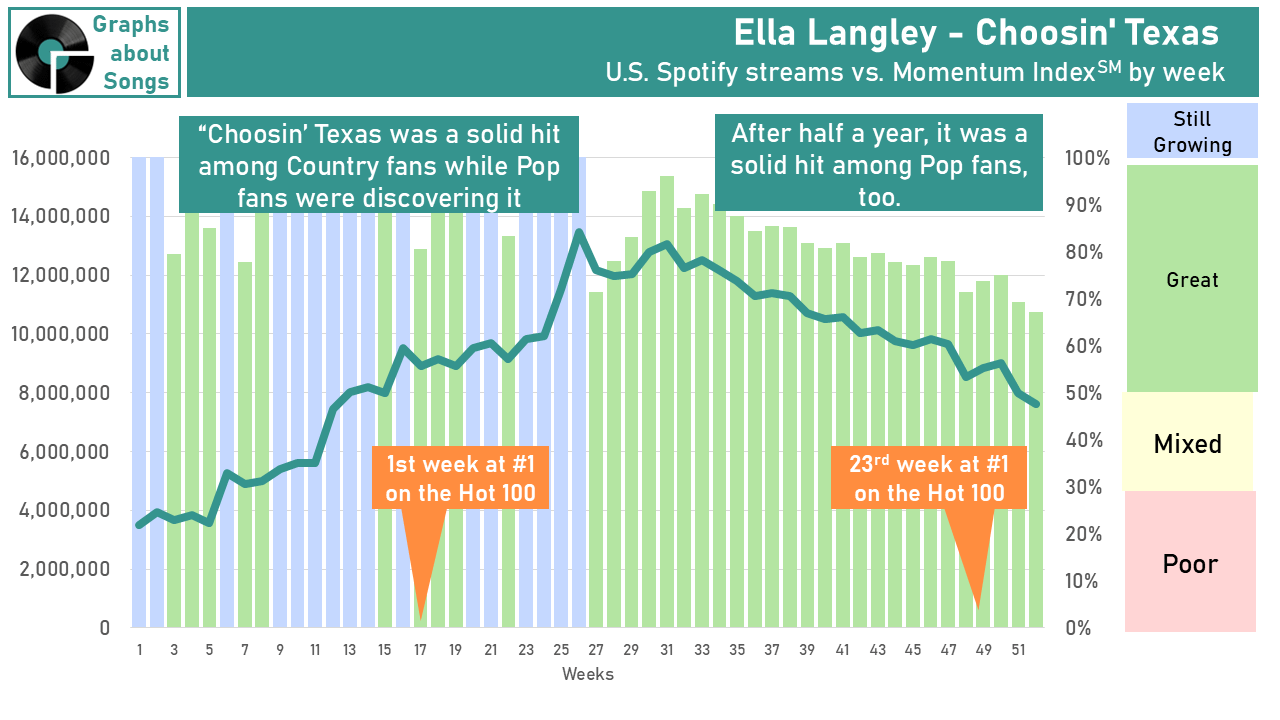
The Country songs that have stayed in the Top 10 the longest have also been Pop hits, including Shaboozy’s “A Bar song (Tipsy)” and “I Had Some Help” from Morgan Wallen, and of course, “Choosin’ Texas.”
Is Country really bigger than ever?
Country is most certainly having a great moment: As our last Graphs About Songs spotlighted, Country booms on the Pop chart when Pop music is in a downcycle and when Adults are overwhelmingly picking the hits. Is Country two-and-a-half times as popular in 2026 than it was at the height of the Urban Cowboy fad of the early 1980s? I’d argue no, not because Country’s appeal is overrepresented on today’s Hot 100, but because Country was underrepresented on yesterday’s Hot 100.
By measuring whenever fans play a song, the genre-agnostic Streaming data that comprise the bulk of the Hot 100 chart today is finally giving Country its fair share.

Data sources for this article:
Spotify 200 Chart for the USA: https://charts.spotify.com/charts/overview/us
The Billboard Hot 100: https://www.billboard.com/charts/hot-100
Wikipedia’s Billboard Hot 100 Top 10 singles: https://en.wikipedia.org/wiki/List_of_Billboard_Hot_100_top-ten_singles
Billboard’s 2025 year-end charts: Hot 100 Songs: https://www.billboard.com/charts/year-end/2025/hot-100-songs/
Billboard’s 2025 year-end charts: Streaming Songs (Top 75): https://www.billboard.com/charts/year-end/2025/streaming-songs/
(Data from previous years’ Billboard Year End charts archived)