


There really are only about 125 Christmas songs we truly love.
That’s true for radio stations playing all Christmas music, as veteran radio consultant and Christmas music expert Gary Berkowitz will tell you. That’s also true on streaming. At last count, about 125 different Christmas songs will receive enough plays to make the Spotify 200 chart during the holiday season.
And while those streaming-first Millennials and Generation Z listeners still want those classic Christmas songs from the 1940s, 1950s, and 1960s, there are some staples of Christmases past that in today’s streaming era no longer make the cut.
You may still hear these songs on the radio, but none of them have appeared among the most popular Christmas songs on the Spotify 200 chart during this decade.
There are comedy songs that today’s audiences don’t find funny.
There are religious songs that no longer inspire.
There are songs that simply weren’t popular enough to stick around.
Let’s bid a fond farewell—or a good riddance---to these 12 Christmas classics that younger generations in the streaming era have rejected:
1) Allan Sherman “The Twelve Gifts of Christmas”
He was Weird Al before Weird Al. He wrote and produced television shows, invented game shows, but was most famous for his 1960s parody songs. In December 1963, his take on the Twelve Days of Christmas mocked the clichéd and chintzy gifts you might receive as a holiday bonus for making mid-south regional assistant sales manager of the year—most notably—a Japanese transistor radio. (The transistor radio was the most popular Christmas gift of 1963 and arguably helped fuel Beatlemania.) While a quality Japanese transistor radio cost over $400 in today’s dough, Mr. Sherman got, “the one that’s discontinued” with a broken earphone.
Like many parodies, “The Twelve Gifts of Christmas” is inseparable from its time. “A calendar book” from your “insurance man” hasn’t been a thing during Millennials’ lifetimes.
(NPR remembered his work and his rapid downfall in Allan Sherman: Beyond ‘Hello Muddah, Hello Fadduh’)
2) Elmo & Patsy “Grandma Got Run Over By A Reindeer”
Dr. Elmo Shropshire is a veterinarian in California who once treated racehorses at Aqueduct and Belmont Park, but it’s his hobby reflecting his childhood in Kentucky that made him famous.
In his spare time, he performed Country and Bluegrass songs alongside his former wife Patsy Trigg. Randy Brook wrote one of those songs, about a pedestrian death. They (or as Elmo now claims “he”) recorded the song in 1979, re-recorded the version we hear now in 1982, and along with his soon to be next wife Pam Wendell, promoted the song heavily Dr. Elmo even performed in drag as the song’s victimized Grandma. (Would that get Emo arrested in Tennessee?)
“Ubiquitous for decades, it’s long been among the most loved and most hated Christmas songs. Whether its hate or irrelevance that has finally exceeded its appeal, Elmo & Patsy’s “Grandma Got Run Over By A Reindeer” has finally followed Grandma to the grave.
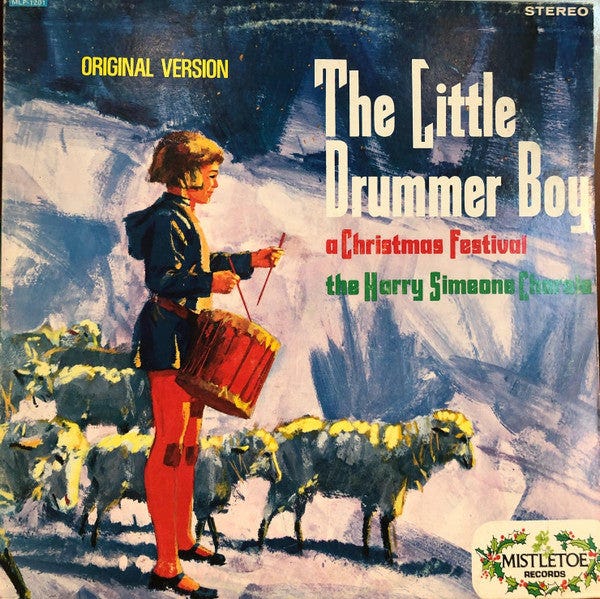
3) The Harry Simeone Chorale “The Little Drummer Boy”
For a time in the late 1950s and early 1960s, there was a subgenre of popular music amongst adults featuring large choirs performing easy-listening renditions of popular favorites. One of those groups is most famous for making a specific Christmas song famous.
Simeone had classical and pop credentials—he dropped out of the Julliard School of Music to work in radio and film. However, Simeone pretty much ripped off an existing recording of the song by Jack Halloran, including hiring the same singers, and changed the official song title from “Carol Of The Drum.” Unlike Halloran, Simeone released his version as a single—and it became an instant hit.
After decades as a must-play Christmas title, The Harry Simeone Chorale rendition of “Little Drummer Boy” is absent from the streaming era Christmas canon. That’s partly due to a steep decline in religious Christmas songs. Streaming-first listeners prefer Santa and Snow.
It’s also because “The Little Drummer Boy” is the only Harry Simeone Chorale that ultimately stuck. The popular version on Spotify is now by Bing Crosby, who along with Nat King Cole, Frank Sinarta, and Michael Bublé, is a core Christmas artist with the coattails to have the “hit” version of several Christmas classics in the streaming era, usurping other artists.
4) The Ray Conniff Singers “The Twelve Days of Christmas”
Unlike Harry Simeone, whose legacy remains one specific song, The Ray Conniff’s singers tendered many Christmas songs, several of which you’ll still hear on the radio today. Also unlike Mr. Simeone’s chorale, The Ray Conniff Singers had many Adult Contemporary hits throughout the 1960s with easy-listening remakes of popular songs, from “Somewhere My Love” to “Sounds of Silence.” More upbeat than elevator music, The Ray Conniff Singers were better labeled “supermarket music” long before Maroon 5 got that role.
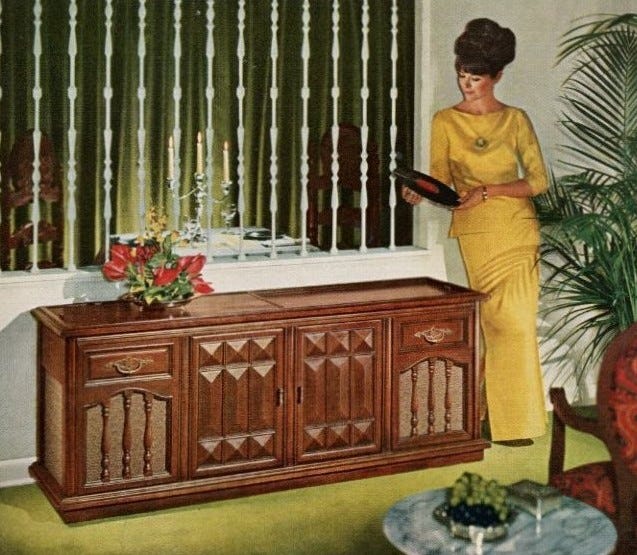
They were particularly successful with their albums in a time when the LP was the province of well-heeled adults. Thirty (30) of their albums made the Billboard Hot 200 album chart from 1958 through 1973, adorning many grown ups’ wood cabinet stereos…
Their rendition of “The Twelve Days of Christmas,” with the gifts doing their thing “daily” and “gayly,” is their most enduring recording—but it’s not made the leap to streaming. This 1965 TV Christmas special with Ray Conniff conducting his greatest Christmas hits, is a Mad Men era gem
5) Mannheim Steamroller “Deck the Halls”
While 1960s sophisticates embraced classical-styled choirs not good enough for a Classical station, 1980s’ yuppies embraced new-age Jazz not good enough for a Jazz station. From the Pat Metheny Group and the Yellowjackets to David Sanborn and Kenny G., the classy adults were into music that had the vibes of the previous decade’s experimental jazz and electronic music, but with familiarity and smoothness that made it mass appeal. By the 1990s, it would devolve into Smooth Jazz.
Meanwhile, music producer Chip Davis was a fan of a musical technique developed in Germany wherein the entire orchestra would create a slowly developing crescendo with a melody that rose in pitch while the baseline remains constant. The Mannheim School’s “roller” effect because his alias: Mannheim Steamroller. Creating new-age Jazz since the mid-1970s, Mannheim Steamroller’s breakthrough came with the 1984 Mannheim Steamroller Christmas album.
By the late 1980s, Mannheim Steamrollers’ modern take on Christmas carols was de rigor as bumper music for local TV news and radio talk shows. Rush Limbaugh was famously a fan.
Today, you won’t find Mannheim Steamroller among the most played Christmas songs on Spotify, but the Trans-Siberian Orchestra still makes the cut.
(What was Chip Davis’ other major contribution to popular music? Did you have a country novelty song based on a mascot for a bakery about the 1970s CB radio fad on your bingo card? Yep—-Chip produced “Convoy.”)
6) NewSong “Christmas Shoes”
For a moment around Y2K, contemporary Christian music made serious inroads into secular culture. This wasn’t merely Amy Grant recording a Pop album. Openly Christian Rock acts Creed and Lifehouse had #1 hits with songs that could be about their girlfriends or Jesus. Bob Carlile’s “Butterfly Kisses” (1997), MercyMe’s “I Can Only Imagine” (2001), and Los Lonely Boys’ “Heaven” (2004), with overtly religious lyrics, all were massive hits on secular Adult Contemporary radio.
In the middle of this good time for God came a song with everything: A dying mother, a little boy, poverty, a busy grown up who lost sight of Christmas, and—of course—Jesus. Sure, some love it. Others despise it as poverty porn.
Ironically, the harshest critics of “Christmas Shoes” are theologians: As Isabelle Senechal noted in “These are the worst (religious) Christmas songs of all time”.
God purposefully made this boy’s mother sick and sent him to the same department store that the narrator was in so that the narrator could learn to just cheer up a little during the holiday season. I’m sorry, but that is 100 percent the worst way to contextualize suffering or helping others.
Whether they’re rejecting it because of the schlock, not listening because of a general shift away from religious Christmas songs, or simply because it never was quite big enough to join the seasonal canon in the first place, “Christmas Shoes” has faded like the shoe department at Sears.
7`) Kenny Rogers and Wynonna Judd “Mary, Did You Know”
Theologians also take umbrage with this one: According to Luke, Mary was most definitely debriefed on the nature of her pregnancy. Then there are the Catholic theologians who believe Mary is immaculately sin-free and in no need of deliverance from the child she will deliver. Some simply find it rude to mansplain to Jesus’ mom.
Mark Lowry, the song’s author and longtime member of Southern Gospel’s preeminent Gaither Vocal Band, deserves some creative license.
Lots of artists have recorded it, particularly Country artists during the 1990s. Kathy Mateea first had a hit with it, while Kenny Rogers and Wynonna Judd had the most enduring rendition.
Today, the only version that still makes the Spotify 200 today is from Pentatonix
8) Alabama “Christmas in Dixie”
Name-check a bunch of cities, wish them all Merry Christmas on behalf of the Southeastern United States, and have a song that remains a staple on both Country and Pop radio for decades.
When you’re among the biggest country groups of the 1980s—and when your voice is as pleasant as is Alabama’s Randy Owen—you can get away with it.
I always chuckled when they sang of Motown, “the city’s on the move.” Yeah, they were moving to Ferndale, Royal Oak, Bloomington Hills…
For radio programmers who can’t afford callout, or who simply want a more complete picture of the hits..

9) The Waitresses “Christmas Wrapping”
Your struggling new wave band is in the middle of a tour when your record label decides it wants all its artists to contribute a song to a Christmas album. You’re exhausted. It’s August. You don’t have time for this crap.
So producer Chris Butler throws together some leftover riffs and writes lyrics in the cab on the way to the recording session. Inspired by the emerging Hip Hop scene generally and Kurtis Blow’s “Christmas Rappin’” specifically, he crafts a song from his own feelings of finding the season a time-sucking pain in the ass.
That’s exactly the irony that made Xers love it.
Not only did that waste of time become a hit, it rejuvenated the rest of their tour, as fans eagerly awaited Christmas Wrapping far more than their previously biggest song, “I Know What Boys Like.”
Arguably, it’s the most Generation X song of the Christmas canon. Unfortunately, those same Millennials who took away our double spaces are taking “Christmas Wrapping” as well.
(Is it just me, or is the line “you forgot cranberries too?” really just code for condoms? I mean they did have a “very happy ending.”)
10) Dan Fogelberg – Same Old Lang Syne
Continuing our theme of chance encounters in supermarkets, Dan’s real-life tale of bumping into his ex on Christmas Eve has been a part of radio’s Christmas playlist ever since---but it’s not a part of the streaming era’s Christmas canon.
Perhaps that’s because Dan Fogelberg’s four Top 10 hits—and 12 Top 10 songs on the Adult Contemporary chart—are now largely forgotten.
11) Percy Faith “We Need A Little Christmas”
The 1966 hit Broadway musical Mame, starring Angela Lansbury and Bea Arthur, spawned this song. It’s the wealthy protagonist’s response to being plunged into poverty after the 1929 Wall Street crash.
Percy Faith’s rendition of the song was among his orchestra’s jauntier hits. His biggest, including 1953’s “Theme from Moulin Rouge,” and 1960’s “Theme from A Summer Place,” were elevator music staples. (“Theme From A Summer Place” set a record at the time of nine weeks at #1 and ultimately became Billboard’s Song of the Year for 1960).
12) John Denver and the Muppets “The Twelve Days of Christmas”
At the height of their fame with kids and grown-ups in 1979, Kermit, Miss Piggy and the gang teamed up with John Denver for a Christmas special on ABC-TV.
They never aired it again, but the soundtrack album has been reissued multiple times on CD.
The song you’ve most likely heard on the radio is The Twelve Days of Christmas, complete with Ms. Piggy’s “ba-dum-bum-bum!” As painful as it is for us Gen Xers (I myself owned this album as a Kindergartner), the Muppets simply aren’t a thing for younger generations.
Thank you for being a part of Graphs About Songs this year! Your readership is one of those blessings I’ll be counting this holiday season!
Graphs About Songs will return in January with a look at how streaming and radio are increasingly living in alternate hit universes. Subscribe below with the FREE option to get it in your inbox.
In the meantime, are there any once ubiquitous Christmas classics you’re no longer hearing? Feel free to add them in the comments below.
FREE updates on Christmas Music Streaming.
What Christmas songs are Americans streaming most each week? I’m now chronicling weekly Christmas music streaming in The Hit Momentum Report, my streaming analysis for Pop music programmers. While the report itself is #22/month, you can access the Christmas music portion of the report each week for FREE.
Click here to see the most recent reports.
Data source for this post: Spotify Charts (2019-2025 for the USA): https://charts.spotify.com/charts/overview/us
Another topic of Christmas music are Christmas songs about very dark things and Please Daddy... Is one of those songs as he is telling his father to not get drunk on Christmas although it is a drinking song, Woody Guthrie's 1913 Massacre, and also John Prine's Christmas In Prison.
Another song that has become a country music Christmas standard is Tennessee Christmas, co-written and first recorded by Amy Grant in 1983, now every country artist covers it.
Also, John Denver put out Please Daddy Don't Get Drunk This Christmas in 1973 as a single from his Farewell Andromeda album which didn't do well as a single, but the version that's become the standard airplay throughout the 70s otherwise is the 1975 re-recording from his Rocky Mountain Christmas album.