


This post is the first in a series examining Billboard’s 2025 Songs of the Year charts
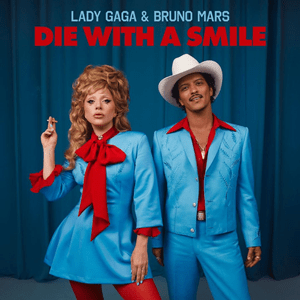
Lady Gaga & Bruno Mars’ love ballad “Die With A Smile” is the biggest song of 2025, according to Billboard’s highly anticipated Year-End Hot 100 singles chart.
Curiously, it’s not a 2025 song.
Released in September 2024, “Die With A Smile” only reached #67 on Billboard’s 2024 Song of the Year list, based predominantly on immediately becoming a hit on streaming. However, it received so many plays on both Pop radio stations and on streaming services during the beginning of the 2025 chart year to place #1.
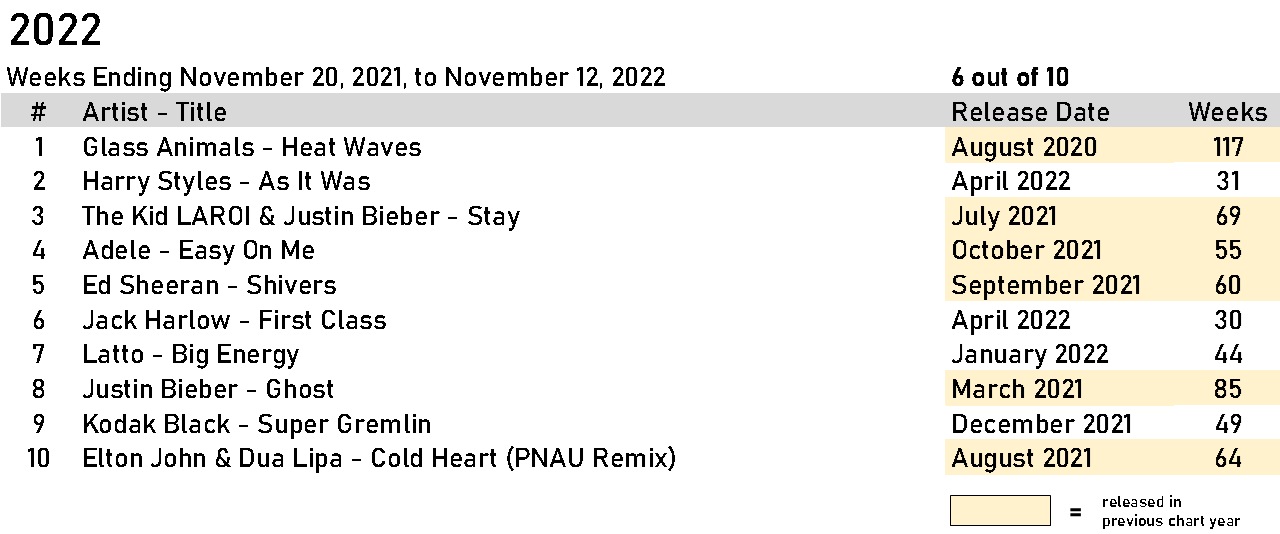
It’s not unprecedented for Billboard’s Song of the Year to actually be from the previous year. In 2022, Billboard’s overall #1, Glass Animals’ “Heat Waves,” was actually released in 2020. The fact is, most songs take some time to find all their fans.
What is unprecedented in 2025 is the sheer number of songs which were actually from 2024—and even 2023.
Only one of 2025’s Top 10 songs—Alex Warren’s “Ordinary”—was actually released in 2025. And it was released way back in February.
Let’s journey together from the end of the iTunes rea through today to see how the vintage of songs has changed in recent years—and why 2025 starkly stands out.
How old were 2025’s biggest hits?
The typical vintage of all of the Top 100 songs of the year during the past six years grew about two months older from 2019 through 2022. Among the 10 most popular songs of the year, it’s a different story.
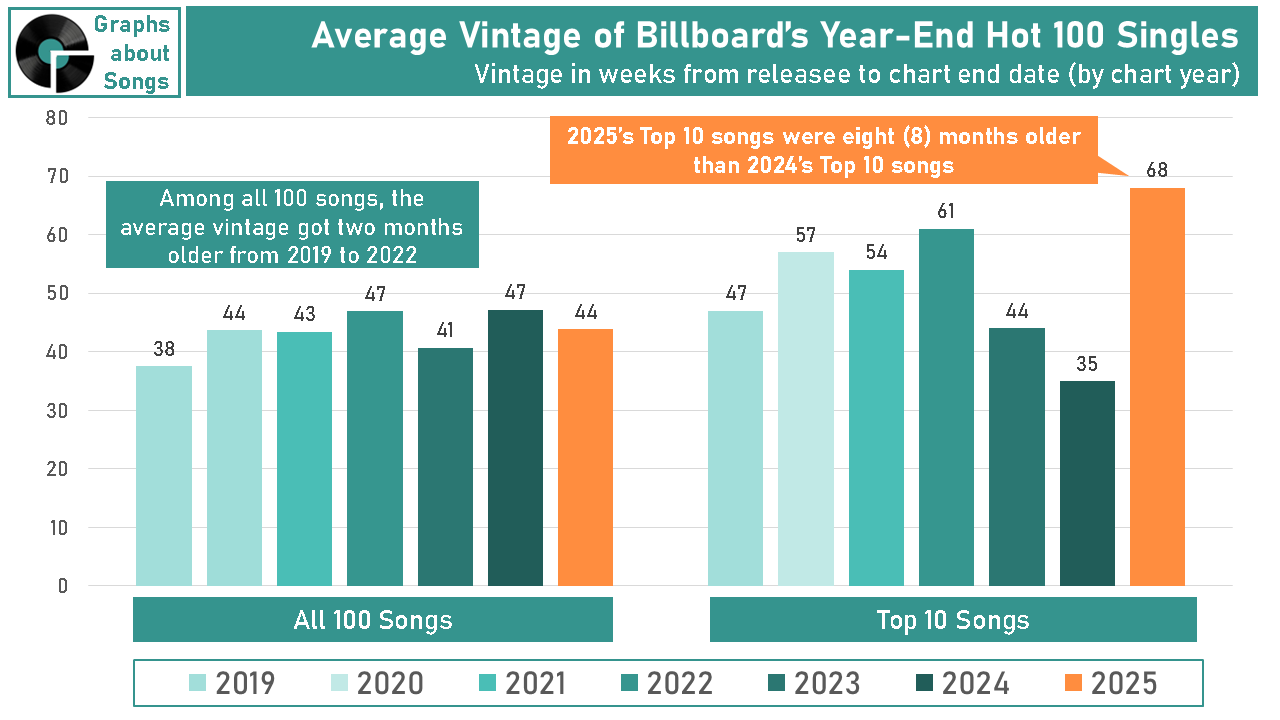
From 2019 through 2022, the Top 10 songs were generally about two months older than the overall Top 100. That makes sense, since those songs not only were bigger hits overall, but they also had a head start during the chart year.
In 2024, however, the Top 10 songs were actually three months NEWER than the overall top 100 songs.
Then in 2025, the Top 10 songs grew to be over five months older than the overall Top 100 songs. Furthermore, 2025’s 10 biggest songs were eight (8) months older than 2025’s overall Top 100 songs
What happened?
About the Billboard year end charts (or What Taylor Swift knows that you don’t)
Billboard uses the same data from its weekly Hot 100 Songs chart to compile its list of the year’s biggest tunes, specifically each singles’ sales for both physical and digital copies, its radio airplay audience, and how often people stream it. While Billboard treats its exact formula as if it’s Coca-Cola, they strive to create an accurate ranking of a song’s total consumption across all media.
Nowadays, that means it predominantly reflects streaming.
You’ll notice I say “chart year” a lot here. That’s because Billboard’s Year End Charts don’t actually reflect the calendar year. Traditionally, it included consumption through Thanksgiving week in November, so that they could compile and share results in Billboard Magazine’s last print edition of the year.
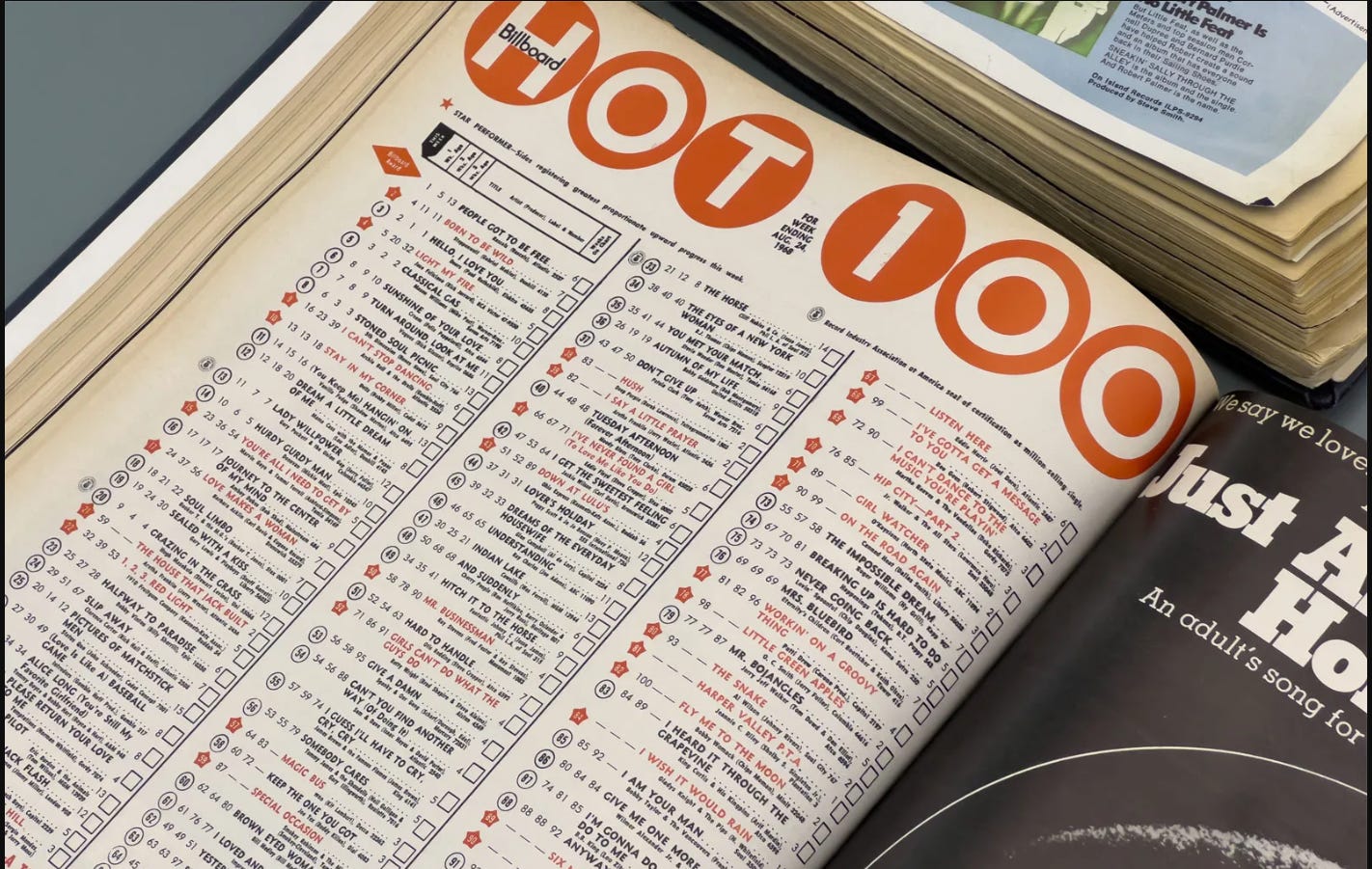
In 2023, however, the cutoff shifted to October. That means consumption during the end of the year actually counts towards the following year’s rankings. When examining my charts, remember:
The “Chart Year” is the dates of data covered by that year’s chart, not the calendar year (which is January 1st through December 31st).
The “Vintage” for each song I reference is how many weeks’ differences there is between the single’s official release date* and the last day covered by that year’s chart. (*Starting in 2019, I also examined each song’s first date appearing in the Spotify 200 chart for all major hits to determine if a song became widely familiar significantly later than its release. If it did, I used that first in the Spotify 200 chart date instead.)
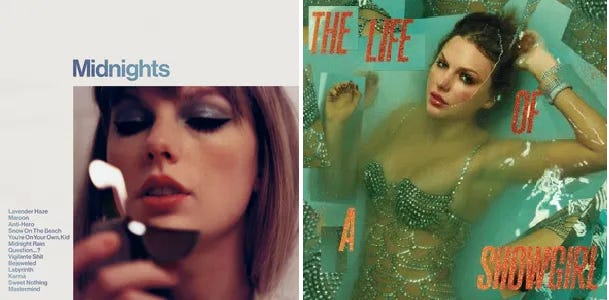
Ever wonder why Taylor Swift drops so many big albums in October?
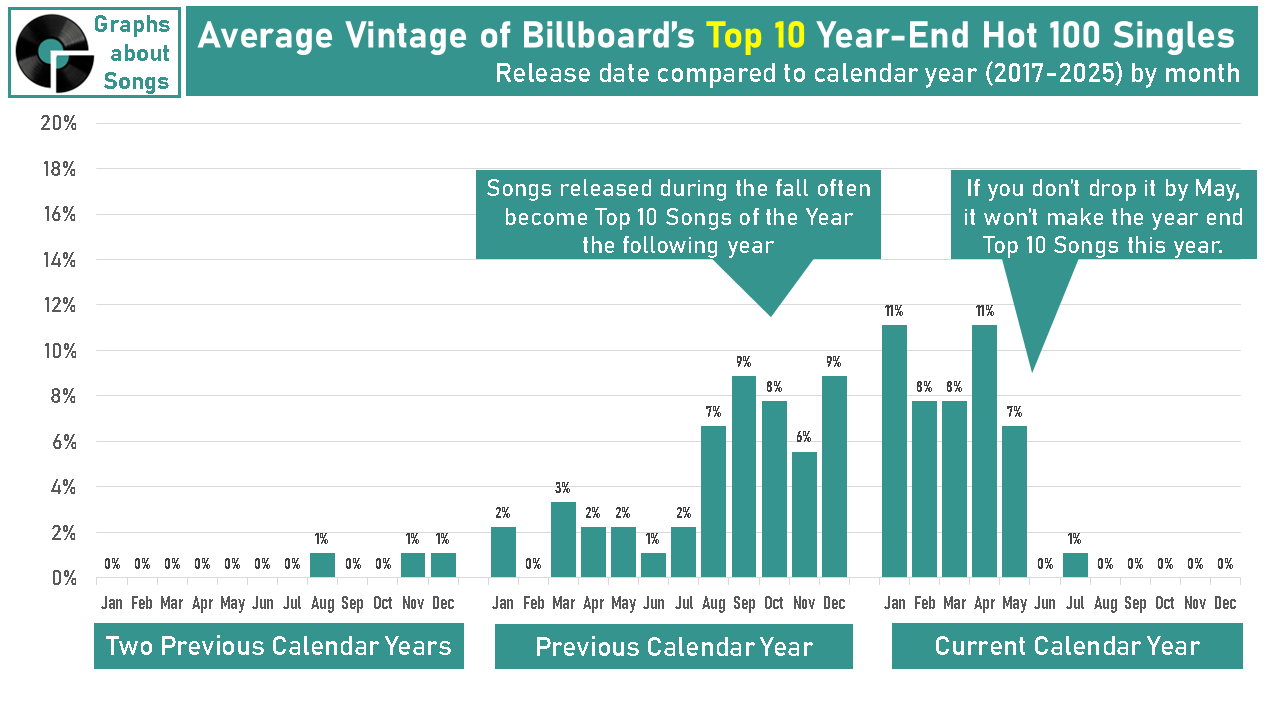
Billboard doesn’t roll over consumption points from year to year, so if a song’s popularity is split evenly between two chart years, a massive hit could fail to make the year end’s best for either year. That’s also why songs from earlier in the year tend to be the #1 song of the year: they mathematically have more time to rack up airplay and streams.
Swift is a genius of leveraging music consumption metrics to bolster her chart records and her bank account. By dropping albums such as “Midnights” and “The Life of a Showgirl” in October, they will hit their stride right at the beginning of a new chart year.
How Streaming and COVID changed Billboard’s Top 10 Songs of The Year
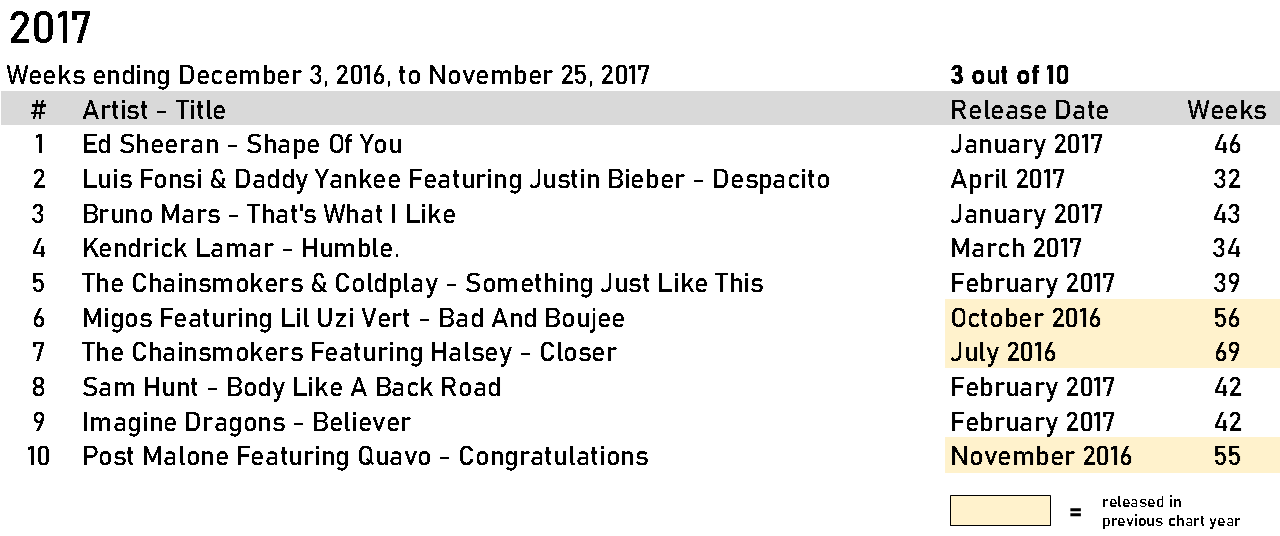
2017 was the last year that paid digital downloads such as iTunes had a greater impact than did streaming. That year, three (3) of the Top 10 songs were from the 2016 chart year.
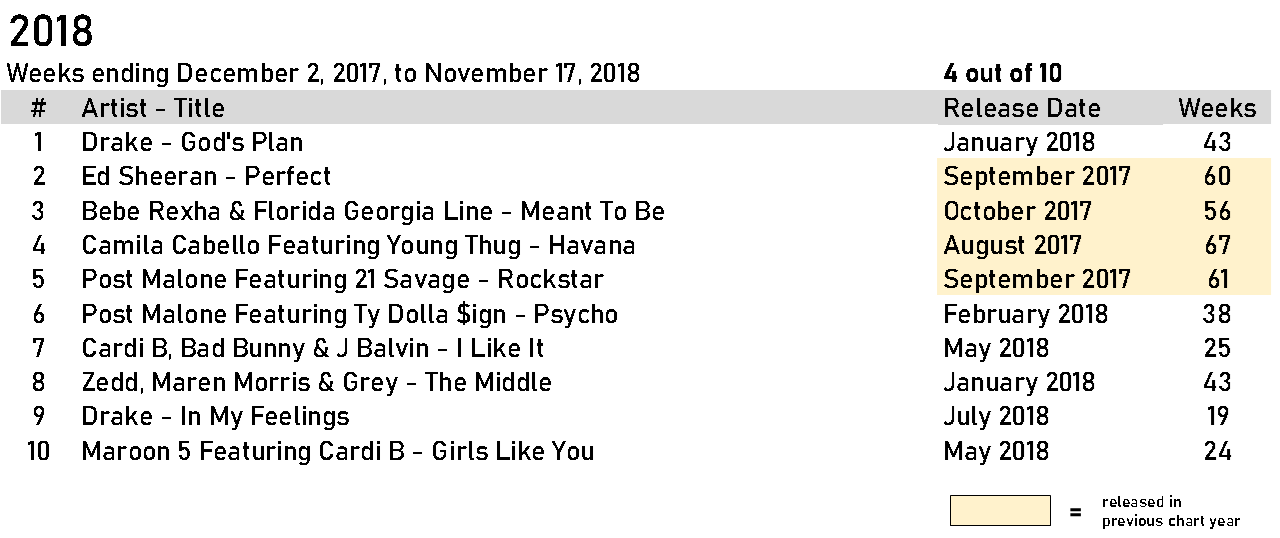
In 2018, the Hot 100’s streaming era began. Drake’s “God’s Plan,” was only #7 in radio airplay, but its massive streaming made it 2018’s #1 song of the year. Four (4) of the Top 10 songs of 2018 were holdovers from 2017’s chart year.
In that last year of the Before Times, Lil Nas X featuring Billy Ray Cyrus ‘
Old Town Road,” was a milestone. While radio was late to play it, that delayed airplay that kicked in when streaming began waning kept the song #1 for a then record 19 weeks.

It was massive streaming that made it the song of the year, however. “Old Town Road” was only #20 in radio airplay for the year. Just as the previous year, four (4) of the Top 10 songs of 2019 were from 2018.
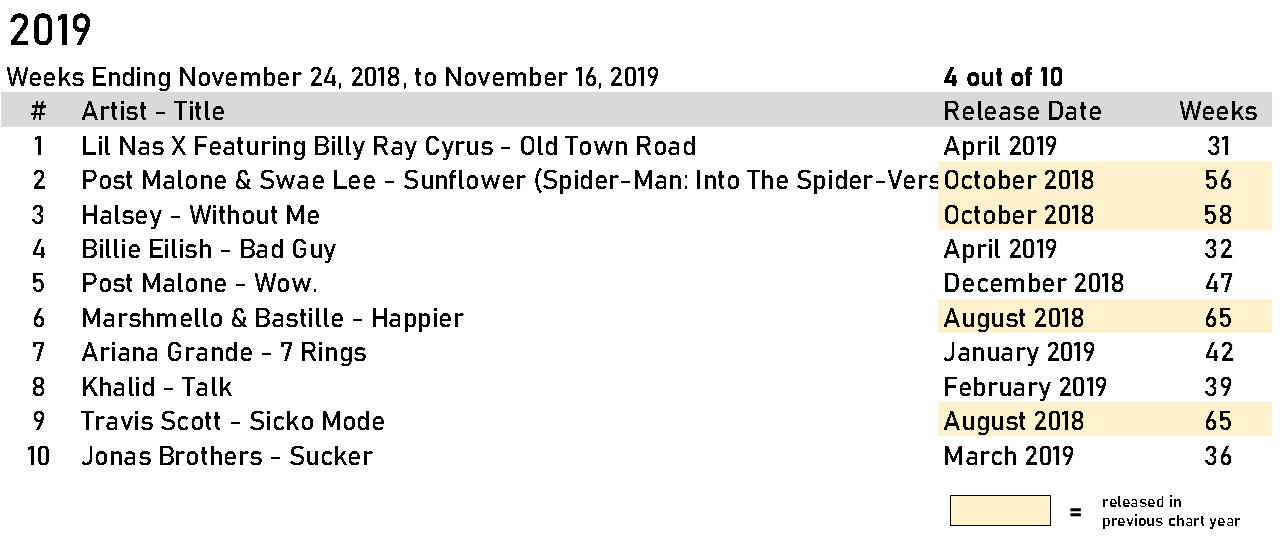
2020 was a terrible year for the music industry. With touring largely impossible, labels hesitated to release new material and struggled to promote what they did release. While most of the year’s Top 10 hits dropped before U.S. lockdowns, only five (5) out of 10 were from the 2019 chart year.
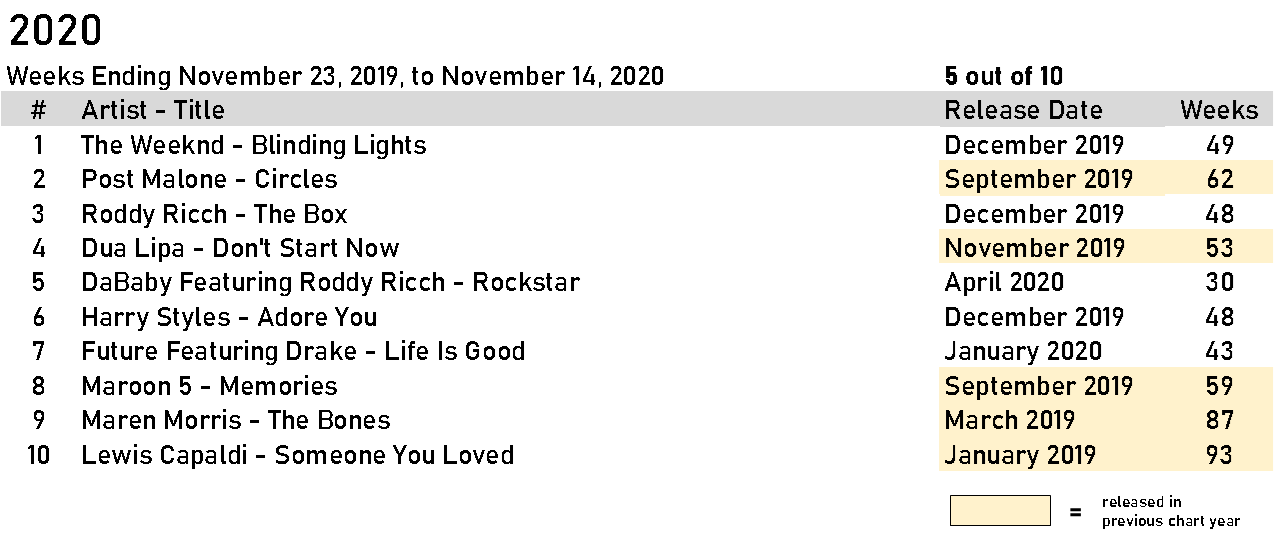
As things reopened, the #1 song of 2020 that defined the pandemic remained so popular, it repeated in 2021: The Weeknd’s “Blinding Lights” was still #4 in radio airplay and #7 in streaming, which somehow made it #3. At 101 weeks, it’s the oldest song so far in the Year End Top 10—but hold our beer…
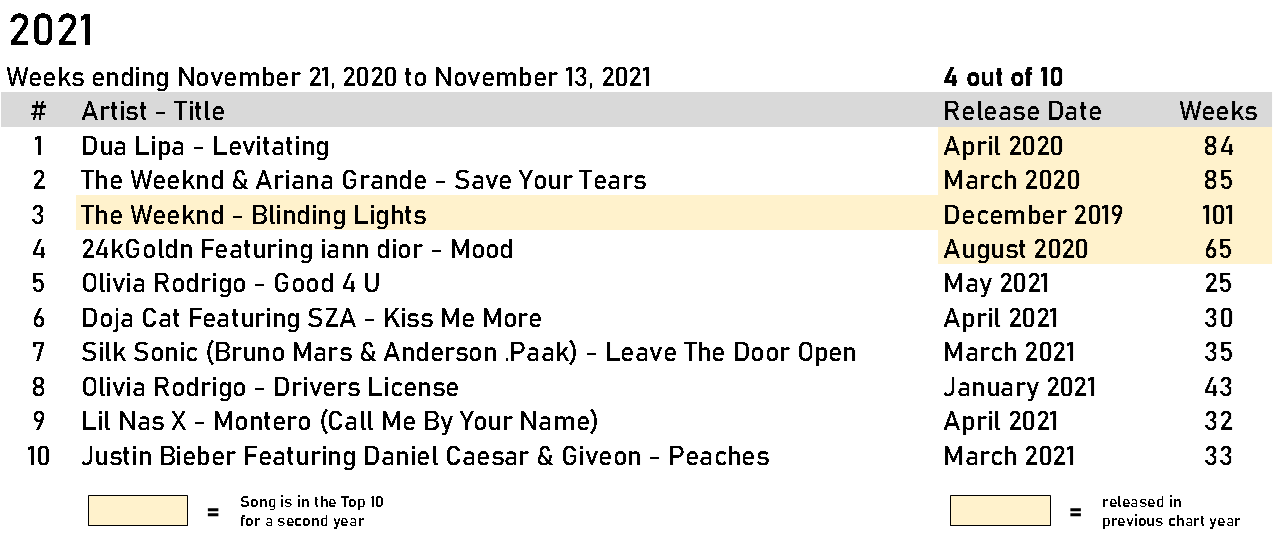
This year, six (6) out of the Top 10 songs were from a previous chart year and the #1 song was even older than “Blinding Lights.” Glass Animals “Heat Waves” first gained popularity among Alternative fans. Only many months later did it become a hit among mainstream Pop fans and—ultimately—become Song Of The Year two years after its release.
What? Only two (2) holdovers from the 2022 chart year among 2023’s Top 10 hits? 2023 marked a rare year when the Top 10 tunes were actually newer than the overall top 100 of the year.
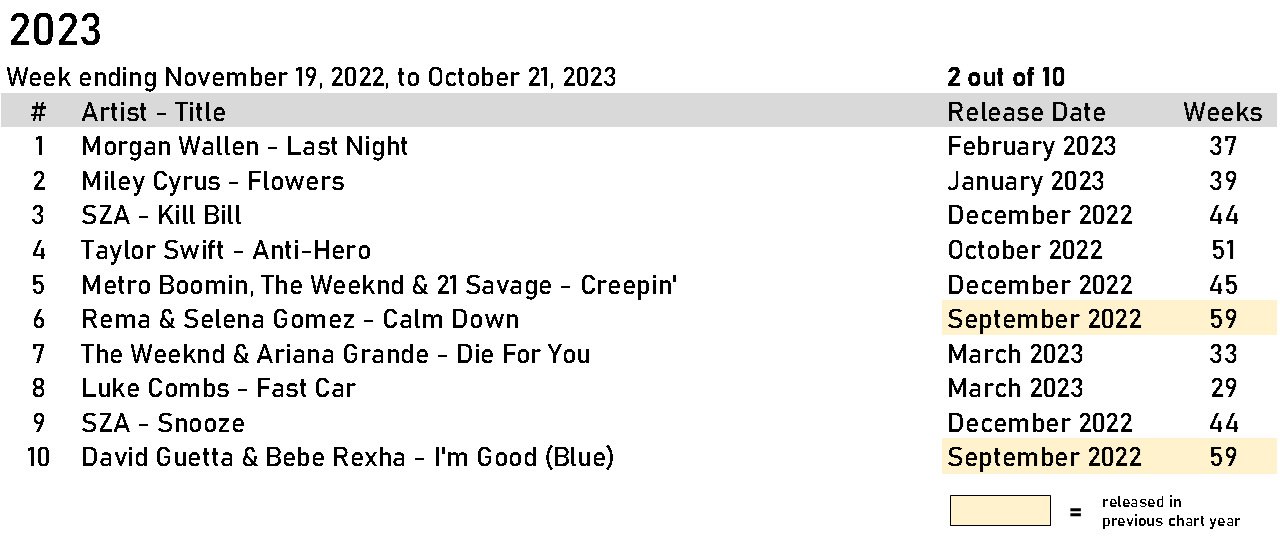
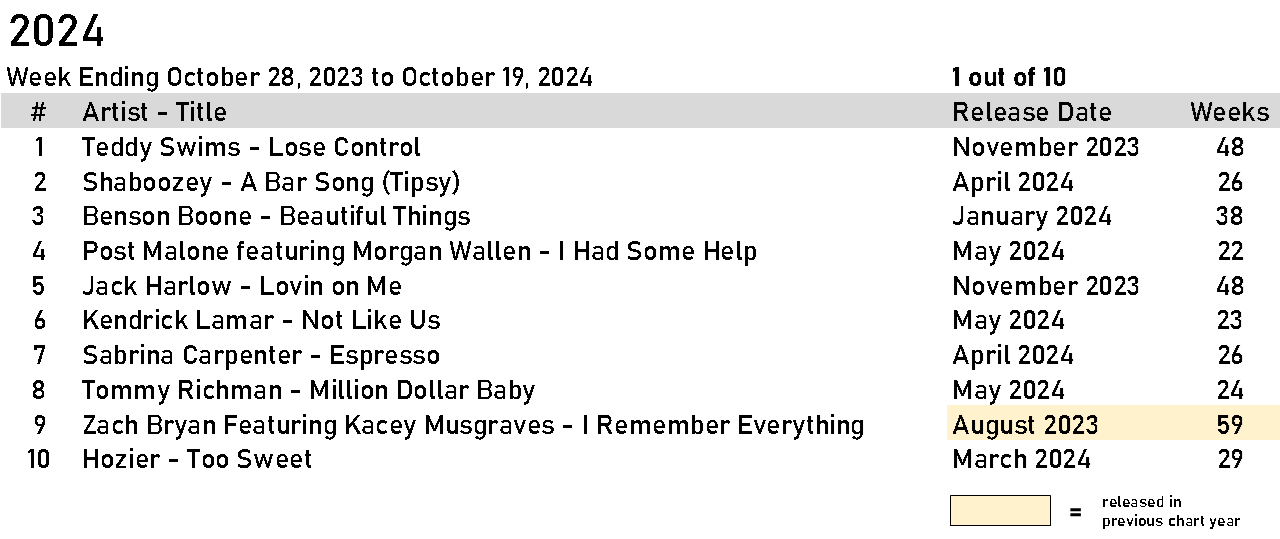
The biggest hits got even fresher in 2024. The year saw only one 2023 chart year holdover—and it was a Country song that despite lackluster radio airplay was the #1 most streamed song of the year: Zach Bryan Featuring Kacey Musgraves’ “I Remember Everything.”

The remaining nine songs were all from the 2024 chart year, marking the youngest Top 10 of the streaming era’s year end charts.
Then, this bullshit happened…
How 2025 became the stalest year in Pop music
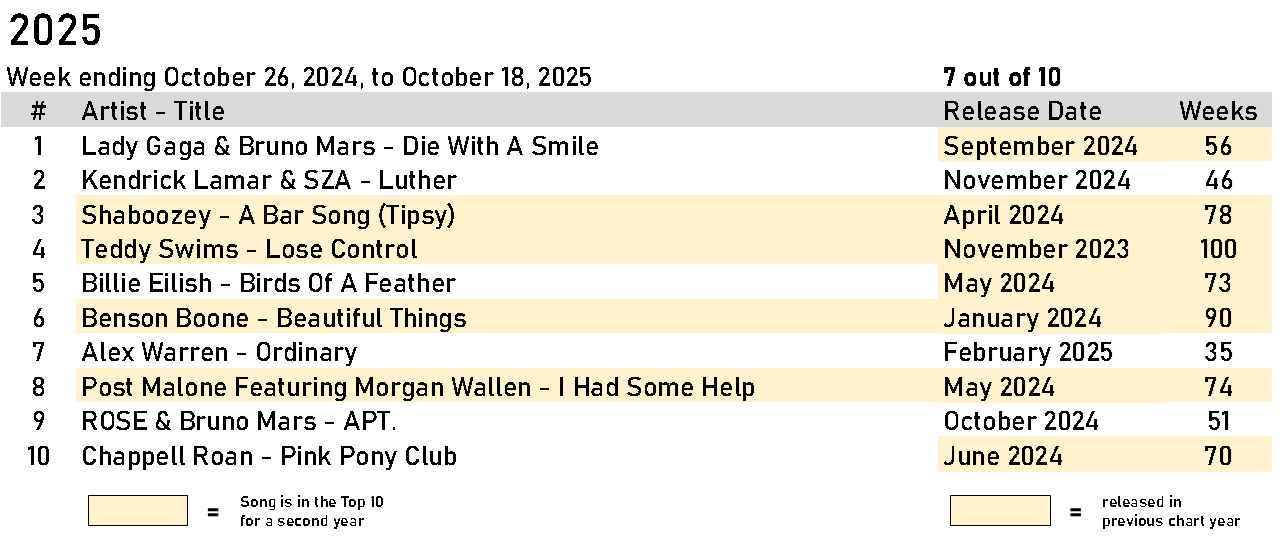
A record seven (7) out of the Top 10 songs of 2025 are leftovers from the 2024 chart year. A record four (4) of those songs are repeats from 2024’s Top 10 songs, namely:
Shaboozey’s “A Bar Song (Tipsy)”
Teddy Swims’s “Lose Control”
Benson Boone’s “Beautiful Things”
Post Malone’s (Featuring Morgan Wallen) “I Had Some Help”
We saw it coming.
As I noted in Where the Hell are the Hits, Alex Warren’s Ordinary (#7 for 2025) was the only truly mass-appeal hit to emerge during 2025’s first half. Seemingly all of 2024’s biggest stars fell flat with their 2025 follow-ups, from Sabrina Carpenter to Teddy Swims, Benson Boone, to Shaboozey. Lady Gaga’s “Abracadabra” was only #56 for the year based almost solely on radio trying to make it a hit. Chappel Roan’s two highly anticipated new songs didn’t even make the year-end chart, despite massive streaming when they first dropped.
I’m pretty sure Ariana Grande’s “Twilight Zone,” gets fewer Spotify plays than Golden Earing’s “Twilight Zone.”
Just before Billboard released ‘25’s year end results, Pop critic and chart analyst Chris Molanphy commented on Bluesky:
I’ll be happy with any—ANY— Hot100 result up to and including A[lex] Warren’s “Ordinary” being 2025’s top song—as long as Teddy Swims doesn’t take it a 2nd year in a row with his unkillable hit. But…we should brace for that possibility.
It’s not radio’s fault. It’s not streaming’s fault.
I’ve expressed concern that radio is risking its future by playing it too safe with stale hits. The average age of the top 10 most-played songs on the radio each year has steadily gotten older since 2017, according to the Billboard Year End Radio Songs chart, while the vintage of the Top 10 most streamed songs remained mostly unchanged during that time.
Except for 2025.
Examine the jump in vintage among the Top 10 most streamed songs from 2024 to 2025, according to Billboard’s Streaming Songs chart: When listeners were in control of their music, the Top 10 songs they picked in 2025 were almost five months older than they were the Top 10 songs they played in 2024.
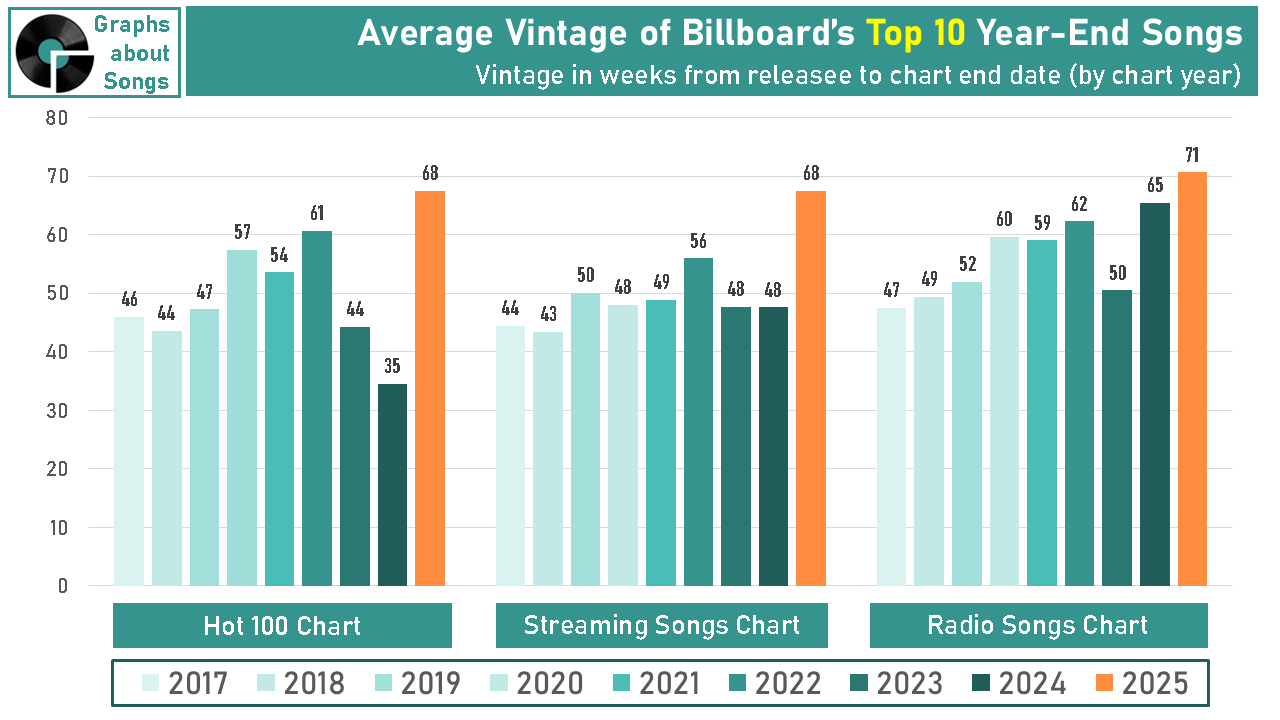
That’s not an indication of any sudden change in who is using streaming platforms. Instead, with such lackluster interest in 2025’s releases, listeners in record numbers simply kept playing the songs they loved last year.
Were 2025’s tunes really that bad?
Quantitative music consumption can’t tell us exactly why 2025’s releases didn’t whet our collective whistle. Were they objectively bad songs? (As someone who thinks this Eurovision winner slaps, I have no right to claim objective opinions.)
Were we so stressed out this year with political divisiveness, global conflict, and economic anxiety that we weren’t in the mood for the new and novel? I’m confident that’s why we whipped out the Christmas music right after Halloween this past year. (I discussed this phenomenon with The Wall Street Journal, Fox 5 New York, and NPR Houston.) Perhaps we simply preferred to ignore 2025 entirely.

Maybe Generation Z simply hasn’t taken the reigns away from aging Millennials in picking our nation’s top tunes. As I detail in my Generational Music Theorem, popular music is typically at its stalest right before a new generation makes an updated style become popular. The Boomers did it with Beatlemania. Generation X did it with MTV New Wave. Millennials did it with Crunk in the club.
Generation Z, it’s high time you save us from Alex Warren.
In a future post in this series examining Billboard’s 2025 year-end charts, I’ll spotlight songs that Generation Z made hits on streaming, but that radio largely ignored.
Subscribe below with the FREE option to get that post in your inbox.
Recommended Further Listening:
For a detailed explanation of how Billboard’s Year End Charts work and a chronicle of every Billboard Song of The Year in Hot 100 history from 1959-2022, play the aforementioned Chris Molanphy’s Hit Parade podcast episode Hits of the Year Edition.
Chris explains the math behind why sometimes Billboard’s Song Of The Year is truly awful.)
Data sources for this post:
Billboard’s 2025 year-end charts: Hot 100 Songs: https://www.billboard.com/charts/year-end/2025/hot-100-songs/
Billboard’s 2025 year-end charts: Streaming Songs (Top 75): https://www.billboard.com/charts/year-end/2025/streaming-songs/
Billboard’s 2025 year-end charts: Radio Songs (Top 75): https://www.billboard.com/charts/year-end/2025/radio-songs/
(Data from previous years’ Billboard Year End charts archived)
Today’s post brought to you by my day job…

Great analysis Matt, we certainly are still in the Doldrums. Billboards new rules that limit the life of songs on the chart should help next year's year end charts. Congrats on the Wall Street Journal and Happy New Year!